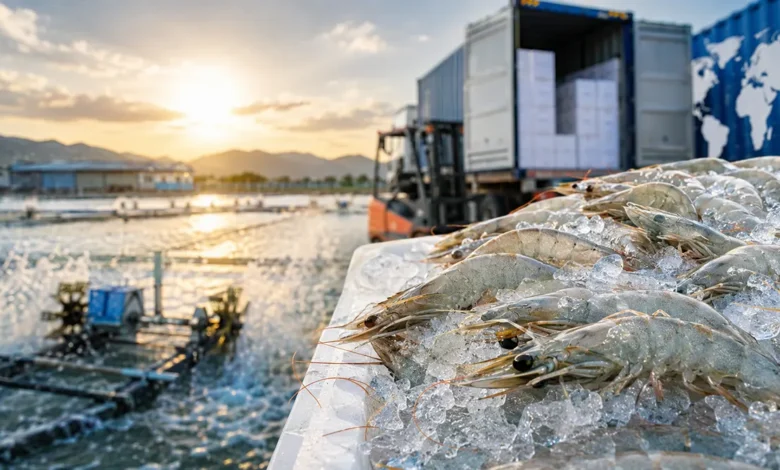
In recent years, Iran has emerged as one of the fastest-growing seafood exporters in the Middle East, attracting increasing attention from international buyers seeking competitive sourcing opportunities. The topic of Iran Shrimp Wholesale Price has become especially important as global seafood demand rises and regional supply chains continue to shift. According to recent industry reports from SeafoodSource, Iran’s shrimp production and export capacity are expanding rapidly, supported by large-scale aquaculture investments and growing access to export markets in Asia, the Gulf region, and Europe. For importers, wholesalers, and seafood distributors, understanding Iran’s pricing structure, product quality, export grades, and logistics conditions is now more important than ever.
Current Iran Shrimp Wholesale Price Per Kg in 2026
Iranian shrimp wholesale prices in 2026 vary depending on shrimp size, processing method, order volume, freezing quality, packaging type, and delivery terms. For international buyers, the most important point is that the final export price is not simply a farm-gate price. It usually includes processing, sorting, freezing, packaging, inspection, cold-chain handling, inland transport, and export documentation. (Read more at FAO report about Iran’s Shrimp production)
In general, larger shrimp sizes command higher prices, while smaller sizes are usually more competitive for bulk buyers, foodservice distributors, and regional importers. Frozen Vannamei shrimp is the dominant commercial category for export, and buyers often request price quotations based on size grades, such as 30/40, 40/50, 50/60, 60/70, or 70/80 pieces per kilogram.

| Product Type | Common Export Form | Price Position |
|---|---|---|
| Large Vannamei shrimp | Frozen, headless or whole | Higher |
| Medium Vannamei shrimp | Frozen, graded, boxed | Mid-range |
| Small Vannamei shrimp | Frozen bulk supply | More competitive |
| Processed shrimp | Peeled, deveined, value-added | Premium |
Shrimp Price in Iran (2026)
| Shrimp Grade | Estimated FOB Price (USD/KG) |
|---|---|
| 30/40 | $7.5 – $9 |
| 40/50 | $6.8 – $8 |
| 50/60 | $6 – $7.2 |
| 60/70 | $5.5 – $6.5 |
Major Factors Affecting Iran Shrimp Wholesale Price
The wholesale price of Iranian shrimp is shaped by several commercial and operational factors. The first is shrimp size. Larger shrimp generally have a higher export value because they are more attractive for restaurants, premium retail, and high-end seafood distributors.
 .
.
The second factor is processing level. Whole shrimp, head-on shrimp, headless shrimp, peeled shrimp, and deveined shrimp are priced differently. Value-added processing increases the final cost but can make Iranian shrimp more attractive for buyers who want ready-to-sell or ready-to-cook products.
The third factor is cold-chain reliability. Since shrimp is a temperature-sensitive seafood product, export buyers usually evaluate freezing speed, storage conditions, container handling, and shipment stability before placing large orders.
The fourth factor is currency movement and payment conditions. For foreign buyers, Iran’s shrimp market can be price-competitive, but payment structure, documentation, sanctions-related limitations, and supplier verification all affect the real cost of doing business. (Read this news about Iran’s seafood industry)
Iran’s Main Shrimp Farming Regions and Production Capacity
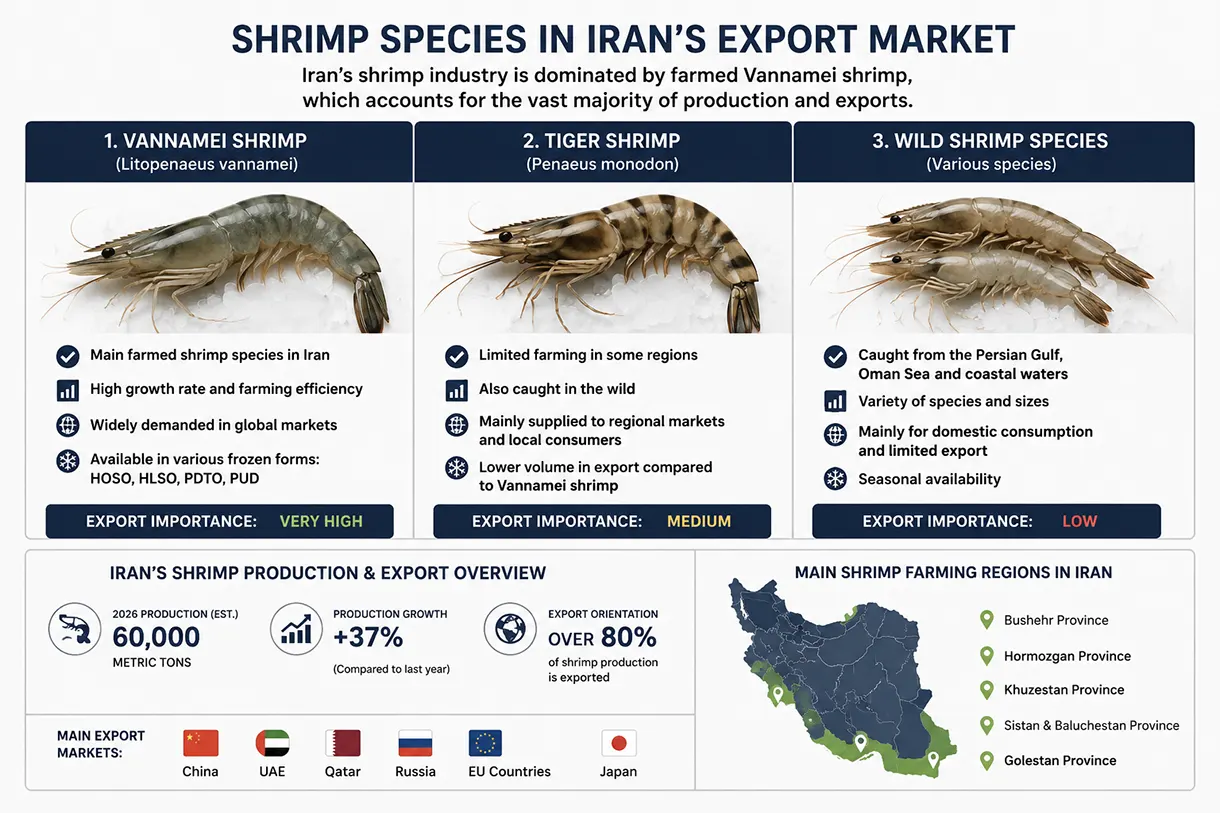
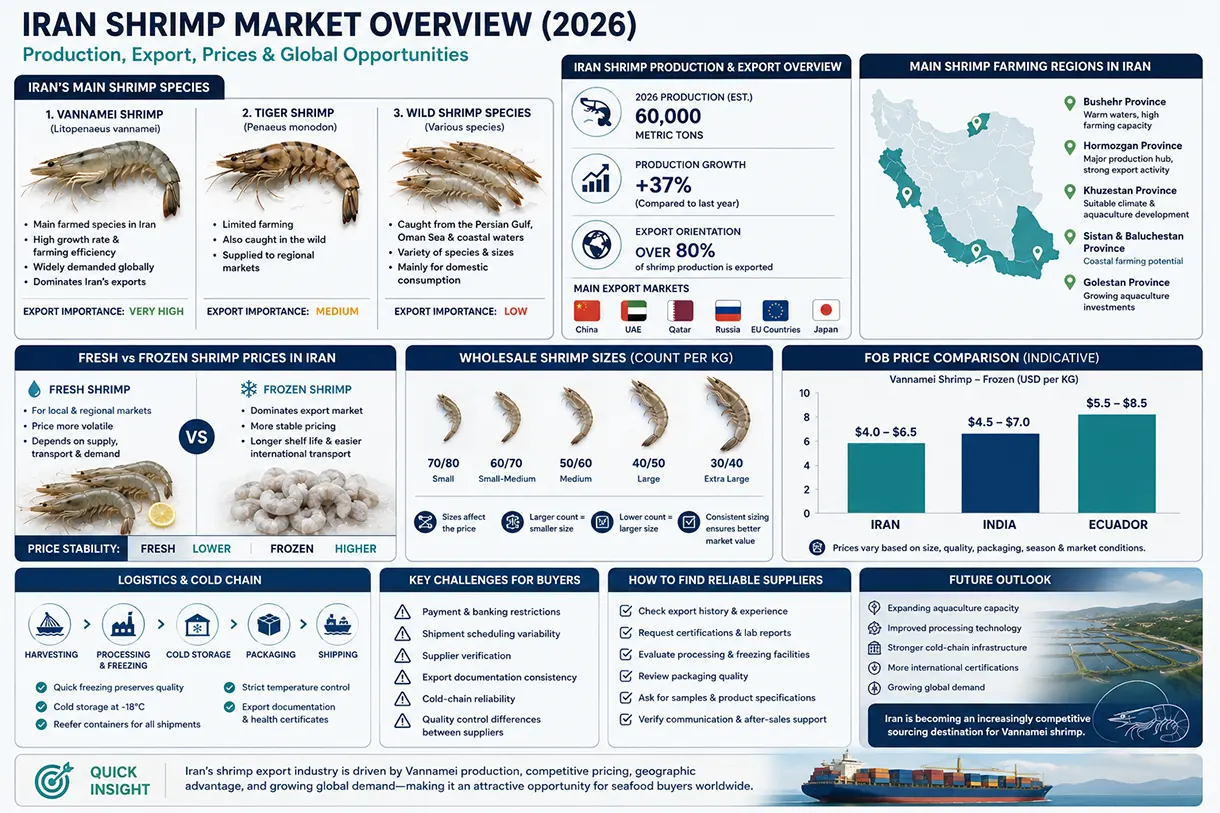
Iran’s shrimp farming is mainly concentrated in coastal provinces with access to warm waters and suitable aquaculture conditions. Bushehr, Hormozgan, Khuzestan, Sistan and Baluchestan, and Golestan are among the key shrimp-producing regions. Industry reports indicate that Iran’s shrimp production has been expanding, with output expected to reach around 60,000 metric tons in 2026.
This growth matters for international buyers because higher production capacity can improve supply stability, increase export availability, and create more room for long-term purchase agreements. However, buyers should still assess each supplier individually, because production volume alone does not guarantee export reliability.
Vannamei Shrimp Production in Iran and Export Quality Standards
Most of Iran’s commercial shrimp export market is built around farmed Vannamei shrimp. This species is widely used in global seafood trade because it is suitable for intensive farming, has strong international demand, and can be processed into different export formats.
For professional buyers, quality assessment should include:
- size consistency
- freezing method
- glazing percentage
- packaging quality
- microbiological standards
- export health certificates
- traceability documents
- supplier history
Iranian shrimp can be competitive in price, but serious buyers should focus on verified suppliers, proper documentation, and stable cold-chain performance rather than price alone.
Shrimp Species in Iran’s Export Market
Iran’s shrimp industry is primarily focused on farmed Vannamei shrimp (Litopenaeus vannamei), which currently represents the dominant share of the country’s commercial shrimp production and exports. Vannamei shrimp is widely preferred in international seafood trade because of its fast growth cycle, consistent sizing, high farming efficiency, and strong demand across Asian, Gulf, and European markets.
Other shrimp species can also be found in Iran’s seafood sector, especially in traditional fisheries and local markets, but their export share is significantly smaller compared to Vannamei.
| Shrimp Type | Scientific Name | Role in Iran’s Market | Export Importance |
|---|---|---|---|
| Vannamei Shrimp | Litopenaeus vannamei | Main farmed shrimp species | Very High |
| Tiger Shrimp | Penaeus monodon | Limited farming and wild catch | Medium |
| Wild Shrimp Species | Various species | Local fisheries and regional supply | Lower |
Today, Iran’s shrimp export industry is largely built around frozen Vannamei shrimp production. Most export-oriented farms and seafood processors are optimized for Vannamei because international buyers typically demand stable sizing, scalable production, and competitive wholesale pricing.
This is one of the main reasons why searches related to Iran Shrimp Wholesale Price are increasingly associated with Vannamei shrimp grades, frozen processing quality, packaging standards, and export logistics rather than traditional wild-caught shrimp products.
Quick Market Insight
Iran’s shrimp export industry is heavily centered on Vannamei shrimp, which represents the majority of the country’s farmed shrimp production and international seafood exports. Thanks to competitive production costs, growing aquaculture capacity, and access to Gulf shipping routes, Iran is becoming an increasingly attractive sourcing destination for buyers looking for competitive Iran Shrimp Wholesale Price opportunities in regional and global seafood markets.
Iran Shrimp Export Markets and International Demand
Iranian shrimp exports are mainly directed toward Asian markets, Gulf countries, and selected international seafood buyers seeking competitively priced frozen shrimp products. China remains one of the most important destinations for seafood imports globally, while regional demand from the UAE, Oman, Qatar, and neighboring countries also plays a major role in Iran’s export activity.
The increasing attention toward Iranian shrimp is largely driven by three factors: competitive wholesale pricing, growing aquaculture production, and geographic access to regional shipping routes. As seafood importers continue diversifying supply chains beyond traditional producers such as Ecuador, India, and Vietnam, Iran is gradually becoming part of the sourcing conversation for frozen Vannamei shrimp.
For international buyers, however, supplier verification and export logistics remain critical. Long-term partnerships are usually built around consistent sizing, stable cold-chain handling, documentation quality, and shipment reliability rather than price alone.
Fresh vs Frozen Shrimp Prices in Iran
Frozen shrimp dominates Iran’s commercial export sector because it offers longer shelf life, easier international transport, and more stable export handling conditions. Most large-scale buyers purchase frozen shrimp in bulk containers with standardized export packaging.
Fresh shrimp prices are usually more volatile because they depend heavily on local supply conditions, transportation speed, and domestic market demand. Frozen export shrimp, on the other hand, is generally priced according to international seafood market trends, processing quality, and export specifications.
| Product Form | Market Role | Price Stability |
|---|---|---|
| Fresh Shrimp | Local and regional markets | Lower |
| Frozen Whole Shrimp | Bulk export trade | Higher |
| Frozen Processed Shrimp | Premium export segment | Moderate to High |
In most export-oriented transactions, international buyers focus primarily on frozen Vannamei shrimp due to its scalability and easier logistics management.
Wholesale Shrimp Packaging, Sizes, and Export Grades
Shrimp export pricing in Iran is strongly linked to grading and packaging standards. International seafood buyers typically request quotations based on shrimp count per kilogram, packaging specifications, glazing percentage, and freezing quality.
Common export grades include:
- 30/40
- 40/50
- 50/60
- 60/70
- 70/80
Smaller count numbers generally indicate larger shrimp sizes and therefore higher export value. Packaging also affects pricing because professional export buyers often require master cartons, retail-ready packaging, or custom branding for distribution markets.
For wholesalers, consistency matters more than isolated low pricing. Buyers usually prioritize stable grading, accurate labeling, and reliable frozen storage conditions before entering long-term purchase agreements.
FOB Iran Shrimp Prices Compared to India and Ecuador
Iranian shrimp is often positioned as a competitive alternative to shrimp supplied from India and Ecuador, especially in regional seafood markets. Ecuador benefits from massive production volumes and strong global distribution networks, while India remains one of the world’s largest shrimp exporters with extensive processing infrastructure.
Iran’s advantage is usually found in regional proximity, lower transportation distances to Gulf markets, and competitive pricing flexibility. However, production scale and international banking limitations can still affect large-volume transactions.
For some buyers, Iran offers attractive sourcing opportunities when supply shortages, rising freight costs, or seasonal fluctuations affect traditional shrimp-exporting countries.
Logistics, Cold Chain, and Shipping Conditions
Cold-chain reliability is one of the most important elements in the seafood export industry. Shrimp quality can deteriorate rapidly if freezing, storage, or transportation conditions are not properly maintained.
Most export-oriented shrimp shipments from Iran move through refrigerated containers using Gulf shipping routes. Export buyers commonly evaluate:
- freezing technology
- storage conditions
- container handling
- shipment timing
- inspection standards
- export documentation
Professional seafood importers typically conduct supplier checks before placing large orders, especially when dealing with frozen seafood products requiring strict temperature control.
Key Challenges for Foreign Shrimp Buyers in Iran
Despite the growing potential of Iran’s seafood sector, foreign buyers should carefully evaluate operational and commercial risks before entering supply agreements.
Some of the most important challenges include:
- payment and banking restrictions
- shipment scheduling variability
- supplier verification
- export documentation consistency
- cold-chain reliability
- quality control differences between suppliers
These risks do not necessarily prevent successful trade, but they increase the importance of working with experienced exporters and verified supply partners.
Iran exported more than 80% of its shrimp production to international markets in recent years, with Vannamei shrimp accounting for the majority of commercial aquaculture output.
How to Find Reliable Shrimp Suppliers in Iran
Finding reliable shrimp suppliers requires more than comparing wholesale prices. Professional seafood buyers should evaluate processing capacity, export history, certifications, freezing systems, packaging quality, and responsiveness in international communication.
Buyers are usually advised to request:
- export documentation
- product specifications
- shipment history
- laboratory reports
- packaging samples
- production images or factory verification
In many cases, local market knowledge and direct communication with exporters can significantly reduce sourcing risks and improve long-term procurement stability.
Why Global Seafood Buyers Are Watching Iran
Iran’s shrimp sector is attracting increasing attention because it combines expanding aquaculture production with relatively competitive export pricing. Rising seafood consumption across Asia and the Middle East is also creating new opportunities for alternative sourcing markets.
For international buyers, the appeal of Iran’s shrimp market is not only about cost. Geographic location, access to Gulf shipping routes, and the country’s growing processing infrastructure are also contributing to its export potential.
As regional seafood trade continues evolving, Iran is expected to strengthen its position as a mid-scale but increasingly relevant shrimp supplier in the international market.
Future Outlook for Iran’s Shrimp Export Industry
Industry forecasts suggest that Iran’s shrimp production capacity will continue expanding in the coming years as aquaculture investment increases and export-oriented farming develops further.
Future growth will likely depend on:
- improved export logistics
- stronger cold-chain infrastructure
- international certifications
- stable trade routes
- processing technology upgrades
- supplier transparency
If these areas continue improving, Iran may become a more recognized sourcing destination for international seafood importers seeking competitive alternatives in the global shrimp market.
Conclusion: Is Iran a Competitive Shrimp Sourcing Market in 2026?
Iran’s shrimp industry is gradually establishing itself as a competitive regional seafood supplier, particularly in frozen Vannamei shrimp exports. Competitive wholesale pricing, expanding aquaculture capacity, and access to regional shipping routes are helping the country gain more visibility among international seafood buyers.
However, successful sourcing from Iran still depends heavily on supplier selection, cold-chain reliability, export documentation quality, and professional logistics coordination. For buyers willing to conduct proper supplier verification and long-term partnership evaluation, Iran can offer attractive opportunities in the evolving global seafood trade market.
Looking for Reliable Shrimp Suppliers in Iran?
If you are planning to buy shrimp from Iran or compare Iran Shrimp Wholesale Price offers, Myindustry Consulting Group can help you evaluate suppliers, check market conditions, and connect with suitable export partners.
Complete the form below and tell us your required shrimp type, size grade, order volume, destination country, and preferred delivery terms. Our team will review your request and guide you toward the most practical sourcing options in Iran.
Contact Myindustry Consulting Group (MCG)
FAQ About Iran Shrimp Wholesale Price
What is the average Iran Shrimp Wholesale Price in 2026?
The average Iran shrimp wholesale price in 2026 depends on shrimp size, processing level, packaging, and export terms. Frozen Vannamei shrimp exported from Iran is commonly priced based on international market demand, size grades, and logistics conditions.
Which shrimp species is most exported from Iran?
Vannamei shrimp (Litopenaeus vannamei) is the main export shrimp species in Iran. It dominates the country’s commercial shrimp farming sector due to its fast growth cycle, stable sizing, and strong international demand.
Does Iran export frozen shrimp?
Yes. Most Iranian shrimp exports are shipped as frozen products using refrigerated containers. Frozen Vannamei shrimp is the dominant export category because it offers longer shelf life and easier international transportation.
What are the main shrimp farming regions in Iran?
The main shrimp farming provinces in Iran include Bushehr, Hormozgan, Khuzestan, Sistan and Baluchestan, and Golestan. These coastal regions provide suitable conditions for commercial aquaculture production.
Is Iranian shrimp competitive compared to India and Ecuador?
Iranian shrimp can be competitive in regional seafood markets due to relatively lower transportation distances to Gulf countries, expanding aquaculture capacity, and flexible export pricing. However, pricing competitiveness may vary depending on shipment volume, processing quality, and global seafood market conditions.