Top Products Iran Needs to Import in 2026 After War Damage
High-Demand Sectors in Iran & Key Export Opportunities

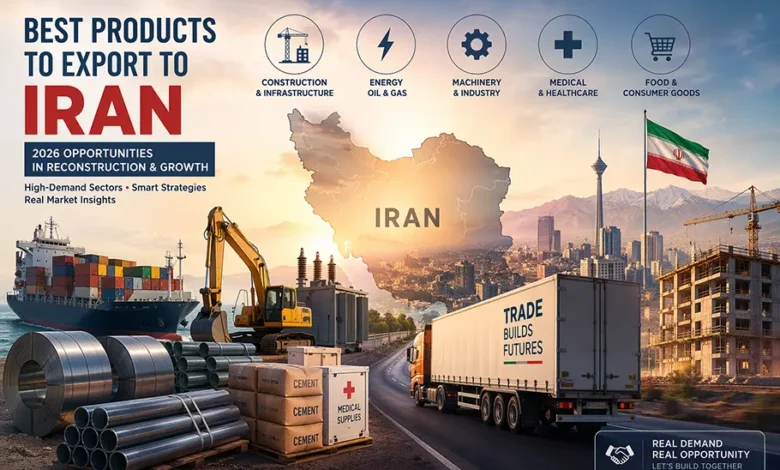
In 2026, following weeks of intense conflict and widespread damage to critical infrastructure, Iran’s economy is entering a phase of reconstruction and supply shortages. As analyzed in our previous report,
Iran War 2026, the war has significantly disrupted supply chains, reduced industrial capacity, and created urgent gaps across key sectors. Similar patterns have been observed in post-conflict economies, where infrastructure damage leads to increased reliance on imports, as highlighted by the World Bank.
In this context, identifying the best products to export to Iran is no longer just a trade opportunity—it is a strategic necessity. Companies that can accurately assess high-demand sectors and respond quickly to market needs will be better positioned to capture emerging opportunities in Iran during this critical transition period.
High-Demand Sectors in Iran & Key Export Opportunities
Construction Materials & Infrastructure Equipment
Iran’s construction sector will experience strong demand due to infrastructure damage. Exporters can benefit from supplying cement, steel products, pipes, and heavy construction equipment.

This surge in demand is primarily driven by damage to transportation networks, residential buildings, and utility infrastructure, which creates an immediate need for reconstruction materials. In practical terms, this includes high volumes of cement for rebuilding housing units, steel rebar and structural sections for restoring buildings and bridges, industrial pipes for water and gas distribution networks, and heavy machinery such as excavators, cranes, and road construction equipment. Similar post-conflict environments have consistently shown that construction inputs become one of the first and largest import categories during recovery phases, as domestic production capacity is often insufficient to meet urgent demand. According to the Architect’s Journal, countries affected by conflict typically face significant infrastructure gaps that require substantial external supply of construction materials and equipment during the rebuilding process.
 .
.
Energy, Oil & Gas Equipment
Damage to power plants and energy infrastructure will increase demand for generators, transformers, industrial cables, and oil & gas equipment.
Automotive Parts & Industrial Machinery
Disruptions in domestic manufacturing will create shortages in spare parts and machinery required for industrial recovery.
Medical Supplies & Healthcare Equipment
Healthcare systems under pressure will require pharmaceuticals, diagnostic tools, and hospital equipment.
- Essential pharmaceuticals (antibiotics, pain management drugs, chronic disease medications)
- Diagnostic equipment (CT scanners, ultrasound devices, laboratory testing kits)
- Hospital consumables (syringes, IV sets, gloves, masks)
- Intensive care equipment (ventilators, patient monitors, infusion pumps)
- Emergency medical supplies (first aid kits, trauma care equipment)
- Medical imaging components and spare parts
Food Products & Essential Consumer Goods
Supply chain disruptions will increase demand for packaged food, essential goods, and agricultural imports.
Best Products to Export to Iran in 2026 (Detailed List)
The table below highlights some of the best products to export to Iran based on current market gaps and post-war demand.
| Product Category | Specific Products | Reason for Demand |
|---|---|---|
| Steel & Construction | Steel sheets, rebar, pipes | Reconstruction and infrastructure repair |
| Energy Equipment | Generators, transformers | Restoring electricity supply |
| Machinery | Industrial and construction machines | Restarting production |
| Medical | Pharmaceuticals, devices | Healthcare shortages |
| Food & FMCG | Packaged food | Supply disruption |
Why Iran Will Rely on Imports After War Damage
Infrastructure Destruction & Supply Chain Disruption
Widespread damage to infrastructure limits domestic production and increases reliance on imports.
Decline in Domestic Production Capacity
Factories affected by conflict reduce output, creating gaps in supply.
Urgent Demand for Reconstruction Materials
Rebuilding efforts require immediate access to materials that may not be available locally.
How to Enter the Iranian Market as an Exporter
Local Distribution Channels
Working with local distributors helps navigate market access and logistics.
Working with Iranian Importers
Partnership with experienced importers reduces operational risk.
Payment Methods (Including BNPL & Local Solutions)
Alternative payment methods such as BNPL platforms are increasingly relevant.
Regulatory Considerations & Sanctions Awareness
Understanding legal and regulatory frameworks is essential for sustainable operations.
Key Platforms to Sell Products in Iran
B2B Platforms & Marketplaces
Digital marketplaces provide access to wholesale buyers.
Local E-commerce Platforms (Torob, Emalls)
Platforms like Torob and Emalls help connect sellers with consumers and retailers. Local e-commerce platforms such as Torob and Emalls play a critical role in Iran’s digital marketplace by acting as price comparison engines and product discovery tools rather than traditional online stores. These platforms aggregate listings from thousands of online shops and direct high-intent buyers to sellers offering competitive prices. For exporters entering the Iranian market, partnering with local distributors who are already active on these platforms can significantly accelerate market penetration. In practical terms, products such as electronics, home appliances, and consumer goods gain visibility faster through Torob and Emalls due to their strong user traffic and search-driven structure. In periods of restricted international internet access, these platforms become even more important as they remain accessible within the domestic network and continue to drive demand and lead generation for sellers.
Role of Messaging Apps in Sales (Bale, Rubika)
Messaging apps are widely used as alternative sales channels during internet restrictions.

Risks and Challenges of Exporting to Iran
Currency Volatility
Exchange rate fluctuations can impact profitability.
Payment & Banking Limitations
International banking restrictions require alternative financial solutions.
Logistics & Transportation Risks
Transport disruptions may affect delivery timelines and costs.
In post-conflict economies like Iran, the most profitable export opportunities lie in products that solve urgent shortages—particularly construction materials, energy equipment, industrial machinery, medical supplies, and essential consumer goods. Exporters who focus on high-demand sectors with immediate market gaps will achieve faster market entry, stronger margins, and sustainable long-term growth.
Final Insights: Where Smart Exporters Will Profit Most
The best products to export to Iran are those that address immediate shortages in infrastructure, energy, healthcare, and essential goods. Exporters who act quickly, understand market dynamics, and build local partnerships will gain a competitive advantage in this evolving market.