Tomato Paste Can Price in Iran 2026: Wholesale Prices by Can Size
Iranian Canned Tomato Paste Wholesale Prices

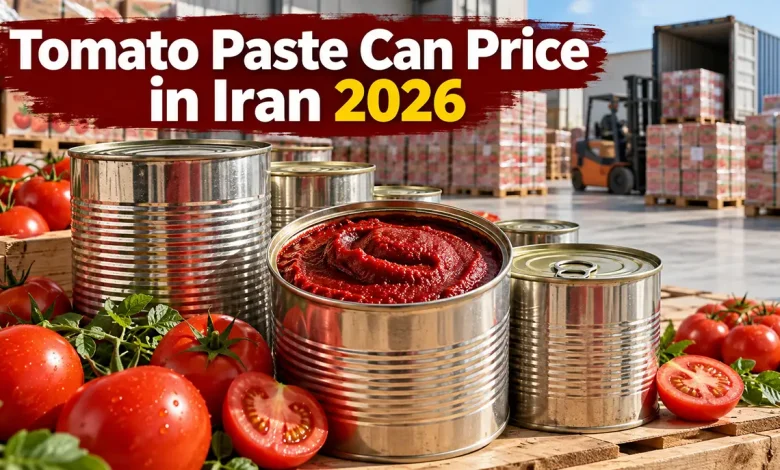
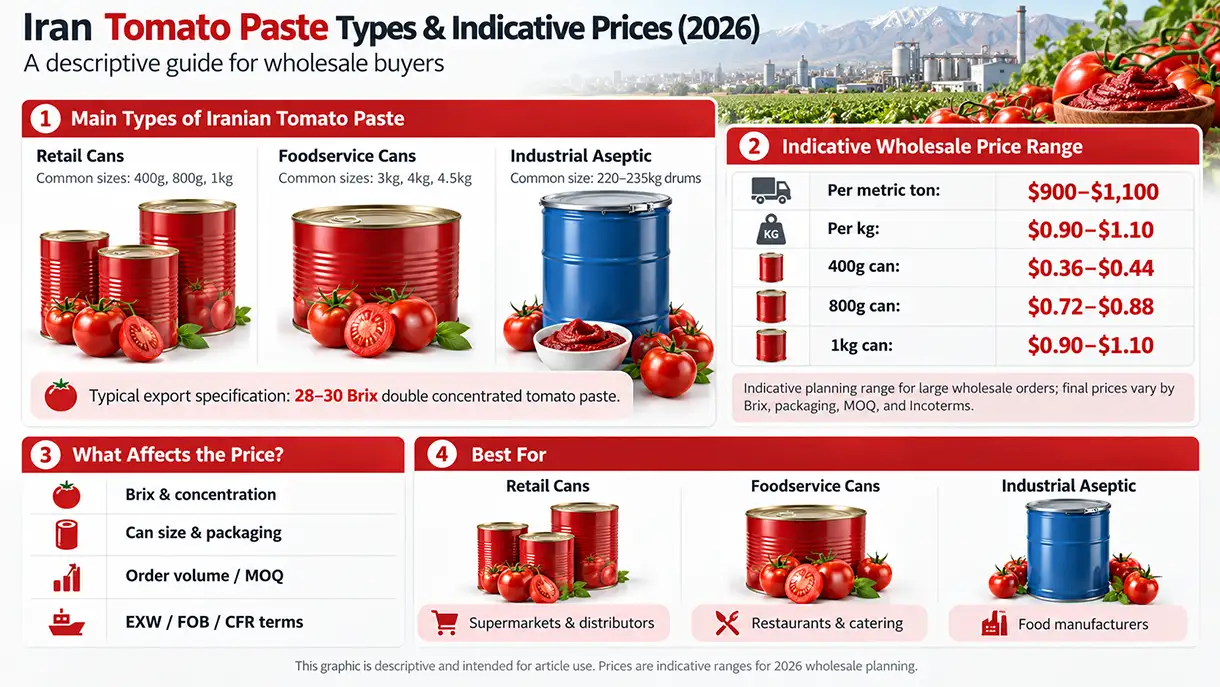
The tomato paste can price in Iran in 2026 is typically around $900–$1,100 per metric ton of net product for large wholesale orders, although the final price varies with can size, Brix level, order quantity, packaging, private-label requirements, exchange rates, and delivery terms. For importers, the most useful comparison is therefore not simply the price of one can, but the total factory or export cost per carton and metric ton. In this guide, we review current Iranian canned tomato paste prices, explain the factors that influence quotations inside Iran, and show how order size, packaging, and Incoterms can change the final purchasing cost. (Price reference: Freshdi Iranian Tomato Paste, 2026.)
Current Wholesale Tomato Paste Prices in Iran
For international buyers, the tomato paste can price in Iran should be evaluated as a wholesale export quotation rather than a retail shelf price. Based on recent 2026 supplier offers, a practical budgeting range for Iranian canned tomato paste is approximately $900–$1,100 per metric ton, or about $0.90–$1.10 per kg of net product for commercial orders.
This is not an official national average. Public B2B quotations vary considerably according to Brix, packaging, order size, brand requirements and Incoterms. For example, Bahane Food Industries listed Iranian tomato paste at $1.00/kg FOB, while an Iranian offer on Freshdi was listed at $1,100/MT for a minimum order of one 20-foot container. Another Iranian supplier advertised a substantially lower FOB level of around $680–$685/MT, illustrating why buyers should compare specifications before comparing prices.
| 2026 market reference | Published price | Key specification | Commercial context |
|---|---|---|---|
| Bahane Food Industries | $1.00/kg | 27% Brix; 400g or 800g cans | FOB supplier quotation |
| Avan Tejarat / Freshdi | $1,100/MT | 28–30% solids; canned and other packing | MOQ: one 20-ft container; EXW/FOB/CIF available |
| TGG Export Co. | $680–$685/MT | Multiple Brix levels and packaging formats | Low-end FOB supplier offer; minimum two 20-ft containers |
| Practical buyer benchmark | $900–$1,100/MT | Export-grade canned tomato paste | Recommended range for initial budgeting, not a fixed market price |
There is also useful trade-data evidence behind this general price level. World Bank WITS data show that Azerbaijan imported about 3.30 million kg of HS 200290 products from Iran in 2024 with a reported trade value of approximately $3.34 million, equivalent to roughly $1.01/kg. Because HS 200290 covers a broader category of preserved tomato products, this figure should be treated as a historical trade benchmark rather than a direct 2026 canned tomato paste quotation.
 .
.
2026 PRICE REVIEW
For an importer preparing a first RFQ, $900–$1,100 per metric ton is a useful working range for Iranian canned tomato paste. A quotation materially below this level is not necessarily incorrect, but the buyer should verify Brix, net weight, can specification, label, carton quality, MOQ and Incoterm before treating it as directly comparable.
Sources: Bahane Food Industries – 21Food · Iranian Tomato Paste – Freshdi · World Bank WITS trade data
Tomato Paste Price per Can, Carton and Metric Ton
For large buyers, comparing the Iranian tomato paste wholesale price per metric ton is usually more useful than comparing a single can. Once the price per kg is known, however, importers can quickly estimate the product value of each can and carton.
Using the $900–$1,100/MT working range above:
| Packing example | Net product weight | Estimated product value |
|---|---|---|
| Per metric ton | 1,000 kg | $900–$1,100 |
| Per kg | 1 kg | $0.90–$1.10 |
| 400g can | 0.40 kg | $0.36–$0.44/can |
| 24 × 400g carton | 9.60 kg | $8.64–$10.56/carton |
| 800g can | 0.80 kg | $0.72–$0.88/can |
| 12 × 800g carton | 9.60 kg | $8.64–$10.56/carton |
| 1kg can | 1.00 kg | $0.90–$1.10/can |
| 12 × 1kg carton | 12.00 kg | $10.80–$13.20/carton |
These figures are price conversions rather than firm offers. The actual tomato paste price per can can be higher or lower because a finished-can quotation also reflects the tin, lid, lithography or paper label, carton, palletization and any private-label requirements.
Iranian suppliers publicly advertise several packaging formats. Current supplier listings include 400g and 800g cans, while other Iranian producers advertise formats ranging from small retail cans to 1kg, 2kg and 4.5kg containers.
BUYER REVIEW
When comparing two suppliers, do not ask only, “What is your 800g can price?” Ask for net weight per carton, cans per carton, cartons per container and total net product weight per container. This makes competing quotations much easier to compare on a true $/MT basis.
Domestic Factory Price vs Export Price
A factory quotation inside Iran and an Iranian tomato paste export price are not automatically the same thing. A factory-level price may cover the finished product at or near the producer’s premises, while an export quotation can include additional logistics and compliance costs required to move the shipment toward the port.
The difference may involve:
- export-grade cans, cartons or pallet specifications;
- private-label printing and destination-language labeling;
- certificates and export documentation requested by the buyer;
- inland transportation from the factory to the loading point or port;
- customs and export-clearance procedures;
- terminal, handling and loading costs;
- payment terms, order quantity and quotation validity.
For this reason, a buyer comparing an Iran tomato paste supplier with another producer should make sure both quotations are based on the same product specification and Incoterm.
| Price basis | What the buyer is mainly comparing | Best use |
|---|---|---|
| Factory / EXW-type price | Product value close to the production point | Buyers with their own logistics network in Iran |
| Export-ready price | Product plus agreed export preparation | Comparing manufacturers supplying foreign markets |
| FOB quotation | Goods delivered on board at the named Iranian port | Strong benchmark for comparing Iranian exporters |
| CFR quotation | Product plus freight to the destination port | Estimating purchase + sea freight together |
Public Iranian offers confirm that the same product may be quoted under different trade terms. The Freshdi Iranian tomato paste listing, for example, identifies EXW, FOB and CIF as available terms and names Bandar Abbas as the loading port.
PRICE COMPARISON REVIEW
A $950/MT EXW offer cannot be assumed to be cheaper than a $1,020/MT FOB offer until inland transport, export handling and other seller/buyer responsibilities are identified. Compare quotations on the same Incoterm, specification, quantity and loading date.
EXW, FOB and CFR Tomato Paste Prices
Incoterms can materially change the quoted tomato paste export price from Iran, so every commercial quotation should state both the price and the named place or port.
Under EXW (Ex Works), the seller makes the goods available at the agreed location, such as the factory or warehouse, while the buyer takes on most of the subsequent transport arrangements. Under FOB (Free On Board), the seller delivers the goods on board the nominated vessel at the named shipment port. Under CFR (Cost and Freight), the seller also contracts and pays for freight to the named destination port, although the transfer of risk still occurs when the goods are placed on board at the shipment port. These definitions follow the International Chamber of Commerce’s Incoterms® 2020 rules.
| Incoterm | Seller’s main responsibility | Main freight | Useful price comparison |
|---|---|---|---|
| EXW | Makes goods available at the named factory/warehouse | Buyer | Factory-level product comparison |
| FOB | Export delivery on board at the named shipment port | Buyer | Comparing Iranian export suppliers |
| CFR | Delivers on board and pays freight to destination port | Seller | Comparing cost to a specific destination |
| CIF | Similar to CFR, with seller-arranged minimum insurance cover | Seller | Comparing freight + insurance-inclusive offers |
For buyers sourcing full containers, asking for both an EXW price and an FOB Bandar Abbas price can be particularly useful because it reveals how much of the quotation relates to the product itself and how much relates to getting the shipment export-ready.
There is also an important technical point for experienced importers: ICC notes that FOB may not be the most appropriate rule for containerized cargo when the goods are handed to the carrier at a container terminal before being loaded on the vessel; in such cases, FCA may be more suitable.
INCOTERMS REVIEW
For every quotation, request the Incoterm + exact named place/port + price per MT + container quantity + quotation validity date. “FOB $1,000/MT” is incomplete; “FOB Bandar Abbas, Iran — USD 1,000/MT” is substantially more useful for a commercial comparison.
Official reference: ICC Incoterms® 2020 – FOB and CFR rules
What Determines Tomato Paste Prices in Iran?
The tomato paste can price in Iran is determined by several variables that go well beyond the weight printed on the can. Two Iranian suppliers may quote noticeably different prices for apparently similar products because the quotations can differ in raw-material cost, Brix, packaging specifications, order volume, currency conditions and delivery terms.
For wholesale buyers, the main price drivers are:
- Fresh tomato cost: tomatoes are the main agricultural input and their availability changes during the production season.
- Brix and concentration: higher-solids tomato paste requires more raw tomato input per unit of finished product.
- Can and carton specifications: metal thickness, easy-open lids, lithographic printing, labels and export cartons all affect the finished cost.
- Order quantity: full-container and repeat orders generally provide manufacturers with better production economics than small custom batches.
- Private-label requirements: customized cans, cartons and artwork may introduce setup or printing costs.
- Iranian rial movements: domestic costs are largely incurred in Iran, while export quotations are commonly expressed in U.S. dollars.
- Incoterms: an EXW quotation cannot be directly compared with FOB, CFR or CIF pricing.
- Payment conditions: the payment method and commercial risk assumed by the supplier may also affect the quotation.
Recent Iranian supplier listings illustrate this variation. A September 2026 Freshdi listing specified 28–30% solids, MOQ of one 20-foot container and EXW/FOB/CIF terms at $1,100/MT, while an August 2026 Iranian listing on 21Food advertised several Brix grades and a minimum quantity of two 20-foot containers at $680–$685/MT FOB. These are supplier offers rather than an official market index, but they demonstrate why specifications must be normalized before prices are compared. (Freshdi | 21Food)
| Price factor | Likely impact on quotation | What the buyer should verify |
|---|---|---|
| Raw tomato availability | Can raise or reduce production cost | Production date and quotation validity |
| Higher Brix | Generally increases tomato input required | Exact soluble-solids specification |
| Larger order | May improve unit economics | MOQ and container quantity |
| Customized packaging | Can add setup and material costs | Label, can and carton specification |
| Currency movement | Can change USD export quotations | Quote date and validity period |
| Different Incoterm | Changes included logistics costs | EXW, FOB, CFR or CIF basis |
PRICE FACTOR REVIEW
When comparing the Iran tomato paste wholesale price, first make sure the quotations have the same Brix, net weight, packaging, order quantity and Incoterm. A lower headline price does not necessarily mean a lower landed purchasing cost.
Fresh Tomato and Production Costs
Fresh tomatoes are one of the most important inputs behind the Iranian tomato paste price. Tomato paste is produced by washing, sorting, crushing, refining and concentrating fresh tomatoes, so changes in the quantity, quality and purchase price of processing tomatoes can directly influence factory economics.
Iran also has a substantial domestic tomato-growing base. The latest FAOSTAT crop-production dataset covers national agricultural production through 2024. FAOSTAT-based data report Iranian tomato production at approximately 3.23 million metric tons in 2024, demonstrating the scale of the country’s raw-material base. (FAOSTAT dataset | FAOSTAT-based Iran tomato series)
For tomato paste manufacturers, however, national production volume alone does not determine cost. What matters is the amount of suitable processing tomato available to factories at the time of production.
Important variables include:
- farm-gate tomato prices;
- harvest volume in processing regions;
- tomato quality and soluble-solid content;
- transportation distance from farms to factories;
- energy used for heating and evaporation;
- labor and processing costs;
- metal-can and carton costs;
- storage requirements before shipment.
The concentration level is particularly relevant. A 28–30 Brix double-concentrated tomato paste contains substantially less water than fresh tomatoes. As a result, manufacturers require several kilograms of raw tomatoes to produce one kilogram of finished concentrated paste; the exact conversion varies with the soluble-solids level and processing characteristics of the incoming tomatoes.
| Production variable | Why it matters to wholesale pricing |
|---|---|
| Raw tomato price | Directly affects the main agricultural input |
| Tomato solids content | Influences processing yield |
| Harvest availability | Affects factory raw-material supply |
| Energy cost | Concentration requires evaporation and thermal processing |
| Transport to factory | Adds to delivered raw-material cost |
| Processing efficiency | Changes finished-product yield per tonne of tomatoes |
RAW MATERIAL REVIEW
A quotation should not be assumed to remain valid throughout the year. For large purchases, ask the tomato paste manufacturer in Iran how long the offer remains valid and whether the price is based on current-season production or stored inventory.
Data reference: FAO’s latest crop-production release covers national production data through 2024 and was revised in December 2025. (FAO)
Exchange Rate and Currency Fluctuations
Currency movement is another important reason why the tomato paste can price in Iran quoted to an overseas buyer can change even when the physical product specification remains unchanged.
Most costs incurred by an Iranian producer—such as local tomatoes, labor, domestic transportation and some operating expenses—are paid inside Iran, while Iranian tomato paste export prices are normally quoted in U.S. dollars. This creates an exchange-rate exposure between domestic production costs and the export quotation.
The Iranian rial has experienced substantial volatility in 2026. Reuters reported that the open-market rate reached approximately 1.81 million rials per U.S. dollar on April 29, 2026, following a sharp two-day depreciation. This figure should not be treated as an official conversion rate for a commercial contract; rather, it illustrates the degree of currency volatility exporters may have to consider when issuing USD quotations. (Reuters, April 29, 2026)
For an importer, exchange-rate risk can appear in several practical ways:
- suppliers may shorten the quotation validity period;
- USD quotations can be revised between inquiries and confirmed orders;
- local packaging or transport costs may change in dollar terms;
- manufacturers may request different payment schedules;
- a quote obtained several weeks earlier may no longer represent the supplier’s current export price.
| Currency-related issue | Practical implication for an importer |
|---|---|
| Rapid rial movement | Supplier may revise USD quotation |
| Long quote validity | Greater pricing risk for supplier |
| Delayed payment | Price may need reconfirmation |
| Local cost inflation | Can offset some benefit from currency depreciation |
| USD-denominated freight | May remain unaffected by rial depreciation |
CURRENCY REVIEW
For a serious RFQ, ask the supplier to state “Price Valid Until” or the number of days for which the quotation remains binding. This is more useful than relying on an old online listing when calculating the current tomato paste export price from Iran.
This is also why MyIndustry’s $900–$1,100/MT working range should be used as a purchasing benchmark rather than a guaranteed fixed price. A buyer should obtain a dated quotation before making a final landed-cost calculation.
Order Volume and MOQ
For commercial buyers, tomato paste MOQ is one of the most important variables affecting both supplier selection and unit pricing. Iranian export suppliers commonly structure canned tomato paste offers around container-scale quantities rather than a small number of cartons.
There is no single MOQ that applies to every Iranian tomato paste supplier. Current public offers demonstrate the difference:
| Iranian supplier listing | Published MOQ | Product / terms |
|---|---|---|
| Avan Tejarat Beigzadeh / Freshdi | 1 × 20-ft container | 28–30% solids; EXW, FOB or CIF |
| TGG Export Co. / 21Food | 2 × 20-ft containers / 46 MT | Multiple Brix and packing options |
| Typical inquiry basis | Full-container order | Specification negotiated with supplier |
Sources: Freshdi – Iranian Tomato Paste and 21Food – TGG Export Co..
The commercial logic is straightforward: a larger order allows production, printing, packing and export handling costs to be distributed across more units. This is particularly relevant when the buyer requests an OEM or private-label tomato paste rather than the manufacturer’s existing brand.
Order volume can influence:
- price per metric ton;
- price per carton;
- private-label printing costs;
- availability of custom can sizes;
- negotiating power on packaging specifications;
- freight efficiency;
- production scheduling;
- payment and delivery negotiations.
Recent buyer activity also confirms that Iranian canned tomato paste is being sourced on an MOQ basis. For example, an August 2026 buying request from the UAE specifically sought Iran-origin 800g tomato paste under CIF terms and asked suppliers to quote their minimum order quantity. (Freshdi Buying Lead, August 12, 2026)
MOQ REVIEW FOR IMPORTERS
For an initial commercial inquiry, one 20-foot container is a realistic starting point to request a quotation, but it should not be presented as a universal Iranian industry minimum. Some suppliers accept one container, while others publicly specify two containers or approximately 46 MT.
A professional RFQ should therefore include at least:
- required Brix;
- preferred can size;
- cans per carton;
- required quantity or number of containers;
- private label or supplier brand;
- destination port;
- requested Incoterm;
- payment preference;
- expected shipment date.
Providing these details allows an Iran tomato paste manufacturer or exporter to give a quotation that is far more useful than simply asking, “What is your tomato paste price?”
Brix, Quality Grade and Ingredients
Brix is one of the most important specifications behind the tomato paste can price in Iran, because it indicates the concentration of soluble tomato solids in the product. Buyers should therefore compare quotations with the same Brix specification rather than assuming that all canned tomato paste is equivalent.
According to the Codex Alimentarius Standard for Processed Tomato Concentrates (CXS 57-1981), a product described as tomato paste must contain at least 24% natural total soluble solids, measured without added salt. The standard also establishes requirements for product quality, composition and permitted ingredients.
In Iranian export trade, 28–30 Brix tomato paste is widely offered as a double-concentrated specification. For example, a current Iranian export listing on Freshdi specifies 28–30% solids for double-concentrated tomato paste.
| Specification | What it tells the buyer | Pricing relevance |
|---|---|---|
| 24%+ soluble solids | Meets the Codex definition of tomato paste | Basic product specification |
| 28–30 Brix | Common export-grade concentrated paste | Important when comparing supplier quotes |
| Color and texture | Indicators of finished-product quality | Can affect grade and buyer acceptance |
| Added salt | Must be considered when comparing specifications | Changes formulation, not natural tomato solids |
| Ingredients | Determines formulation and market suitability | May affect production and labeling requirements |
Codex permits certain additional ingredients, including:
- salt;
- spices and aromatic herbs;
- lemon juice used as an acidulant;
- water.
However, an importer may specify a simpler formulation—for example, tomato concentrate and salt only—depending on the target market and brand positioning. Codex also states that processed tomato concentrate should have characteristic flavor and odor, reasonably good red color and a homogeneous texture.
QUALITY REVIEW
Never compare a 28–30 Brix Iranian tomato paste price with another quotation unless the competing product has a comparable concentration and formulation. Ask for a Specification Sheet and Certificate of Analysis (COA) before selecting a supplier based only on price.
For an international RFQ, the buyer should ideally state the required Brix, salt level, ingredient declaration, color specification and microbiological requirements before requesting the final wholesale price.
Packaging, Labeling and Carton Costs
Packaging can materially affect the final Iranian canned tomato paste wholesale price, particularly when the order involves private-label production.
A finished export can is more than the tomato paste inside it. Depending on the contract, the manufacturer’s quotation may also include the metal can, lid, printed label or lithographed can, carton, shrink wrapping, palletization and export markings.
The main packaging variables affecting cost include:
- standard lid versus easy-open lid;
- plain can versus lithographed or printed can;
- paper label versus directly printed packaging;
- number of cans per carton;
- carton strength and printing requirements;
- shrink wrapping and palletization;
- destination-language labeling;
- private-label artwork and printing setup;
- customized master cartons.
Iranian suppliers confirm that customized packaging and private-label production are available. Royal Foods, for example, states that it packs canned tomato paste for international clients under private labels and lists annual canning capacity above 25 million tins. Martiran likewise offers OEM/private-label production and customized packaging for export buyers.
| Packaging choice | Potential effect on quotation |
|---|---|
| Standard manufacturer packaging | Usually simplest basis for quotation |
| Private label | May add artwork, printing or setup requirements |
| Easy-open lid | Different component cost from a standard lid |
| Custom printed carton | Additional printing/specification requirement |
| Palletized shipment | Adds pallet and wrapping costs |
| Custom can size | May require different production planning |
Packaging should therefore be specified before comparing the tomato paste price per carton from different factories.
PACKAGING REVIEW
A $20–$30/MT difference between two quotations may be less important than differences in can quality, lid type, carton strength or private-label requirements. For wholesale imports, ask suppliers to separate the product specification from the packaging specification in the quotation.
A useful RFQ should state both the required net weight per can and the exact transport packing—for example, cans per carton, cartons per pallet and whether palletization is required.
Tomato Paste Can Sizes Available for Wholesale Orders
Iranian manufacturers can supply canned tomato paste in a broad range of sizes, allowing importers to select packaging for supermarkets, wholesalers, restaurants or institutional buyers.
There is no single national list of mandatory can sizes. Available formats depend on the factory and production line. Current Iranian suppliers advertise sizes ranging from small retail cans to large food-service tins.
For example, Royal Foods lists 70g, 200g, 400g, 800g and 4kg metal cans, while another Iran-origin supplier lists 400g, 800g and 4.5kg cans, with larger 10kg and 17kg tins also available for commercial orders.
| Packaging segment | Examples available from Iranian suppliers | Typical buyer |
|---|---|---|
| Small retail | 70g, 200g | Consumer retail / small households |
| Standard retail | 400g, 800g | Supermarkets and distributors |
| Large retail / foodservice | 1kg, 3kg, 4kg, 4.5kg | Restaurants, catering and wholesale |
| Institutional tins | 10kg, 17kg | Catering and food-service buyers |
| Industrial bulk | 220–235kg aseptic drums | Food manufacturers |
Martiran also advertises 400g, 800g, 1kg, 3kg and 4kg retail or food-service formats along with 220–235kg aseptic drums for industrial buyers.
This means a wholesale importer should not search only for an “800g tomato paste supplier.” A better approach is to identify the pack size that fits the destination market and then request pricing for a full commercial shipment.
CAN SIZE REVIEW
For traders, the most important question is not which can size is cheapest individually, but which format produces the best combination of market demand, container utilization, carton efficiency and landed cost per kilogram.
When requesting the tomato paste can price in Iran, specify:
- net weight per can;
- cans per carton;
- required number of containers;
- easy-open or standard lid;
- printed can or paper label;
- private label or supplier brand;
- destination country.
This makes quotations from different Iranian tomato paste manufacturers substantially easier to compare.
Iranian Tomato Paste Export Prices by Order Volume
Order volume can influence the Iranian tomato paste export price, but buyers should be cautious about generic online claims such as “10% discount for two containers” or “20% discount for five containers.” There is no reliable industry-wide discount schedule because each manufacturer has different production, packaging and payment conditions.
Public supplier offers nevertheless provide useful reference points.
| Order basis | Public 2026 reference | Price / condition | Interpretation |
|---|---|---|---|
| 1 × 20-ft container | Iranian supplier on Freshdi | $1,100/MT | 28–30% solids; negotiable; EXW/FOB/CIF |
| 2 × 20-ft containers / about 46 MT | Iranian supplier on 21Food | $680–$685/MT FOB | Different product specifications and packing options |
| 1 FCL | Iran-origin supplier | Price on request | 400g, 800g and other commercial packs |
| Repeated / multi-container contract | Negotiated directly | No universal public rate | Depends on volume, packaging and contract terms |
The first two prices should not be interpreted as proof that doubling the order reduces the price from $1,100 to $680/MT. They come from different suppliers and may involve different specifications, Brix levels, packaging and commercial conditions. Their value is in demonstrating how wide public supplier quotations can be.
For larger orders, manufacturers may have more room to optimize:
- production runs;
- can and carton purchasing;
- private-label printing;
- loading and export handling;
- factory scheduling;
- payment negotiations.
One Iranian supplier, VEXA, publicly states an MOQ of one 20-foot container, approximately 24,000 cans of 800g, for canned tomato paste. That represents about 19.2 metric tons of net tomato paste before accounting for the weight of cans, cartons and other packaging.
Using the article’s $900–$1,100/MT planning range, the net-product value of 19.2 MT would correspond to approximately:
| Working price | 19.2 MT net product value |
|---|---|
| $900/MT | $17,280 |
| $1,000/MT | $19,200 |
| $1,100/MT | $21,120 |
These figures are budgeting calculations, not supplier quotations. Freight, insurance, customs costs, pallets and destination charges are not included.
VOLUME PRICE REVIEW
For a serious importer, the best way to obtain a lower Iran tomato paste wholesale price is to request quotations for specific volumes—for example 1 FCL, 2 FCL and 5 FCL—using exactly the same Brix, can, carton, private-label and Incoterm specifications. This reveals the supplier’s actual volume discount without relying on generalized market assumptions.
For repeat purchasing, buyers can also request a separate quotation for a quarterly or annual supply agreement. A predictable purchasing schedule may be commercially more valuable to a manufacturer than one unusually large spot order.
Small Wholesale Orders
Small wholesale orders can be useful for market testing, but they do not always represent the best Iranian tomato paste wholesale price. Export-oriented factories often optimize production and loading around larger quantities, while smaller orders may carry higher packaging, handling and logistics costs per unit.
There is no universal minimum order across Iran. Current supplier listings illustrate how widely MOQ policies can differ:
| Supplier example | Published MOQ | Commercial implication |
|---|---|---|
| Mahram export listing | 50 cartons / 600 × 800g cans | Suitable for a smaller trial order |
| Kamrooz export listing | 100 shrink packs | Regional or test-order scale |
| VEXA | 1 × 20-ft container | Full-container export model |
| Freshdi Iranian offer | 1 × 20-ft container | Container-scale commercial quotation |
Mahram’s 800g export listing, for example, states an MOQ of 50 cartons, while VEXA specifies one 20-foot container containing approximately 24,000 800g cans for its canned tomato paste program.
For a trader testing a new market, a smaller order may still make sense when:
- the brand is new in the destination country;
- the importer wants to test consumer acceptance;
- several different products will share one shipment;
- warehousing capacity is limited;
- regulatory registration should be completed before larger purchases.
However, buyers should avoid assuming that the price obtained for 50 or 100 cartons will remain valid for container-scale purchasing.
SMALL-ORDER REVIEW
Use small quantities primarily to test quality, packaging and market acceptance. For a meaningful benchmark of the tomato paste can price in Iran, request a separate quotation for at least 1 FCL even if the first order will be smaller.
Full Truck and Container Orders
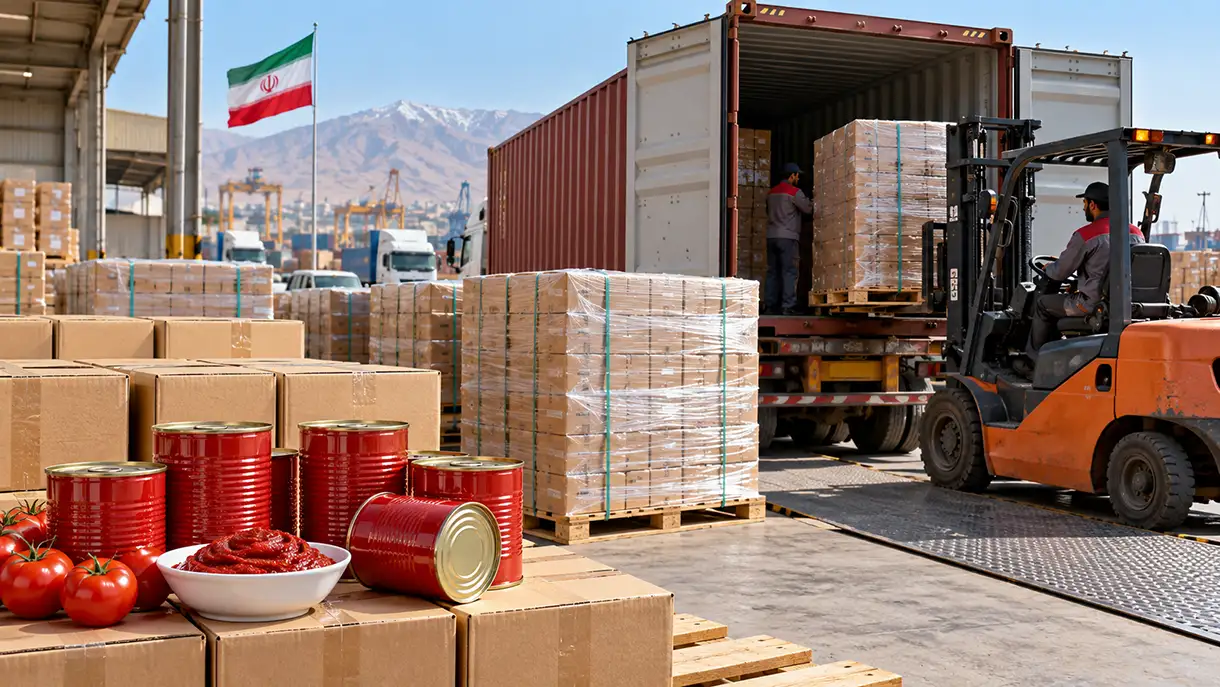
For serious importers, a full-container quotation is generally more useful because the supplier can specify the total quantity, carton count, net product weight and shipping basis.
VEXA states that one 20-foot container of its canned tomato paste contains approximately 24,000 cans of 800g, equal to around 19.2 metric tons of net product. Another Iranian export listing estimates approximately 22,800–25,200 cans of 800g in a 20-foot container, depending on loading and weight restrictions.
Using the $900–$1,100/MT planning range used throughout this guide:
| Example 800g container load | Approx. net product | Indicative product value* |
|---|---|---|
| 22,800 cans | 18.24 MT | $16,416–$20,064 |
| 24,000 cans | 19.20 MT | $17,280–$21,120 |
| 25,200 cans | 20.16 MT | $18,144–$22,176 |
*Planning calculation only; not a supplier quotation. Freight, destination charges, insurance, customs duties and other costs are excluded.
Actual container loading depends on:
- can weight and dimensions;
- cans per carton;
- carton dimensions;
- palletized versus floor-loaded shipment;
- container payload restrictions;
- road and port weight limitations;
- destination-country requirements.
For this reason, traders should request a container loading plan rather than estimating purchasing cost from the number of cans alone.
FCL REVIEW
Before comparing two full-container offers, calculate net tomato paste weight per container. One supplier may quote fewer cans but a heavier pack size, while another may achieve higher carton density. Compare the resulting $/MT and total container value, not just the number of units.
Private Label and OEM Orders
Private-label production is widely available among Iranian tomato paste exporters and can be particularly attractive to distributors that already operate a retail or food-service brand.
Several Iranian suppliers explicitly offer OEM / private-label tomato paste. Royal Foods states that its canning operation supplies private labels for international clients, while VEXA and Martiran also advertise customized branding and packaging for export buyers.
Private-label buyers may be able to customize:
- brand name and artwork;
- can size;
- easy-open or standard lid;
- paper label or printed can;
- carton design;
- destination-language labeling;
- Brix specification;
- salt level and formulation within applicable standards;
- carton quantity and pallet configuration.
Private label can also influence the final tomato paste can price in Iran because customized printing, minimum print runs and packaging setup may have to be incorporated into the quotation.
| Private-label item | What to confirm before ordering |
|---|---|
| Artwork | Final editable files and approval process |
| Can printing | Minimum printing quantity |
| Label language | Destination-country requirements |
| Brix | Exact specification in contract |
| Net weight | Declared weight per can |
| Carton | Units per carton and printing |
| Shelf life | Production and expiry marking |
| Quality documents | COA, specification and certificates |
PRIVATE-LABEL REVIEW
Ask the manufacturer to quote standard factory brand and private label separately. This makes it possible to see how much customization actually adds to the wholesale price instead of assuming that OEM production is automatically more expensive.
Seasonal Tomato Paste Price Trends in Iran
The tomato paste price in Iran can change through the year because the country’s processing industry is closely linked to the availability of fresh tomatoes.
This matters especially in 2026. The World Processing Tomato Council reported in late August that harvesting of the new processing-tomato crop had begun in northern and western Iran and that factories were actively processing the new crop. At that point, WPTC maintained an estimated 1.7 million metric tons of processing tomatoes for Iran’s 2026 crop, while noting that weather and heat damage still created uncertainty around final output.
| Period | Typical market situation | What buyers should watch |
|---|---|---|
| Before main processing season | Greater reliance on existing inventory | Remaining stock and quotation validity |
| Main harvest / processing period | Fresh tomatoes entering factories | New-season production and availability |
| Immediately after production | Larger volume of fresh inventory available | Opportunity for forward purchasing |
| Later in storage cycle | Inventory composition changes | Remaining grade, packaging and supplier stock |
Seasonality does not mean that the Iranian tomato paste wholesale price automatically reaches its lowest point on a specific date. Currency movements, packaging material prices, export demand and freight costs can offset changes in raw-tomato supply.
2026 MARKET REVIEW
The key fact for buyers is that Iran’s 2026 processing campaign is active, with WPTC estimating roughly 1.7 million MT of processing tomatoes as of its August update. Buyers negotiating new-season contracts should therefore request a quotation based specifically on 2026 production, rather than relying on an older online price listing.
Harvest Season and Raw Tomato Supply
Iran has different tomato-growing regions, so production timing is not identical across the country. Industry sources generally place the main processing window across the summer and early autumn.
Taraz Foods describes Iran’s peak tomato harvesting period as roughly late July to mid-September, while an Iranian processing-industry profile published by Tomato News describes one major producer’s production campaign as running from early June through late October, with the peak in August and September.
The 2026 WPTC update provides a more current picture: by August 28, 2026, harvesting had begun in Iran’s northern and western production regions and factories were processing significant quantities of fresh tomatoes.
Raw-material availability can influence:
- factory utilization;
- processing yield;
- inventory availability;
- Brix and quality options;
- willingness to negotiate larger contracts;
- delivery schedules for new production.
Weather also matters. WPTC reported that high temperatures and heat waves were affecting harvesting schedules and tomato quality in parts of Iran during the 2026 crop.
HARVEST REVIEW
For 2026 purchasing, August–September is particularly important for monitoring new Iranian production, but the cheapest quotation cannot be predicted from harvest timing alone. Buyers should compare dated offers during and shortly after the processing campaign.
Best Time to Buy Tomato Paste from Iran
For many wholesale buyers, the most useful period to request new-season quotations is during the main processing campaign and the months immediately following it, when new inventory is entering the market.
That does not mean an importer should wait for one exact “lowest-price month.” A better strategy is to obtain comparable quotations at several points during the season.
A professional buyer can:
- request the first quotation when new-season processing begins;
- update it during peak production;
- compare it again after major production volumes have entered storage;
- ask whether the offer is based on current-season or previous-season stock;
- negotiate a fixed-volume or scheduled-delivery contract if pricing is acceptable.
For buyers planning several containers, it may also be useful to negotiate the total volume now but schedule shipments over several months.
| Buying strategy | Potential advantage |
|---|---|
| Spot purchase | Flexibility |
| New-season purchase | Access to recently produced stock |
| Multi-container contract | Better production planning |
| Scheduled deliveries | Reduced warehouse pressure |
| Annual supply agreement | Greater price and supply visibility |
BUYING-TIME REVIEW
The best time to buy is not simply “the harvest month.” It is the point when new-season availability, exchange rate, packaging cost and your shipping schedule produce an acceptable landed cost. Use the harvest calendar to time RFQs—not as proof that a specific month must be cheapest.
How to Get the Best Wholesale Tomato Paste Price from Iran
The most effective way to obtain a competitive Iran tomato paste wholesale price is to send several suppliers exactly the same specification.
A vague inquiry such as “Please send tomato paste price” produces quotations that are difficult to compare. Instead, buyers should define the commercial requirement before asking for price.
At minimum, specify:
- required Brix;
- can size;
- cans per carton;
- quantity or number of containers;
- factory brand or private label;
- lid type;
- destination port;
- required Incoterm;
- expected shipment period;
- required certificates;
- preferred payment terms.
This approach turns the tomato paste can price in Iran from an isolated number into a comparable commercial offer.
PRICE-NEGOTIATION REVIEW
The best quotation is not necessarily the lowest $/MT. The strongest offer is the one that combines verified specification, acceptable packaging, realistic loading, suitable Incoterm and reliable documentation at the lowest comparable cost.
Negotiating Directly with Manufacturers
Buying directly from a manufacturer can reduce the number of commercial intermediaries involved, but it does not automatically guarantee the lowest landed price.
Direct-factory negotiations are particularly useful when the buyer needs:
- several containers;
- recurring orders;
- private labeling;
- customized cans or cartons;
- specific Brix or formulation;
- production scheduling;
- long-term supply agreements.
Iranian factories also differ substantially in production scale. Royal Foods, for example, reports canning capacity above 25 million tins per year, while Tabiat states capacity of 6 million tomato paste cans per month at its Mamounieh facility. These are company-reported figures and should be independently confirmed during supplier due diligence.
When negotiating directly, ask for:
- company registration details;
- factory address;
- product specification;
- current certificates;
- recent COA;
- production photos or video where appropriate;
- sample;
- references or existing export markets;
- formal Proforma Invoice.
MANUFACTURER REVIEW
Factory capacity is useful, but it is not a substitute for due diligence. Verify the specific manufacturer, batch specification, certificates and contractual seller before transferring funds or committing to a large order.
Comparing Factory and Trading Company Quotes
A trading company should not automatically be rejected simply because it is not the manufacturer. Traders can sometimes provide useful services such as mixed loads, smaller MOQs, export coordination or access to several factories.
The real comparison should be based on what each seller includes.
| Factor | Direct manufacturer | Trading / export company |
|---|---|---|
| Factory access | Usually direct | Depends on trader |
| Private label | Often available | May coordinate with factory |
| MOQ | May favor production-scale orders | Can sometimes offer flexibility |
| Mixed products | Usually limited to factory portfolio | May combine multiple products |
| Export coordination | Varies | Often a core service |
| Price transparency | Factory quotation possible | Margin normally included |
| Quality responsibility | Direct producer relationship | Contractual structure should be checked |
A trader quoting $980/MT FOB could still offer a better commercial result than a factory quoting $930/MT EXW if the trader’s offer includes export handling that the buyer would otherwise have to arrange separately.
QUOTE REVIEW
Never compare “factory” and “trader” prices by headline price alone. Normalize both offers to the same Brix, packing, net quantity and Incoterm before deciding which is actually cheaper.
Requesting an Accurate Export Quotation
A good RFQ should enable the supplier to calculate the offer without guessing what the buyer wants.
A practical tomato paste RFQ can include:
| RFQ field | Example |
|---|---|
| Product | Canned tomato paste |
| Origin | Iran |
| Brix | 28–30 |
| Can size | 800g |
| Carton | 12 cans |
| Order | 1 × 20-ft FCL |
| Branding | Private label |
| Lid | Easy-open |
| Destination | Buyer’s destination port |
| Incoterm | FOB Bandar Abbas / CFR destination |
| Required documents | COA, COO, Health Certificate, Packing List |
| Shipment | Requested month |
| Quote validity | Supplier to specify |
Buyers should also ask the supplier to state:
- price per can;
- price per carton;
- price per metric ton;
- cartons per container;
- net and gross container weight;
- production lead time;
- quotation validity;
- payment terms.
RFQ REVIEW
The most useful answer to “What is the tomato paste can price in Iran?” is not one number. It is a dated, specification-based quotation that allows the importer to calculate both product cost and landed cost.
Buying and Importing Canned Tomato Paste from Iran
Buying Iranian canned tomato paste involves more than agreeing on price. The importer should verify product specifications, supplier identity, labeling, documentation, payment arrangements and destination-country food regulations before shipment.
A practical purchasing sequence is:
- Define product and packaging specifications.
- Request comparable quotations.
- Verify the supplier.
- Obtain samples where necessary.
- Review specification sheet and certificates.
- Confirm labeling requirements in the importing country.
- Agree on price, Incoterm and payment terms.
- Receive and verify the Proforma Invoice.
- Approve production and packaging.
- Review pre-shipment documents.
- Arrange shipment and destination clearance.
Iranian suppliers publicly list multiple export options. Freshdi’s current Iranian offer, for example, identifies EXW, FOB and CIF terms with Bandar Abbas as its loading port, while VEXA states that it supports EXW, FOB and CIF and can arrange other Incoterms by agreement.
IMPORTER REVIEW
Always check your own country’s food-import, labeling, customs and banking requirements before production begins. A product acceptable in one destination cannot automatically be assumed to satisfy another country’s rules.
MOQ, Payment and Delivery Terms
MOQ and payment conditions vary by seller and should therefore be treated as negotiable commercial terms rather than fixed characteristics of the Iranian market.
For example:
- VEXA lists 1 × 20-ft container as its canned tomato paste MOQ;
- Freshdi’s September 2026 Iranian offer also lists 1 × 20-ft container and T/T as the payment term;
- EXIM Asian lists 1 FCL and identifies LC and advance payment among its offered payment methods.
This variation demonstrates why importers should ask rather than assume.
| Commercial term | What should be written in the contract / PI |
|---|---|
| MOQ | Exact cans, cartons or MT |
| Price | Currency and unit basis |
| Incoterm | Rule + named place |
| Payment | Method and payment milestones |
| Production | Lead time |
| Shipment | Estimated shipment date |
| Validity | Offer expiration date |
| Specification | Brix, weight and formulation |
| Packaging | Can, lid, carton and label |
| Documents | Required certificates and shipping documents |
Because international banking arrangements can depend on the buyer, seller, banks and jurisdictions involved, the actual payment channel should be confirmed before signing the final supply contract.
PAYMENT REVIEW
Do not send payment based only on an online quotation or informal message. Confirm the legal seller, beneficiary details, Proforma Invoice, product specification and agreed commercial terms first.
Shipping and Export Documentation
Documentation requirements depend partly on the importing country, but Iranian tomato paste exporters commonly identify a core set of export documents.
VEXA states that its export shipments can be accompanied by:
- Certificate of Analysis (COA);
- Product Specification Sheet;
- Certificate of Origin;
- Health / Sanitary Certificate;
- Packing List;
- Bill of Lading.
A commercial shipment will also normally involve commercial documentation such as the seller’s invoice, while destination authorities may require additional food-registration, conformity, labeling or laboratory documentation.
| Document | Main purpose |
|---|---|
| Commercial Invoice | Commercial value and transaction details |
| Packing List | Quantity and packing configuration |
| Certificate of Origin | Confirms declared country of origin |
| COA | Reports batch/product quality parameters |
| Specification Sheet | Defines contracted product |
| Health / Sanitary Certificate | Food-health documentation where applicable |
| Bill of Lading | Transport document for sea shipment |
| Additional certificates | Destination/customer-specific requirements |
Tomato paste commonly appears under HS heading 200290, including in Iranian supplier documentation and recorded international trade shipments. However, the exact national tariff subheading can vary with product characteristics and the importing country’s customs tariff; importers should therefore confirm final classification with their customs broker or competent authority.
DOCUMENT REVIEW
Ask for a draft document set before shipment, especially the invoice, packing list, certificate details and Bill of Lading instructions. Correcting documentation before vessel departure is usually easier than resolving inconsistencies after arrival.
Frequently Asked Questions About Tomato Paste Can Prices in Iran
What Is the Wholesale Price of Tomato Paste in Iran?
For 2026 budgeting, a practical working range for export-grade Iranian canned tomato paste is approximately $900–$1,100 per metric ton, but this should not be interpreted as an official national price.
Current public supplier offers vary significantly. Freshdi listed an Iranian 28–30% solids product at $1,100/MT in September 2026, while other supplier offers have appeared both below and around this level. Differences in Brix, packing, MOQ and Incoterms mean that individual quotations are not directly comparable without normalizing specifications.
How Much Does an 800g Can of Iranian Tomato Paste Cost Wholesale?
Using the article’s $900–$1,100/MT net-product benchmark, 800g of product represents approximately $0.72–$0.88 in tomato paste value.
This is a calculation, not a firm finished-can quotation. Actual 800g tomato paste can prices in Iran also reflect the can, lid, labeling, carton, private branding and supplier margin.
A public Iranian supplier listing has separately advertised an 800g canned product at approximately $0.60 per can, illustrating that live commercial offers may fall outside a calculated benchmark depending on specification and terms.
What Is the Minimum Order for Iranian Canned Tomato Paste?
There is no universal Iranian MOQ.
Some export suppliers specify approximately one 20-foot container, while others advertise smaller trial quantities. VEXA, for example, lists one 20-foot container—approximately 24,000 cans of 800g—as its MOQ. Mahram’s export listing shows a smaller MOQ of 50 cartons / 600 cans.
For serious price comparison, buyers should nevertheless request a full-container quotation even when initially purchasing less.
What Tomato Paste Can Sizes Can Be Purchased from Iran?
Available sizes differ by manufacturer.
Published Iranian offerings include 70g, 200g, 400g, 800g, 1kg, 3kg, 4kg, 4.5kg, 10kg and 17kg formats, while industrial buyers can also source aseptic paste in approximately 220–235kg drums.
Importers should confirm the exact size with the manufacturer because not every factory produces every format.
Is 28–30 Brix Tomato Paste Available from Iran?
Yes. 28–30 Brix double-concentrated tomato paste is actively offered by Iranian exporters. Freshdi’s September 2026 listing, for example, specifies 28–30% solids for its Iranian product.
Buyers should confirm Brix on the contract, specification sheet and COA rather than relying only on a product listing.
Can I Order Iranian Tomato Paste Under My Own Brand?
Yes. Multiple Iranian manufacturers and exporters advertise private-label / OEM tomato paste production, including custom labels and packaging for destination markets.
Royal Foods, VEXA and Martiran all publicly state that private-label services are available.
MOQ and printing requirements should be confirmed before artwork preparation.
Is FOB Bandar Abbas Common for Iranian Tomato Paste Exports?
Bandar Abbas is used in Iranian tomato paste export offers. For example, Freshdi’s September 2026 listing identifies Bandar Abbas as the port of loading and offers FOB, EXW and CIF terms.
This does not mean every Iranian tomato paste shipment must use Bandar Abbas; the appropriate route depends on the supplier, destination and agreed transport plan.
What Should I Ask an Iranian Tomato Paste Supplier Before Buying?
Before confirming an order, request at least:
- current price and quotation validity;
- Brix and complete product specification;
- COA or sample COA;
- can and carton specifications;
- MOQ;
- container loading quantity;
- Incoterm and named place;
- production lead time;
- payment terms;
- shelf life;
- available certificates;
- private-label requirements if applicable;
- draft export-document list.
The more precise the RFQ, the more meaningful the resulting tomato paste can price in Iran will be for actual purchasing decisions.
FINAL BUYER REVIEW — 2026
For initial budgeting, use $900–$1,100/MT as a practical reference rather than a guaranteed market price. Then request current quotations based on the same Brix, can size, carton configuration, order volume and Incoterm. Iran’s 2026 processing season is active, with WPTC estimating roughly 1.7 million MT of processing tomatoes, so traders purchasing new-season stock should explicitly ask suppliers whether the quotation refers to 2026 production.