Frozen Chicken Price in Iran Today: Wholesale Prices & Buying Guide
Current Frozen Chicken Prices in Iran

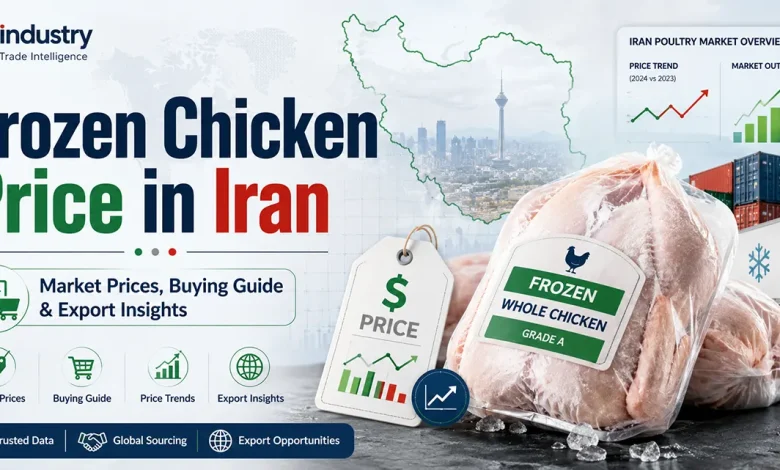
The frozen chicken price in Iran currently provides an attractive price reference for international buyers evaluating the Iranian poultry market. As of , the consumer-market price of whole frozen chicken distributed through Iran’s regulated market is approximately 290,000 tomans per kilogram.
Using the reference exchange rate adopted for this article — 1 USD = 190,000 Iranian tomans — the current frozen whole chicken price is equivalent to approximately USD 1.53 per kilogram.
Quick Answer: Frozen Chicken Price in Iran Today


As of August 9, 2026, the price of
whole frozen chicken in Iran is approximately
290,000 tomans per kilogram in the regulated consumer market.
Using the reference exchange rate of
190,000 tomans per US dollar, this equals approximately
USD 1.53 per kg.
 .
.
- Frozen whole chicken: 290,000 tomans/kg
- Approximate USD price: $1.53/kg
- Price type: Domestic regulated consumer-market benchmark
- Reference exchange rate: 190,000 tomans/USD
- Last price update: August 9, 2026
For international buyers: This is a domestic market benchmark,
not a fixed export price. Wholesale and export prices depend on order volume,
product specifications, packaging, destination, Incoterm, certification,
and current Iranian export regulations.
Frozen Chicken Price in Iran Today – Price Table
| Product | Market Type | Price per kg (Toman) | Approx. USD/kg |
|---|---|---|---|
| Whole Frozen Chicken | Regulated Consumer Market | 290,000 | $1.53 |
| Whole Chicken | Consumer Market | 300,000–330,000 | $1.58–$1.74 |
| Fresh Whole Chicken, Slaughter-Day | Consumer Market | Approx. 400,000 | Approx. $2.11 |
Source: Iranian poultry market prices reported on . See the original Iranian market price report .
USD values are calculated by MyIndustry using a reference rate of 190,000 tomans per US dollar.
The table is designed to give overseas buyers a clear picture of the underlying consumer-market price in Iran. It is important, however, to distinguish between domestic consumer prices, regulated distribution prices and commercial export quotations.
The 290,000-toman figure refers specifically to whole frozen chicken supplied through the regulated market.
The same market report places the broader consumer price of whole chicken at approximately 300,000 to 330,000 tomans per kilogram. Fresh slaughter-day whole chicken may be priced higher.
Frozen Whole Chicken Price per Kilogram
The current benchmark price for whole frozen chicken in Iran is approximately 290,000 tomans per kilogram. Based on the exchange-rate reference used by MyIndustry for this article, the calculation is:
290,000 tomans ÷ 190,000 tomans/USD = approximately USD 1.53 per kg
For comparison, the general consumer-market price of whole chicken is currently around 300,000 to 330,000 tomans per kilogram, equivalent to approximately USD 1.58 to USD 1.74 per kilogram using the same reference rate.
These figures give international buyers a useful benchmark for understanding chicken prices in Iran, but they should not be interpreted as a guaranteed export selling price.
What Does the 290,000-Toman Price Represent?
- It refers to whole frozen chicken, not chicken cuts.
- It is a price per kilogram.
- It represents a domestic consumer-market reference.
- It relates to frozen chicken distributed through the regulated market.
- It does not include international freight or export logistics.
- It should not be treated as an FOB, CFR or CIF export quotation.
Price Conversion Methodology
To make Iranian poultry prices easier to understand for international buyers, MyIndustry provides an approximate US-dollar equivalent alongside prices quoted in Iranian tomans.
Iranian currency can also be confusing for foreign buyers because the official currency unit is the Iranian rial (IRR), while prices in everyday business and consumer transactions are commonly expressed in tomans. One toman equals 10 Iranian rials. Unless otherwise stated, all Iranian prices on this page are expressed in tomans.
Wholesale Frozen Chicken Prices in Iran
The wholesale frozen chicken price in Iran should not be assumed to be identical to the consumer-market price shown above. Large commercial orders are generally priced according to the exact specifications requested by the buyer.
For this reason, MyIndustry uses the observable Iranian consumer-market price as a market benchmark rather than publishing an unsupported fixed export price. A genuine wholesale or export quotation should be obtained from a supplier for a specific transaction.
Factors That Affect a Wholesale Frozen Chicken Quote
- Order quantity: total volume and number of containers
- Product specification: whole chicken or specific cuts
- Carcass weight: required weight range per chicken
- Processing: slaughtering, cleaning and freezing specifications
- Freezing method: processing and cold-storage requirements
- Packaging: individual bags, cartons and private-label requirements
- Certification: veterinary, health and destination-country documentation
- Delivery destination: country, port or border point
- Incoterm: EXW, FCA, FOB, CFR, CIF or other agreed terms
- Payment terms: agreed commercial and settlement conditions
Consumer Price vs. Wholesale and Export Price
| Price Type | Approx. Price (Toman/kg) | Approx. Price (USD/kg) | Buyer Interpretation |
|---|---|---|---|
| Regulated Whole Frozen Chicken | 290,000 | $1.53 | Current domestic frozen-chicken benchmark |
| Whole Chicken – Consumer Market | 300,000–330,000 | $1.58–$1.74 | General retail market reference |
| Fresh Whole Chicken | Around 400,000 | Around $2.11 | Higher-priced fresh-market benchmark |
| Wholesale Frozen Chicken | Negotiated | Negotiated | Depends on volume, weight, packaging and supplier |
| Export Frozen Chicken Quote | Transaction-specific | Transaction-specific | Depends on Incoterm, destination, certificates and logistics |
USD conversion: Calculated by MyIndustry using a reference exchange rate of 190,000 tomans per US dollar. Domestic consumer prices are market benchmarks and should not be interpreted as wholesale or export quotations.
Therefore, an international buyer should not simply multiply the Iranian retail price by the required shipment weight. Export preparation, packaging, certification, cold-chain logistics, transportation and contractual terms can change the final purchase and landed cost.
For an accurate quotation, buyers should provide suppliers with their required quantity, product specification, preferred chicken weight, packaging requirements, destination and requested Incoterm.
What Determines Frozen Chicken Prices in Iran?
The frozen chicken price in Iran is influenced by several interconnected factors, from poultry-feed costs and currency movements to domestic production, inventories, and consumer demand. For international buyers, understanding these variables is important because a change in the Iranian consumer price does not always translate directly into the same percentage change in an export quotation.
The main price drivers can be summarized as follows:
- Exchange-rate movements, particularly where imported production inputs are involved
- Corn and soybean meal costs, which are key poultry-feed ingredients
- Domestic broiler production and slaughter volumes
- Availability of frozen chicken inventories
- Changes in consumer demand
- Government market-management and distribution policies
- Transportation, energy, processing, and cold-storage costs
- Export availability and commercial order specifications
Iran has a substantial domestic poultry industry. FAO reported in 2026 that Iranian poultry-meat production meets approximately 95% of domestic consumption, at around 2.4 million tonnes. This relatively high level of domestic production means that chicken prices are primarily connected to conditions inside Iran, although imported feed inputs and international commodity markets can still have an important indirect effect.
For buyers evaluating Iran as a sourcing market, it is therefore more useful to monitor the combination of domestic chicken prices, feed availability, production volumes, exchange rates, and export conditions rather than relying on a single historical price.
Exchange Rate and Currency Fluctuations
Currency movements can affect Iranian chicken prices both directly and indirectly.
Iran produces most of the poultry meat consumed domestically, but the poultry supply chain still relies significantly on agricultural inputs that are traded internationally. Consequently, changes in the cost of obtaining imported feed ingredients can eventually affect poultry production costs.
For an international chicken buyer, currency should therefore be considered in two different ways:
- Production effect: currency movements may influence the local cost of imported feed and other inputs.
- Price-conversion effect: the USD equivalent of a price quoted in Iranian tomans changes when the exchange-rate assumption changes.
- Contract effect: the exchange rate used in an actual commercial transaction may differ from the reference rate used for market analysis.
Timing effect: a USD quotation calculated today may no longer represent the same toman value if exchange rates change before payment or shipment.
For consistency, MyIndustry uses 190,000 tomans per US dollar as the reference exchange rate throughout this article.
For example:
290,000 tomans/kg ÷ 190,000 tomans/USD = approximately USD 1.53/kg
This exchange rate is a calculation reference used by MyIndustry, not an official exchange rate or a guaranteed rate for a commercial transaction. Buyers should therefore confirm the applicable settlement and exchange conditions when requesting an actual quotation.
This distinction is particularly important when searching for the frozen chicken price in Iran in USD: the underlying Iranian price and the exchange rate used to convert that price are two separate variables.
Production and Feed Costs
Feed is one of the most important cost components in commercial poultry production. Corn and soybean meal are particularly important feed ingredients, meaning that changes in their price and availability can affect the cost of raising broiler chickens.
Iran’s dependence on substantial quantities of imported feed grain makes this factor especially relevant. FAO estimates that the country may require around 11 million tonnes of maize imports in 2026/27, reflecting sustained feed demand from its livestock and poultry industries.
For buyers, the poultry production cost chain can be simplified as:
Feed and production inputs → Broiler production cost → Slaughterhouse/processor cost → Wholesale price → Consumer or export price

Important production-related factors include:
- corn prices;
- soybean meal prices;
- day-old chick costs;
- veterinary and animal-health expenses;
- labor costs;
- energy costs;
- transportation expenses;
- slaughtering and processing costs;
- freezing costs; and
- refrigerated storage costs.
At the same time, Iran has significant poultry-production capacity. A recent report from Iran’s Ministry of Agriculture-Jahad stated that approximately 137 million broiler chickens were produced in the preceding month, with an estimated surplus of at least 15 million birds after domestic requirements, creating potential capacity for exports.
This is an important point for international buyers: Iranian frozen chicken prices are not determined by feed costs alone. Strong broiler production or temporary surpluses can increase market availability and potentially offset some upward cost pressures.
Supply, Demand, and Seasonal Changes
Like other agricultural commodities, the price of chicken in Iran responds to changes in the balance between supply and demand.
When broiler production exceeds immediate domestic consumption, additional poultry can enter cold storage, regulated distribution channels, or potentially the export market. Conversely, tighter production or disruption to feed, processing, transportation, or distribution can reduce availability and put upward pressure on prices.
The basic relationship can be summarized as:
- Higher production + stable demand → greater supply and potentially softer prices
- Lower production + stable demand → tighter supply and potentially higher prices
- Temporary production surplus → greater frozen inventory or export potential
- Sudden increase in demand → possible short-term price pressure
- Large frozen inventories → greater ability to stabilize temporary supply shortages
Current Iranian market conditions illustrate why supply data matter. In early August 2026, Iran’s Ministry of Agriculture-Jahad described the poultry-meat market as being in a relatively balanced condition for both producers and consumers. Officials also emphasized that managing the poultry supply chain becomes more complex when the pattern of demand changes.
Recent production data also point to substantial supply capacity. The reported production of approximately 137 million broilers in one month, including an estimated surplus of at least 15 million birds after domestic needs, suggests that export availability can increase when domestic production exceeds consumption.
For international purchasers, this means that the best buying opportunity may not be identified simply by checking the frozen chicken price in Iran today. Buyers should also consider:
- current broiler production levels;
- frozen chicken inventories;
- feed availability;
- domestic demand conditions;
- export permissions;
- supplier capacity; and
- the size and timing of the intended order.
A period of strong domestic production combined with adequate frozen inventories may create more favorable conditions for negotiating a large wholesale or export order than a period when domestic supply is relatively tight.
Packaging and Order Volume
Packaging and order size can have a direct impact on the final commercial price of frozen chicken from Iran. A domestic consumer-market price normally reflects standard retail distribution, while a bulk order may require different packaging, labeling, storage, documentation, and logistics arrangements.
For an international buyer, the quotation should therefore be based on a clearly defined product specification rather than price per kilogram alone.
Key variables normally include:
- Total order volume: trial shipment, partial load, or container-scale purchase
- Average carcass weight: the required weight range of each whole chicken
- Primary packaging: individual plastic bags or other buyer-specified formats
- Outer packaging: carton size, net weight, and number of chickens per carton
- Labeling: product name, production date, expiry date, origin, storage instructions, and destination-market requirements
- Private labeling: buyer or distributor branding where available
- Storage condition: required frozen-storage temperature
- Palletization: where requested by the buyer or logistics provider
- Destination requirements: additional packaging or labeling rules imposed by the importing country
A useful purchasing specification can be organized as follows:
| Item | Example of Information Buyer Should Provide |
|---|---|
| Product | Whole frozen chicken |
| Order Size | Quantity in tonnes or containers |
| Carcass Weight | Required weight range per bird |
| Packing | Individual bag + master carton |
| Carton Net Weight | Buyer-specified |
| Label Language | Based on destination market |
| Private Label | Required / Not required |
| Destination | Country and port/border |
| Incoterm | EXW, FCA, FOB, CFR, CIF, etc. |
Order volume can also affect unit economics. Larger shipments may distribute some fixed processing, documentation, and logistics costs across more kilograms of product. However, this does not necessarily mean that every large order automatically receives a lower price per kilogram; product availability, packaging specifications, market conditions, and delivery terms also influence the quotation.
For this reason, international buyers comparing Iranian suppliers should request quotations using the same quantity, product specification, packaging, and Incoterm. Otherwise, two apparently different prices may simply represent different commercial conditions.
Iran Poultry Market at a Glance
Iran has a large domestic poultry industry supported by broiler farms,
official slaughterhouses, processing facilities, cold storage, wholesale distribution,
and regulated market channels.
- Chicken meat supplied in Farvardin 1405: 200,751 tonnes
- Chicken meat supplied in Ordibehesht 1405: 157,034 tonnes
- Chicken’s share of poultry meat in official slaughterhouses: about 97%
- Broiler placement outlook: approximately 130–140 million birds in early 1405 production cycles
- Market structure: primarily domestic, with exports subject to current regulations
What this means for buyers: Iran has substantial chicken production capacity, but the availability of Iranian frozen chicken for export depends on domestic supply, frozen inventories, supplier capacity, and current export regulations—not production volume alone.
Iran’s Frozen Chicken Market
Iran has a large poultry production and processing sector serving primarily its domestic market. Current official slaughterhouse statistics help illustrate the scale of this industry.
According to data from the Statistical Center of Iran, reported by Iran’s agricultural news agency IANA, official slaughterhouses supplied approximately 200,751 tonnes of chicken meat in Farvardin 1405 and 157,034 tonnes in Ordibehesht 1405. Chicken accounted for about 97% of poultry meat supplied by official slaughterhouses in both reporting periods.
| Period | Chicken Meat Supplied by Official Slaughterhouses |
|---|---|
| Farvardin 1405 | 200,751 tonnes |
| Ordibehesht 1405 | 157,034 tonnes |
These figures refer to chicken supplied through official slaughterhouses and should not be interpreted as frozen-chicken export volumes. They are useful, however, for demonstrating the scale of Iran’s commercial poultry supply chain.
The Iranian market includes several interconnected channels:
- broiler farms;
- slaughterhouses and processing facilities;
- cold-storage facilities;
- wholesale distribution;
- retail and chain-store distribution;
- regulated market-supply programs; and
- commercial and, where permitted, export channels.
Frozen chicken also has an important role in market management because inventories can be stored and released when required. In 2026, Iran’s Veterinary Organization stated that national meat, chicken, and egg reserves remained largely intact after domestic production had supplied market requirements, with some production being stored for market-regulation purposes.
For foreign purchasers, this means that Iran should not be viewed merely as a market with a single daily chicken price. It is a substantial production system in which current output, available inventories, regulatory decisions, and supplier-specific capacity all matter when evaluating a potential purchase.
Domestic Production and Supply
Recent production indicators show that Iran maintains significant domestic chicken-production capacity.
The Statistical Center of Iran reported that official slaughterhouses supplied 200,751 tonnes of chicken meat in Farvardin 1405, representing 97.1% of all poultry meat supplied through official slaughterhouses during the month. In Ordibehesht, reported chicken-meat supply was 157,034 tonnes, or approximately 97% of total poultry meat supplied through those slaughterhouses.
Broiler placement data provide another useful forward-looking indicator of supply. Iran’s Deputy Minister for Animal Production projected approximately 130–140 million broiler placements for the early months of the 1405 production cycle and indicated that continued increases in placement could improve chicken availability and potentially ease prices, provided feed inputs remained available.
For an overseas buyer, several domestic supply indicators are therefore worth monitoring:
- monthly broiler placements;
- chicken meat supplied through official slaughterhouses;
- availability of poultry feed;
- cold-storage inventories;
- domestic consumer demand;
- government market-regulation measures; and
- current export rules.
These indicators provide more context than a daily retail price alone. High production does not automatically mean that the entire surplus can be exported, because export eligibility is also determined by Iranian trade and agricultural policy.
Buying Frozen Chicken from Iran
Foreign buyers considering frozen chicken from Iran should first verify that the specific product they want to purchase is currently eligible for export.
This is particularly important because Iran’s poultry export rules can change according to domestic supply and market-management policy.
Under a 2026 directive reported by IANA based on an announcement from Iran’s Trade Promotion Organization, exports of uncut frozen whole chicken under HS code 02071200 were conditionally permitted only when the product consisted of cull hens from laying units. The directive stated that this exemption would remain valid until further notice.
This means that an international buyer should not assume that any frozen whole chicken available in the Iranian domestic market can automatically be exported.
Before requesting a commercial quotation, buyers should confirm:
- Product eligibility for export under current Iranian regulations
- HS code applicable to the requested product
- Producer or processor eligibility
- Veterinary and health certification requirements
- Requirements of the destination country
- Available quantity and carcass specifications
- Packaging and labeling requirements
- Incoterm and delivery point
- Cold-chain arrangements
- Payment and contractual terms
A practical sourcing process can therefore be structured as:
Product specification → Export eligibility check → Supplier verification → Veterinary/document review → Price quotation → Logistics assessment → Commercial agreement
The export-policy check should come before price negotiation. A low domestic market price has limited commercial value to a foreign buyer if the requested product category cannot legally be exported at the time of purchase.
Iran’s current rules also demonstrate why buyers should work with suppliers or trading partners familiar with the country’s agricultural and export regulations. Conditions applicable to frozen chicken can be amended as domestic production, inventories, and food-market priorities change. The latest available directive should therefore be verified for every transaction.
How International Buyers Can Source Frozen Chicken from Iran
International buyers looking to buy frozen chicken from Iran should begin with product eligibility and supplier capability rather than price alone.
As of August 2026, Iran does not have unrestricted export availability for every category of whole frozen chicken. A Trade Promotion Organization directive permits exports of uncut frozen chicken under HS code 02071200 only when the product is derived from cull hens from laying units; the exemption remains valid until further notice.
A practical sourcing process is:
| Step | Buyer Action |
|---|---|
| 1 | Define the frozen chicken specification |
| 2 | Confirm that the product is currently eligible for export |
| 3 | Identify qualified Iranian frozen chicken suppliers or exporters |
| 4 | Verify production, processing, packaging, and certification capability |
| 5 | Request a detailed commercial quotation |
| 6 | Compare price, Incoterm, documentation, and logistics terms |
| 7 | Complete regulatory and veterinary checks |
| 8 | Finalize the contract and shipment arrangements |
Before requesting a quote from an Iranian frozen chicken supplier, the buyer should ideally provide:
- product type and HS code;
- required quantity;
- carcass weight range;
- packaging specification;
- destination country;
- destination port or border;
- required certificates;
- preferred Incoterm; and
- required delivery period.
This makes supplier quotations more comparable and reduces the risk of comparing offers based on different specifications.
Minimum Order Quantities and Wholesale Purchasing
There is no single national minimum order quantity, or MOQ, that applies to all frozen chicken suppliers in Iran. Minimum quantities are commercial terms determined by the producer, processor, exporter, available inventory, and logistics arrangement.
A buyer may encounter several purchasing formats:
- trial or sample commercial orders;
- palletized wholesale orders;
- truck-scale shipments to neighboring markets;
- container-scale frozen poultry shipments; and
- recurring supply contracts.
For bulk frozen chicken, larger orders can improve logistics efficiency, but the lowest unit price should not be the only consideration. A buyer should evaluate the total commercial offer.
Important wholesale variables include:
| Commercial Variable | Why It Matters |
|---|---|
| Quantity | Influences production planning and logistics |
| Carcass size | Determines product specification and market suitability |
| Packaging | Affects processing and handling cost |
| Delivery term | Changes which logistics costs are included |
| Destination | Influences transport route and documentation |
| Certification | May require additional inspections or testing |
| Shipment frequency | Can affect supplier planning and contract terms |
For this reason, a serious buyer searching for a frozen poultry wholesale price in Iran should request a transaction-specific quotation rather than assuming that the domestic market price represents the final bulk price.
Quality Standards and Required Certifications
Quality assurance is particularly important when sourcing animal-origin food products internationally.
Iranian veterinary authorities supervise the movement and health control of animal products. In 2026, Iranian authorities reported the seizure of approximately 25 tonnes of frozen chicken being transported without the required veterinary health transport certificate, illustrating the regulatory importance of documented movement of frozen poultry.
Veterinary health certification is also part of Iran’s export system for animal-origin products. Recent export reporting from Qazvin showed that veterinary authorities issued health certificates for animal products after specialist testing and verification of sanitary requirements.
An international buyer should therefore verify at least the following before shipment:
- identity and authorization of the producer or processing facility;
- veterinary supervision;
- product health documentation;
- production and expiry dates;
- batch or lot identification;
- carcass weight specification;
- freezing and storage conditions;
- packaging integrity;
- labeling requirements;
- destination-country import requirements; and
- any additional laboratory tests required by the importing country.
The exact certificates required can differ by destination. Therefore, buyers should confirm the importing country’s veterinary and food-safety requirements before signing the final purchase contract.
Exporting Frozen Chicken from Iran
The opportunity to source frozen chicken from Iran depends not only on production capacity but also on export policy.
Current regulations are especially important. Under the latest available Trade Promotion Organization directive, exports of uncut frozen chicken classified under HS 02071200 are conditionally permitted when the product consists of cull hens from laying units. The rule was announced as valid until further notice.
This distinction matters because a foreign buyer may find frozen poultry available in Iran’s domestic market without that same product being legally available for export.
Therefore, before an Iran chicken exporter confirms an order, the parties should verify:
- current export eligibility;
- correct HS classification;
- veterinary requirements;
- destination-country import approval;
- supplier and processing-facility eligibility; and
- customs and shipment documentation.
For international buyers, regulatory verification should be treated as part of the purchasing process—not as a final administrative step after the commercial terms have already been agreed.
Export Procedures and Documentation
The documentation required for a shipment depends on the product, destination, and contractual arrangement. However, a frozen chicken export transaction will normally require the buyer and exporter to coordinate several categories of documents.
| Document / Requirement | Main Purpose |
|---|---|
| Commercial Invoice | Records the commercial value and transaction details |
| Packing List | Describes cartons, weights, and shipment contents |
| Veterinary Health Documentation | Confirms relevant sanitary compliance |
| Certificate of Origin, where required | Identifies the origin of the goods |
| Customs Export Documentation | Supports export clearance |
| Transport Document | Covers road, sea, or other transportation |
| Destination Import Documents | Satisfy the importing country’s requirements |
| Product Specification | Defines weight, processing, packaging, and quality |
Because poultry is a regulated food product, veterinary approval should be addressed early in the transaction. Iranian veterinary authorities actively control the movement of raw animal products, and health documentation is a material part of that control system.
A useful sequence for buyers is:
Regulatory check → Product specification → Supplier verification → Veterinary requirements → Commercial contract → Export documentation → Customs clearance → Cold-chain shipment
Destination-country requirements can differ substantially, so neither the exporter nor buyer should rely solely on documents used for a previous shipment to another market.
Cold Chain and Transportation
Maintaining the cold chain is essential when transporting frozen chicken for export.
Codex guidance for quick-frozen foods states that products should generally be maintained at −18°C or colder throughout the cold chain, subject to any tolerances permitted under national legislation. The guidance covers storage, transportation, export, import, distribution, and sale.
FAO guidance on frozen meat storage likewise identifies approximately −18°C to −25°C as a typical range for long-term frozen storage and lists well-packaged poultry among products suitable for extended frozen storage under controlled conditions.
For buyers, cold-chain control should cover:
- frozen storage before dispatch;
- refrigerated loading conditions;
- refrigerated truck or reefer-container capability;
- temperature monitoring during transit;
- transfer points;
- port or border handling;
- unloading at destination; and
- documentation of any temperature requirements specified in the contract.
Iranian veterinary guidance also requires vehicles transporting raw animal products to comply with sanitary and cold-chain requirements.
For a commercial shipment, the buyer and supplier should agree in advance on the required product temperature, responsibility for temperature monitoring, and the procedure to follow if a cold-chain deviation occurs.
How to Find Reliable Frozen Chicken Suppliers in Iran
Finding the right frozen chicken supplier in Iran requires more than locating a company that can offer a competitive price.
An international buyer should distinguish between:
- poultry producers;
- slaughterhouses;
- processing facilities;
- cold-storage operators;
- trading companies; and
- companies actually capable of handling export transactions.
A supplier may have access to chicken but lack the processing, documentation, veterinary, packaging, or export capabilities required for an international shipment.
For that reason, supplier selection should combine commercial verification, product verification, and regulatory verification.
Evaluating Iranian Suppliers
Before placing an order, buyers should request enough information to establish whether the supplier can actually deliver the required product.
A basic supplier due-diligence checklist includes:
| Verification Area | What to Check |
|---|---|
| Company Identity | Legal company details and business information |
| Product Source | Producer, slaughterhouse, or processing facility |
| Export Eligibility | Ability to export the requested poultry category |
| Production Capacity | Ability to supply the required quantity |
| Product Specification | Weight, processing, freezing, and packaging |
| Veterinary Compliance | Availability of required health documentation |
| Cold Storage | Suitable frozen storage capability |
| Logistics | Ability to arrange the agreed delivery term |
| Export Experience | Previous international poultry or food shipments |
| Documentation | Ability to provide required commercial and export documents |
Buyers may also ask for:
- current product photographs;
- packaging photographs;
- label samples;
- product specifications;
- facility information;
- relevant certificates;
- recent laboratory results where appropriate; and
- references from previous commercial transactions where available.
The goal is not simply to find the cheapest Iran chicken supplier, but to identify a supplier capable of delivering the agreed product under the agreed commercial and regulatory conditions.
Requesting Quotations and Product Specifications
A well-structured Request for Quotation (RFQ) can significantly improve the quality of offers received from Iranian frozen chicken exporters and suppliers.
Instead of asking only, “What is your frozen chicken price?”, a buyer should send a specification such as:
| RFQ Item | Buyer Specification |
|---|---|
| Product | Whole frozen chicken |
| Quantity | ___ tonnes / containers |
| Carcass Weight | ___ kg per bird |
| Freezing | Buyer-required specification |
| Packaging | ___ kg/carton |
| Private Label | Yes / No |
| Destination Country | ___ |
| Port / Border | ___ |
| Incoterm | ___ |
| Required Certificates | ___ |
| Delivery Period | ___ |
| Payment Terms | To be agreed |
The supplier’s quotation should clearly identify what is included in the quoted price.
A useful quotation should state:
- unit price;
- currency;
- quantity;
- product specification;
- packaging;
- Incoterm;
- delivery location;
- quotation validity;
- production or delivery lead conditions;
- payment terms; and
- responsibility for certificates and logistics.
This approach makes it much easier to compare several frozen chicken suppliers in Iran on a like-for-like basis.
Payment and Contract Considerations
International poultry transactions should be supported by a written commercial agreement defining the responsibilities of both parties.
The contract should clearly address:
- exact product specification;
- agreed quantity and tolerances;
- price and currency;
- Incoterm;
- shipment period;
- packaging;
- required documents;
- veterinary and destination-market requirements;
- inspection arrangements;
- payment terms;
- responsibility for freight and insurance;
- treatment of shipment delays;
- cold-chain requirements; and
- procedures for product or documentation discrepancies.
Buyers should also confirm that the proposed payment method and financial channel are legally and practically available to both parties before committing to the transaction.
For first-time purchases, completing supplier verification and documentation review before making a significant payment commitment can reduce commercial risk.
“`html
Looking to Buy Frozen Chicken from Iran?
If you are an importer, distributor, wholesaler, or food-trading company interested in
sourcing frozen chicken from Iran, MyIndustry can help you evaluate the Iranian market,
identify potential suppliers, and better understand pricing, specifications, export conditions,
and commercial requirements.
To receive a relevant quotation, prepare your required
quantity, carcass weight, packaging, destination, and preferred Incoterm.
Contact Myindustry Consulting Group (MCG)
Frozen Chicken in Iran: Key Takeaways for Buyers
- Current benchmark price: whole frozen chicken is approximately 290,000 tomans/kg in Iran’s regulated consumer market.
- USD equivalent: approximately $1.53/kg using the article’s reference rate of 190,000 tomans per US dollar.
- Wholesale price: there is no single fixed export price; commercial quotations depend on quantity, carcass weight, packaging, certification, destination, and Incoterm.
- Market size: Iran has substantial domestic poultry production, processing, slaughterhouse, and cold-storage capacity.
- Export availability: not every type of frozen chicken available in Iran’s domestic market is automatically eligible for export; current regulations must be checked before contracting.
- Quality and documentation: veterinary health requirements, product specifications, destination-country rules, and cold-chain compliance should be verified before shipment.
- Cold-chain benchmark: frozen poultry should generally be maintained at −18°C or colder throughout the cold chain.
- Best approach for international buyers: define the product specification first, verify export eligibility, evaluate the supplier, and then request a transaction-specific quotation.
Bottom line: Iran can be an attractive sourcing market for frozen poultry, but buyers should evaluate the current price, supplier capability, export eligibility, documentation, and logistics together rather than making a purchasing decision based on price per kilogram alone.

Frequently Asked Questions About Frozen Chicken Prices in Iran
What Is the Frozen Chicken Price in Iran Today?
As of August 9, 2026, the benchmark consumer-market price for regulated whole frozen chicken in Iran is approximately 290,000 tomans per kilogram, equivalent to about USD 1.53/kg using the 190,000-toman/USD reference rate applied in this article.
Is Iranian Frozen Chicken Available for Export?
Not all frozen chicken is currently freely exportable. Under the latest available directive, uncut frozen chicken under HS 02071200 may be exported under specified conditions when sourced from cull hens from laying units. Buyers should verify the rule again before contracting because export policy can change.
Can Foreign Buyers Purchase Directly from Iranian Suppliers?
Yes, foreign companies can negotiate with Iranian producers, processors, trading companies, or exporters, provided that the specific product is eligible for export and the transaction satisfies applicable veterinary, customs, destination-country, and commercial requirements.
What Is the Minimum Order for Frozen Chicken from Iran?
There is no universal MOQ for the Iranian market. The minimum quantity depends on the supplier, product specification, packaging, destination, and transportation method.
How Often Do Frozen Chicken Prices Change in Iran?
Chicken prices can change as production, feed costs, inventories, domestic demand, government market-management measures, and currency conditions change. Buyers planning a transaction should therefore request a current frozen chicken quotation from Iran close to the intended purchase date.