Pistachio Price in Iran 2026: Wholesale & Export Prices by Grade
Iranian Pistachio Market Overview: Varieties, Sizes and Trade Prices

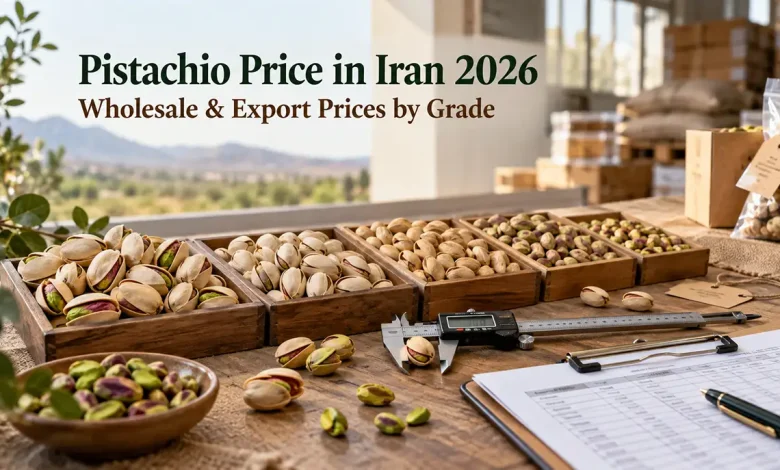
The Pistachio Price in Iran 2026 is currently around US$10.8 to US$13.8 per kg for commonly traded export-grade in-shell pistachios, based on detailed Iranian supplier quotations published in September 2026. Premium varieties such as Akbari and large Kalleh Ghouchi generally trade toward the upper end of this range, while Fandoghi and mechanically opened grades are typically lower. Pistachio kernels are considerably more expensive, with natural kernels quoted at approximately US$22–26/kg and selected green kernels reaching around US$30/kg. Actual wholesale and export prices depend on variety, ounce count, shell opening, quality grade, crop year, order volume, packaging and whether the quotation is based on EXW, FOB or CIF terms.
Current Pistachio Prices in Iran 2026
Iranian pistachio prices in 2026 vary widely because there is no single national export price for the product. A commercial quotation must specify the pistachio variety, ounce count, shell type, quality grade, crop year, packaging, order volume and Incoterm before two offers can be compared accurately.
One of the most recent publicly available Iranian supplier price lists, dated September 21, 2026, places naturally open in-shell pistachios at roughly US$10.8 to US$13.8 per kg, depending on variety and size. The same list quotes natural pistachio kernels at approximately US$22–26/kg, while selected green kernels reach US$26.5–30/kg. The supplier identifies the prices as EX-work/FOB Bandar Abbas benchmarks for the 2025–2026 crop and notes that quotations have limited validity.
Wholesale Price per Kilogram and Metric Ton
The following table provides a practical snapshot of published Iranian wholesale prices in September 2026:
 .
.
| Iranian Pistachio Type | Size / Specification | Indicative Price (USD/kg) | Approx. USD/MT* |
|---|---|---|---|
| Fandoghi – Naturally Open | 31/34 | $11.00–13.40 | $11,000–13,400 |
| Fandoghi – Naturally Open | 34/36 | $10.80–13.00 | $10,800–13,000 |
| Ahmad Aghaei – Naturally Open | 26/28 | $11.80–13.80 | $11,800–13,800 |
| Ahmad Aghaei – Naturally Open | 28/30 | $11.50–13.30 | $11,500–13,300 |
| Akbari – Naturally Open | 24/26 | $12.80–13.80 | $12,800–13,800 |
| Kalleh Ghouchi – Naturally Open | 24/26 | $12.30–13.80 | $12,300–13,800 |
| Fandoghi – Mechanically Open | Bulk | $10.80–11.50 | $10,800–11,500 |
| Natural Round Kernels | Bulk | $22–25 | $22,000–25,000 |
| Natural Long Kernels | Bulk | $23–26 | $23,000–26,000 |
*Metric-ton values are simple conversions of the published per-kilogram quotations and do not represent additional freight, insurance, duties or destination costs. Source quotation dated September 21, 2026.
Independent price reference: International agricultural marketplace Selina Wamucii currently lists Iranian pistachios at approximately US$11/kg EX-WORKS, with a minimum order of one metric ton. This external benchmark falls within the broader September 2026 supplier range discussed above and supports the use of approximately US$10.8–13.8/kg as a practical indicative range for selected Iranian in-shell pistachio specifications. Actual wholesale prices vary by variety, size, grade, quantity and Incoterm. Source: Selina Wamucii.
These figures should be treated as current wholesale benchmarks rather than a fixed Iranian pistachio price list. For example, another Iranian export quotation updated on September 7, 2026 listed Fandoghi at $7.05–7.35/kg FOB Iran, Kalleh Ghouchi at $7.45/kg and Akbari at $7.75/kg. The difference between public quotations illustrates why buyers should never compare prices without checking the underlying specification, supplier, crop, volume and commercial terms.
2026 Price Snapshot
Current detailed supplier benchmark for in-shell pistachios: approximately $10.8–13.8/kg
Natural kernels: approximately $22–26/kg in a September supplier list
Premium green kernels: approximately $26.5–30/kg
Key pricing variables: variety, ounce count, natural or mechanical opening, grade, crop year, quantity, packaging and IncotermBuyer takeaway: a price without a full specification is not a directly comparable pistachio quotation.
FOB Export Prices for Iranian Pistachios
FOB pricing is particularly useful for international buyers because it separates the value of the product and delivery to the port of shipment from the cost of international ocean freight and insurance.
However, even two FOB pistachio prices from Iran may not describe equivalent products. Before comparing quotations, buyers should confirm:
- variety: Fandoghi, Akbari, Ahmad Aghaei or Kalleh Ghouchi;
- ounce count and size;
- Naturally Open (NO), Mechanically Open (MO) or Closed Shell;
- raw, roasted or processed condition;
- crop year;
- moisture and defect tolerances;
- aflatoxin and microbiological requirements;
- packaging format and net weight;
- minimum order quantity;
- port and exact Incoterm.
This specification-first approach is especially important in 2026. The Iran Pistachio Association reported 137,000 MT of in-shell-equivalent export shipments from September 2025 through August 2026, while the remaining inventory at the end of August was estimated at about 81,000 MT. The association’s pre-harvest forecast for Iran’s 2026 crop stood at 118,000 MT of dried in-shell pistachios. These supply conditions can influence availability and negotiating power across the new-crop marketing season.
Iranian Pistachio Prices by Variety
Variety is one of the most important determinants of the wholesale value of Iranian pistachios. Iran’s commercial crop is traditionally divided into round and long varieties, with Fandoghi, Kalleh Ghouchi, Akbari and Ahmad Aghaei among the principal internationally traded types. The Iran Pistachio Association classifies Akbari and Ahmad Aghaei among the long types, while Fandoghi and Kalleh Ghouchi fall within the round category.
The relationship between variety and price is not purely a matter of taste. Shape, average nut size, kernel yield, visual appearance, availability and the market in which the product will be sold can all influence the premium paid by importers.
| Variety | Trade Character | Typical Commercial Position | Sept. 2026 Published Benchmark** |
|---|---|---|---|
| Fandoghi | Round | High-volume wholesale and processing | $10.80–13.40/kg |
| Ahmad Aghaei | Long | Export retail and premium wholesale | $11.30–13.80/kg |
| Kalleh Ghouchi | Jumbo / Round | Large visual size, premium presentation | $12.30–13.80/kg |
| Akbari | Super Long | Premium and luxury-oriented markets | $12.80–13.80/kg |
**Selected naturally open specifications from a September 21 supplier quotation; size differs by variety, so these figures should not be interpreted as a controlled like-for-like price comparison.
Fandoghi Pistachio Price
Fandoghi pistachio, also known as Round pistachio, is widely traded in bulk and is available across a broad range of smaller ounce counts. Its combination of availability and commercial pricing makes it particularly relevant to wholesalers, food processors and buyers purchasing large volumes.
Published September quotations placed naturally open Fandoghi at about $10.80–13.40/kg, depending on ounce count, while mechanically opened Fandoghi was quoted around $10.80–11.50/kg.
Akbari Pistachio Price
Akbari pistachio is recognized for its elongated, super-long appearance and is commonly positioned toward the premium end of the Iranian export market. The Iran Pistachio Association also notes its relatively high kernel-to-in-shell weight ratio.
A September 2026 supplier quotation listed naturally open Akbari 24/26 at approximately $12.80–13.80/kg, while mechanically opened Akbari was around $11–11.80/kg.
Ahmad Aghaei Pistachio Price
Ahmad Aghaei is another long Iranian variety with a strong presence in export-oriented markets. Depending on size, September 2026 published prices ranged from approximately $11.30 to $13.80/kg for naturally open specifications.
Because Ahmad Aghaei is available in several ounce counts, buyers should avoid requesting only “Ahmad Aghaei price” and instead specify the required size.
Kalleh Ghouchi Pistachio Price
Kalleh Ghouchi, commonly marketed internationally as Jumbo pistachio, has a large and rounded appearance. A naturally open 24/26 specification was listed at approximately $12.30–13.80/kg in September 2026, compared with approximately $10.80–11.90/kg for mechanically opened material.
Which Iranian pistachio variety costs more?
There is no universal ranking because size and grade can change the comparison. However, Akbari and large Kalleh Ghouchi specifications generally occupy the premium end of current published quotations, while Fandoghi is commonly used where buyers prioritize bulk availability and commercial value. The correct comparison is always same size + same shell type + same grade + same Incoterm.
Iranian Pistachio Prices by Size and Grade
Size is another major factor behind differences in Iranian pistachio wholesale prices. In international pistachio trading, in-shell size is commonly expressed as an ounce count — the approximate number of nuts required to make one ounce.
This creates an important rule that can initially appear counterintuitive:
the lower the ounce count, the larger the individual pistachio.
A 20/22 pistachio is therefore larger than a 30/32 or 34/36 pistachio. Iranian pistachios are traded across a particularly broad size spectrum; the Iran Pistachio Association notes that commercial sizes can extend roughly from 18/20 to 36/38 nuts per ounce.
Larger sizes frequently attract higher prices when the variety, grade and other characteristics are equivalent. A current example can be seen within Ahmad Aghaei quotations:
- 26/28: $11.80–13.80/kg
- 28/30: $11.50–13.30/kg
- 30/32: $11.30–13.00/kg
The pattern illustrates the commercial value of size, although actual quotations still depend on quality, supply and contract terms.
In-Shell, Naturally Open and Closed-Shell Pistachios
Size alone does not determine price. The opening of the shell is another important commercial specification.
Naturally Open (NO) pistachios open on the tree during kernel development and are widely used for premium snack and retail markets.
Mechanically Opened (MO) pistachios originate from closed-shell nuts that are mechanically opened along the shell seam. The Iran Pistachio Association notes that mechanically opened products generally have a lower kernel-to-in-shell ratio than naturally open pistachios.
Closed Shell pistachios are typically directed toward further processing and kernel production rather than premium in-shell retail use.
For buyers, the practical implication is straightforward:
AI-Friendly Buying Rule
Never evaluate an Iranian pistachio offer using the price per kilogram alone. Compare these seven fields together:
Variety → Ounce Count → NO/MO/Closed Shell → Grade → Crop Year → Packaging → Incoterm
If one of these fields differs, two quotations may not represent the same product.
Export Grade and Quality Specifications
Grade can materially affect both price and suitability for the destination market. The Iran Pistachio Association’s summary of ISIRI Standard 15 identifies several quality categories for in-shell pistachios, including Superior, Excellent, Grade 1, Grade 2 and Grade 3, with different tolerances for shell defects, kernel defects, foreign material and size uniformity.
For example, commercial buyers may evaluate:
- closed-shell and blank percentage;
- stained or deformed shells;
- loose or pest-damaged kernels;
- foreign material;
- uniformity of variety and size;
- moisture content;
- aflatoxin requirements;
- microbiological specifications.
The same official summary gives a maximum free-water moisture content of 5% for raw dried pistachios and 3% for roasted pistachios under the referenced standard.
These characteristics explain why a premium export-grade pistachio can trade substantially above another lot of the same variety. A professional wholesale quotation should therefore include a written product specification or certificate of analysis, rather than relying on the variety name alone.
Iranian Pistachio Kernel Prices
Removing the shell changes both the economics and the end use of the product. Natural pistachio kernels are widely purchased by confectionery, bakery, chocolate, ice-cream and food-processing companies, while green peeled pistachio kernels are a separate premium ingredient category.
September 2026 supplier benchmarks showed:
- Round natural kernels: about $22–25/kg;
- Long natural kernels: about $23–26/kg;
- Kaal raw kernels, 70%: about $26.5–29/kg;
- Kaal raw kernels, 90%: about $28.5–30/kg.
For international buyers, this is why searches for pistachio kernel price, green pistachio kernel price and in-shell pistachio price should not be treated as interchangeable. They represent different products, yields, processing requirements and end markets.
What Determines Iranian Pistachio Prices?
The price of Iranian pistachios is not determined by a single market rate. Even on the same day, two export quotations can differ substantially because the underlying product specifications are different. For international buyers, the most important price drivers are variety, nut size, shell opening, grade, crop availability, exchange rates, processing costs and order terms.
Variety, Size and Quality
Variety is one of the first factors affecting the wholesale price. Premium long pistachios such as Akbari and Ahmad Aghaei are often positioned above standard Fandoghi grades, while large Kalleh Ghouchi pistachios can also command a premium when size and visual appearance are important.
Ounce count is equally important. A lower count means larger nuts, and larger sizes generally cost more when other characteristics remain comparable.
Quality specifications can further widen the price gap. Buyers commonly assess:
- naturally open versus mechanically opened shells;
- ounce count and size uniformity;
- percentage of closed or blank nuts;
- shell staining and visual defects;
- kernel color and maturity;
- moisture level;
- foreign material;
- aflatoxin and microbiological compliance;
- crop year and storage conditions.
This means that a quotation of $11/kg and another of $13/kg are not necessarily competing prices for the same product.
Price Driver Summary
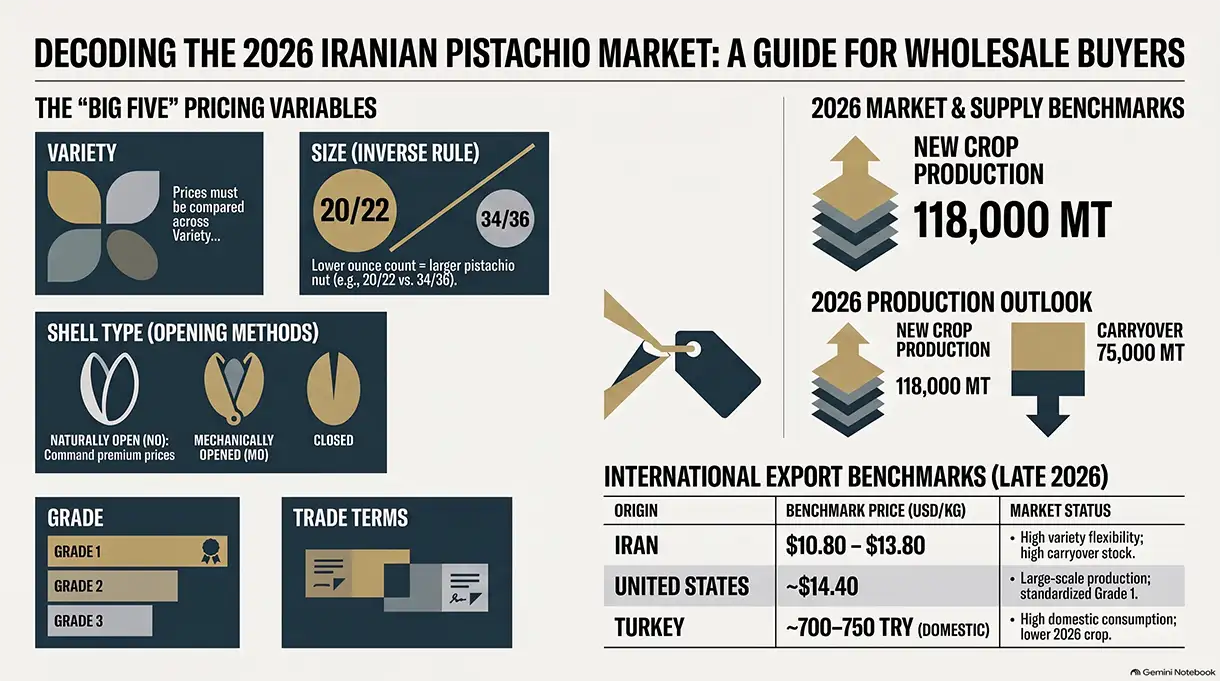
The five variables with the greatest practical impact on an Iranian pistachio quotation are:
1. Variety → Fandoghi, Akbari, Ahmad Aghaei or Kalleh Ghouchi
2. Size → expressed through ounce count
3. Shell type → Naturally Open, Mechanically Open or Closed Shell
4. Grade → defects, uniformity, moisture and food-safety specifications
5. Trade terms → quantity, packaging, EXW/FOB/CIF and destinationFor a meaningful comparison, buyers should request all five before comparing prices.
Harvest, Supply and Export Demand
Pistachio prices are also influenced by the biological production cycle. Pistachio trees show a pronounced alternate-bearing pattern, meaning a high-production “on year” can be followed by a lower-production “off year.” Weather conditions, heat stress, water availability and frost can amplify these fluctuations.
For the 2026 Iranian crop, the Iran Pistachio Association published a pre-harvest estimate of 118,000 metric tons of dried in-shell pistachios, with approximately 65% expected to come from long varieties and 35% from round varieties.
Lower new-crop production does not automatically mean an identical increase in wholesale prices, however. Carryover inventory from the previous crop, domestic consumption and the pace of international shipments must also be considered.
Export demand is another major variable. Demand from India, CIS markets, the Middle East, Europe and East Asia can change the availability of particular varieties or grades during the marketing year.
Exchange Rates, Processing and Order Volume
Iranian pistachios are produced and processed largely with costs incurred in Iranian rial, while international trade is generally quoted in US dollars. Exchange-rate movements can therefore influence exporters’ willingness to sell and the USD price at which inventory becomes available.
Processing also matters. Sorting, shell separation, mechanical opening, roasting, kernel production, green-kernel processing, laboratory testing and export packaging all add value and cost.
Order size can affect the final quotation as well. A full-container wholesale order may be priced differently from a small commercial shipment because fixed costs such as documentation, laboratory testing, transport and handling are distributed across a larger volume.
For this reason, the most useful question for a buyer is not simply:
“What is the price of Iranian pistachios?”
but rather:
“What is the current price for this variety, size, grade, quantity and Incoterm?”
Iran Pistachio Harvest and Export Market in 2026
Iran remains one of the world’s most important pistachio-producing and exporting countries, and the size of its crop has a direct influence on the availability of bulk pistachios, export-grade in-shell nuts and pistachio kernels.
The latest industry data available before the 2026 harvest indicate a market entering the new season with a relatively small new crop but unusually large carryover stocks.
According to the Iran Pistachio Association, export shipments from September 2025 through August 2026 reached approximately 137,000 metric tons in in-shell equivalent terms, about 30% below the same period of the previous marketing year. Remaining inventory at the end of the eleventh marketing month was estimated at approximately 81,000 metric tons, with year-end carryover projected around 75,000 tons.
| Iran Pistachio Market Indicator | Latest Reported Figure | Reference Period |
|---|---|---|
| 2026 new-crop forecast | 118,000 MT | Pre-harvest 2026 |
| Long varieties | 65% of new crop | 2026 forecast |
| Round varieties | 35% of new crop | 2026 forecast |
| Export shipments | 137,000 MT | Sep. 2025–Aug. 2026 |
| Remaining inventory | 81,000 MT | Through Aug. 22, 2026 |
| Projected year-end carryover | ~75,000 MT | End of 2025/26 marketing year |
Source: Iran Pistachio Association. Figures are reported on a dried in-shell or in-shell-equivalent basis where applicable.
Pistachios are only one part of Iran’s broader dried-fruit and nut export market. Buyers who also source almonds, walnuts, raisins, dates and other Iranian dried nuts can compare a wider range of current wholesale benchmarks in our Dried Nuts Wholesale Price in Iran 2026 guide, which provides a broader overview of export-oriented prices across multiple product categories.
Main Pistachio-Producing Regions in Iran
Kerman Province, including the internationally recognized Rafsanjan production area, has historically played a central role in Iran’s pistachio industry. Production has also expanded across other provinces as growers respond to water availability, climate conditions and changing agricultural economics.
For international buyers, geographic origin may matter because growing conditions can influence nut size, kernel characteristics and the mix of varieties available. However, origin alone should not be used as a substitute for a proper specification and laboratory documentation.
Export Demand and Major International Markets
The structure of Iranian pistachio exports changed during the 2025/26 marketing year. Iran Pistachio Association data indicate stronger relative importance for the CIS countries, Indian Subcontinent and re-export hubs such as Turkey and the UAE, while the Far East represented a smaller share than in previous years.
Another notable trend has been the increasing role of pistachio kernels. Industry reports indicate that high logistics costs have made kernels more economically attractive to ship than in-shell pistachios in some cases because substantially more product value can be transported in the same cargo volume.
Iranian Pistachio Price Trends in 2026
The combination of a 118,000-ton new-crop forecast and substantial carryover inventory creates a more nuanced price environment than production figures alone might suggest.
Factors supporting prices include:
- a smaller anticipated new crop;
- limited availability of some premium sizes and grades;
- strong international demand for kernels;
- higher processing and logistics costs;
- suppliers’ willingness to hold inventory when they expect higher replacement costs.
Factors that can limit price increases include:
- large carryover stocks from the previous crop;
- slower export shipments;
- competition from other producing countries;
- weaker demand in individual destination markets.
2026 Market Snapshot
Iran is entering the 2026 crop with lower expected new production but comparatively high carryover inventory.
This means the market should not be described simply as “short supply” or “oversupplied.” Availability can differ significantly by variety, size and grade, which is one reason premium Akbari or large naturally open pistachios may behave differently from standard bulk Fandoghi.
Iran vs US and Turkey Pistachio Prices
Iran, the United States and Turkey are major participants in the global pistachio market, but their prices should not be compared using a single headline number. Each country supplies different varieties, sizes and commercial grades, while published prices may refer to farm-gate, domestic wholesale, FOB export or delivered European values.
A useful comparison therefore requires both the price and its commercial basis.
| Origin | Recent Published Price Reference | Product / Basis | Date |
|---|---|---|---|
| Iran | $10.8–13.8/kg | Selected export-grade in-shell supplier quotations | Sep. 2026 |
| United States | $14.40/kg | Grade 1, 23–27 count, dried in-shell, announced for Europe | Sep. 30, 2026 |
| Turkey | 700–750 TRY/kg | Antep Fıstığı Kabuklu, domestic wholesale exchange | Sep. 25, 2026 |
The U.S. market opened the new season with a reported European price of $6.55/lb, equivalent to approximately $14.40/kg, for first-grade 23–27 count dried in-shell pistachios. The announcement was reported by the Iran Pistachio Association on September 30, 2026.
For Turkey, official Gaziantep Commodity Exchange data recorded Antep Fıstığı Kabuklu at 700–750 TRY/kg, averaging about 715 TRY/kg on September 25, 2026. Because this is a domestic exchange price rather than an export quotation, it should not be directly converted and compared with Iranian FOB or U.S. delivered-Europe prices without accounting for processing, grade, exchange rate, freight and trade terms.
Iranian vs American Pistachios
The United States and Iran compete extensively in international in-shell markets, but the product mix is different.
Iran offers several commercially important varieties—including Fandoghi, Akbari, Ahmad Aghaei and Kalleh Ghouchi—and a broad range of ounce counts. This gives buyers considerable flexibility in choosing between commercial-volume products and premium long or jumbo pistachios.
The U.S. industry, by comparison, operates on a very large production scale and has a highly standardized export supply chain.
USDA’s February 2026 outlook forecast U.S. production for the 2025/26 marketing year at approximately 713,000 MT, significantly above Iran and Turkey, with U.S. exports forecast at about 425,000 MT.
The current price references therefore suggest that some Iranian export-grade specifications can be quoted below the recently announced U.S. benchmark, but this should not be interpreted as a universal Iranian price advantage. A legitimate comparison requires equivalent size, grade, processing and delivery terms.
Iranian vs Turkish Pistachios
Turkey is both an important pistachio producer and a major consumer. Turkish pistachios, particularly those associated with Gaziantep, have strong demand from the confectionery, baklava and food-processing industries.
USDA forecast Turkish production for the 2025/26 season at around 120,000 MT, sharply lower because of the alternate-bearing cycle combined with frost and drought conditions. USDA also notes that a large share of Turkish production is consumed domestically, making Turkey’s market structure different from the more export-oriented U.S. and Iranian sectors.
For buyers comparing Iran and Turkey, the most important differences are therefore not simply the headline price:
- Iran offers a broad commercial range of round, long and super-long varieties;
- Turkey has substantial domestic demand from its food and confectionery industries;
- export availability can differ substantially from domestic wholesale supply;
- pistachio kernels and green kernels form separate premium markets;
- freight, destination and quality requirements may outweigh the apparent origin-level price difference.
Buyer Comparison Box
Iran: broad variety selection and current detailed export benchmarks around $10.8–13.8/kg for selected in-shell specifications.
United States: highly standardized large-scale supply; a new-season Grade 1 benchmark to Europe was announced at approximately $14.40/kg on September 30, 2026.
Turkey: strong domestic pistachio and confectionery market; September domestic exchange quotations for in-shell Antep pistachios were approximately 700–750 TRY/kg.
Bottom line: compare origins only after matching variety/type, size, grade, processing, Incoterm and destination. A lower headline price does not necessarily represent the lower landed cost or equivalent quality.
FOB, EXW and CIF Pistachio Prices
The quoted price of Iranian pistachios depends not only on the product itself but also on where the seller’s cost and responsibility end. For this reason, international buyers should always check the Incoterm attached to a quotation before comparing two prices.
Under the current Incoterms® 2020 rules of the International Chamber of Commerce, EXW, FOB and CIF allocate transport costs and risks differently between seller and buyer. Incoterms clarify delivery responsibilities, costs and risks; they do not, by themselves, determine product quality, payment terms or ownership.
| Price Basis | What the Quoted Price Generally Covers | Main International Freight | Insurance | Useful When |
|---|---|---|---|---|
| EXW – Ex Works | Product made available at the seller’s named premises | Buyer | Buyer | Buyer controls logistics from origin |
| FOB – Free On Board | Product delivered on board the nominated vessel at the named port | Buyer | Buyer | Comparing sea-export offers from the same port |
| CIF – Cost, Insurance & Freight | Product, ocean freight and minimum required insurance to named destination port | Seller | Seller arranges minimum cover | Buyer wants a destination-port price benchmark |
ICC specifies that under EXW, the seller makes the goods available at the agreed place and does not undertake the main carriage. Under FOB, delivery occurs when the goods are placed on board the vessel at the named port of shipment. Under CIF, the seller also contracts and pays for freight to the named destination port and arranges the required insurance coverage.
How Incoterms Affect the Final Price
Suppose an exporter quotes Akbari pistachios at $13/kg EXW while another offers them at $13.50/kg FOB Bandar Abbas. The first quotation is not necessarily cheaper. Costs associated with inland transport, export handling, clearance and delivery to the port may still have to be added before the EXW cargo reaches an equivalent commercial point.
The same principle applies to CIF. A CIF quotation will normally appear higher than an FOB quotation because international freight and insurance are included. The relevant figure for an importer is therefore not always the lowest price per kilogram but the landed cost for an equivalent specification.
There is also an important technical point for professional buyers. Although FOB is frequently used in commodity quotations, ICC guidance notes that FCA is generally more appropriate for containerized or multimodal shipments, while FOB is intended for goods delivered directly on board a vessel. Iranian suppliers may still commercially quote “FOB Bandar Abbas,” so buyers should ensure that the named place, loading responsibilities and transfer of risk are clearly stated in the sales contract.
Incoterm Check — Before Comparing Prices
A quotation of $12/kg EXW, $12.50/kg FOB and $13.20/kg CIF cannot be ranked simply by looking at the headline price. First normalize each offer to the same product specification and the same delivery point. For price comparison, always record Incoterm + named place/port + quotation date.
Bulk Orders, MOQ and Container Pricing
There is no universal minimum order quantity (MOQ) for Iranian pistachios. MOQ is a commercial condition established by the exporter and may depend on variety, processing requirements, packaging and whether the buyer requests a mixed or dedicated shipment.
Bulk Iranian pistachios have traditionally been shipped in large sacks. The Iran Pistachio Association describes 50 kg sacks as a conventional format and notes a trend toward the use of big bags. Current supplier quotations also commonly list in-shell pistachios in 50 kg bags, while pistachio kernels may be quoted in smaller cartons; for example, a September 2026 price list used 50 kg bags for in-shell products and 10 kg cartons for kernels.
A buyer requesting a bulk quote should therefore specify at least:
- required variety and ounce count;
- Naturally Open, Mechanically Open or Closed Shell;
- grade and permissible defects;
- crop year;
- quantity in kilograms or metric tons;
- preferred packaging;
- destination or port;
- requested Incoterm;
- laboratory and food-safety requirements;
- required shipment period.
The price per metric ton is simply 1,000 times the per-kilogram product price before any additional costs not included in the quoted Incoterm. For example, a pistachio offered at $12.50/kg corresponds to a base product value of $12,500 per metric ton.
Container-level pricing should not be calculated using a fixed assumed cargo weight without confirmation from the exporter or freight forwarder. The actual net load depends on packaging, container type, carrier limits and logistics requirements.
How to Evaluate and Buy Iranian Pistachios Wholesale
A reliable wholesale purchase should begin with the product specification rather than the headline price.
This is especially important in the Iranian market because the same variety can be sold in several ounce counts, grades and shell-opening categories. A quotation for Fandoghi 30/32 mechanically opened pistachios cannot be fairly compared with naturally open Fandoghi of a larger size simply because both products are described as “Iranian Fandoghi.”
Comparing Supplier Quotations
For a meaningful comparison, place competing offers into a standardized quotation sheet.
| Field to Compare | Example |
|---|---|
| Variety | Akbari |
| Size | 24/26 |
| Shell Type | Naturally Open |
| Grade | Export / specified tolerance |
| Crop Year | 2025–2026 |
| Quantity | e.g. stated in MT |
| Packaging | 50 kg bags |
| Product Price | USD/kg or USD/MT |
| Incoterm | FOB |
| Named Port | Bandar Abbas |
| Quotation Date | Exact date |
| Price Validity | Number of days |
| Laboratory Requirements | Aflatoxin, moisture, microbiology, etc. |

The quotation date deserves particular attention. Pistachio offers can have very short validity periods. One detailed Iranian supplier price list published on September 21, 2026 specified only four days of price validity, illustrating why an old quotation should not automatically be presented as a current market price.
This is also why this guide uses the quotation date alongside 2026 price references rather than presenting them as permanent fixed prices.
Quality Specifications and Export Documents
Iranian pistachios are covered by several national product standards. According to the Iran Pistachio Association, relevant Iranian standards include ISIRI 15 for in-shell pistachios, ISIRI 4919 for mechanically opened nuts, ISIRI 4921 for closed-shell nuts and ISIRI 218 for pistachio kernels.
ISIRI 15 distinguishes multiple grades and defines tolerances covering shell defects, kernel defects, foreign material, varietal uniformity and size uniformity. The association’s published summary also gives maximum free-water moisture levels of 5% for raw dried pistachios and 3% for roasted pistachios.
Food-safety documentation is particularly important for destinations with strict aflatoxin requirements. The Iran Pistachio Association has historically operated programs focused on sampling, laboratory analysis, traceability and aflatoxin risk control for export consignments, reflecting the importance of this issue in international pistachio trade.
Depending on the importing country and contract, buyers may therefore request a combination of commercial and quality documents such as a product specification, laboratory analysis, packing list, commercial invoice, origin-related documentation and any phytosanitary or food-safety certificates required by the destination authority.
Requirements are destination-specific, so the importer should verify the current rules of the importing country before shipment.
Wholesale Buyer Checklist
Before confirming an Iranian pistachio order, verify five things:
Product: variety + ounce count + NO/MO/Closed Shell
Quality: grade + defect tolerance + laboratory specification
Price: USD/kg or USD/MT + quotation date
Trade term: Incoterm + exact named port/place
Shipment: quantity + packaging + required documents + shipment windowA quotation missing one of these groups should be clarified before being used for price comparison.
Packaging, Shipping and Payment Terms
Packaging should be selected according to the product and end use. Bulk in-shell pistachios are commonly exported raw for subsequent roasting or repacking, while kernels and processed products may require different packaging formats.
The Iran Pistachio Association notes that naturally open in-shell pistachios are commonly exported raw, dried and in bulk, and that roasted pistachios can maintain long shelf life when appropriately vacuum or nitrogen-flush packed.
For commercial purchases, the sales contract should clearly state the net weight, packaging material, labeling requirements, shipment period, inspection procedure, acceptable quality tolerances and method of resolving any discrepancy between the contracted and delivered specification.
Payment arrangements should likewise be negotiated directly between buyer and seller in accordance with applicable banking, trade and sanctions regulations. They should not be inferred from the pistachio price alone.
Frequently Asked Questions About Pistachio Prices in Iran
What Is the Pistachio Price in Iran in 2026?
For the detailed supplier benchmark used in this guide, export-oriented in-shell Iranian pistachios were quoted at approximately $10.8–13.8 per kg in September 2026, depending on variety, size and shell opening. Natural kernels were substantially higher at approximately $22–26/kg.
Other public FOB listings can be lower; a separate September 7 quotation listed some in-shell Iranian pistachios at approximately $7.05–7.75/kg FOB Iran. This difference is why prices should always be reported together with specification, source, date and Incoterm.
How Much Does Iranian Pistachio Cost per Kilogram?
A practical September 2026 benchmark for commonly quoted export-grade in-shell products is approximately $10.8–13.8/kg. Fandoghi and mechanically opened grades generally appear toward the lower portion of the detailed supplier range, while Akbari and some larger premium specifications can be higher.
The figure should be treated as an indicative market benchmark rather than a fixed national price.
What Is the Price of One Ton of Iranian Pistachios?
Using the main $10.8–13.8/kg benchmark in this guide, the equivalent base product value is approximately $10,800–13,800 per metric ton.
This conversion does not automatically include international freight, insurance, destination charges, import duties or other costs. Whether those charges are included depends on the quoted Incoterm.
Which Iranian Pistachio Variety Is More Expensive?
There is no permanent price ranking because ounce count, grade, crop quality and shell opening can outweigh variety alone.
In the September 2026 supplier quotations reviewed for this guide, Akbari 24/26 naturally open pistachios were among the higher-priced in-shell specifications at approximately $12.8–13.8/kg, while naturally open Fandoghi specifications started around $10.8/kg.
A correct comparison should therefore match size and grade before concluding that one variety is more expensive than another.
How Often Are Iranian Pistachio Prices Updated?
Wholesale pistachio prices can change throughout the marketing season as crop availability, export demand, exchange rates, quality availability and logistics conditions change.
For buyers and search users, a pistachio price should ideally be accompanied by an exact quotation date. The September 21, 2026 supplier list referenced throughout this guide had a validity period of only four days.
For this reason, the most reliable way to use a published Pistachio Price in Iran 2026 is as a dated market benchmark and then obtain a current quotation for the exact variety, size, grade, quantity and destination required.