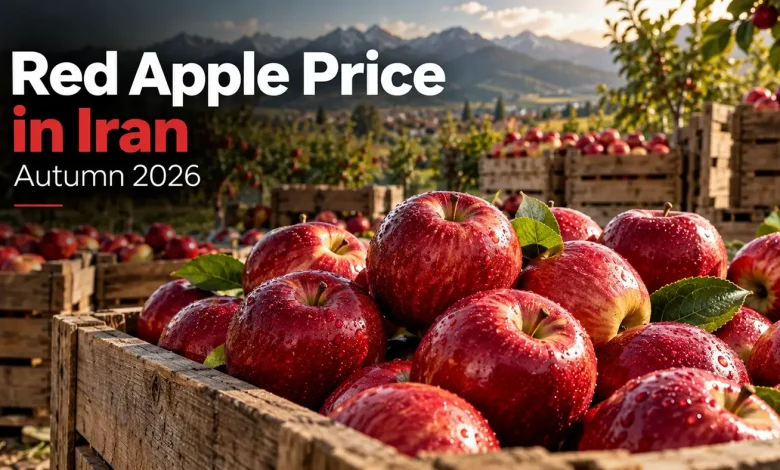
The red apple price in Iran in autumn 2026 depends on fruit variety, quality grade, purchasing volume, and market conditions. Prices paid by domestic wholesalers can differ considerably from export quotations and prices recorded in international destination markets.
For international buyers, understanding the Iranian red apple price per kg in USD is particularly important when comparing suppliers, negotiating bulk orders, and calculating import costs. This guide examines available price benchmarks, wholesale market conditions, and Iranian red apple export prices using international trade platforms and market data.
Red Apple Price in Iran in Autumn 2026 (Updated Price per Kg)
Iran is an established producer and exporter of fresh apples, including Red Delicious and other red-skinned varieties. However, there is no single nationwide price for red apples, and independently verified domestic quotations for autumn 2026 are not consistently available from international market databases.


International trade records and destination-market quotations provide useful reference points. These figures must be interpreted according to their reporting dates and market levels.
 .
Current Red Apple Prices per Kg in Iran
The following table presents publicly available price indicators for Iranian-origin red apples. All prices are expressed in US dollars per kilogram for easier international comparison.
| Product | Market / Price Basis | Price (USD/kg) | Reference Period |
|---|---|---|---|
| Iranian Red Apples | Dubai Al Aweer Wholesale Market | $0.74 | October 20, 2026 |
| Iranian Red Delicious | Reported Trade Flows to India | $0.63 | June 2026 |
| Iranian Red Delicious | Sample Export Transactions to India | $0.58–$0.61 | March 2026 |
Sources:
Al Aweer Market – Red Apple Wholesale Prices | Tridge – Red Delicious Apple Trade Data, June 2026 | Tridge – Iranian Red Delicious Apple Market | Central Bank of the UAE – Exchange Rate Reference.

Important: The Dubai figure represents the wholesale price of Iranian-origin red apples in the UAE, not the farm-gate or wholesale price inside Iran. The March and June transaction figures are historical trade observations, not autumn 2026 quotations. Therefore, these figures should not be treated as directly comparable domestic prices.
Domestic Red Apple Wholesale Prices in Tehran – October 2026
To provide a domestic benchmark for the red apple price in Iran, the following table presents wholesale prices reported from Tehran’s Central Fruit and Vegetable Market for the week of September 28 to October 4, 2026. The original Iranian toman quotations have been converted into US dollars per kilogram.
| Apple Category | Wholesale Price (USD/kg) | Market | Reference Date |
|---|---|---|---|
| Gala Apples | $0.63 | Tehran Central Wholesale Market | October 3, 2026 |
| Red and Yellow Lebanese-Type Apples (Combined Category) | $0.31 | Tehran Central Wholesale Market | October 3, 2026 |
Sources:
Nabz Gheymat – Tehran Central Wholesale Fruit Market Price Report, October 3, 2026 | Artesh – Historical USD/IRR Open-Market Exchange Rates.
Conversion methodology: USD prices were calculated using the indicative October 3, 2026 open-market exchange rate of 1 USD = 254,900 Iranian tomans. Figures are rounded to two decimal places. The Lebanese-type apple quotation covers red and yellow apples as a combined category; it is not a separately observed Red Delicious price.
Market interpretation: These figures represent reported domestic wholesale benchmarks, not export quotations or guaranteed transaction prices. Actual prices may vary with apple variety, grade, size, and trading conditions.
Red Apple Price in US Dollars (USD)
Expressing Iranian apple prices in US dollars helps international buyers compare agricultural products across different exporting countries. Nevertheless, currency conversion alone does not make two prices economically equivalent.
For example, an apple price recorded in a destination market may include international transportation, import handling, local distribution, and other expenses that would not be included in the original producer’s selling price.
In October 2026, Dubai’s Al Aweer market reported an indicative wholesale price equivalent to approximately $0.74 per kilogram for red apples originating from Iran. This USD value was calculated from the published local-market quotation using the UAE dirham’s official exchange-rate relationship with the US dollar.
Importers should compare quotations on the same basis, including fruit grade, net weight, packaging, delivery conditions, and transaction date.
Price Data Sources and Last Updated Date
Market review date: October 20, 2026.
This article uses internationally accessible market references, including Al Aweer wholesale prices, Tridge trade statistics, and supplier quotations published on international B2B platforms.
These sources represent different types of pricing information. A wholesale-market observation reflects a particular trading location, while an export transaction unit value reflects a reported trade record. Supplier advertisements, meanwhile, indicate asking prices rather than independently confirmed completed transactions.
Some international databases display recently updated pages while their underlying agricultural prices refer to earlier years. For this reason, the original reference period must always be checked before interpreting a figure as a current market price.
The tables in this article distinguish autumn 2026 observations from historical benchmarks and undated supplier offers. Buyers should request updated quotations before making commercial decisions.
Price Review: Iranian Red Apples in Autumn 2026
There is no single independently verified nationwide red apple price in Iran for autumn 2026. Available international market data provide the following reference points:
Tehran wholesale benchmark: On October 3, 2026, Gala apples were quoted at approximately $0.63/kg, while the combined red and yellow Lebanese-type apple category was quoted at $0.31/kg. These are domestic wholesale price references, not export quotations.
$0.74/kg: Iranian-origin red apples in Dubai’s Al Aweer wholesale market on October 20, 2026. This is a destination-market price, not a domestic Iranian quotation.
$0.63/kg: Reported trade unit value for Iranian Red Delicious apples exported to India in June 2026. This is historical trade data, not an autumn price.
Key takeaway: Domestic wholesale prices, export transaction values, and foreign-market prices must be compared separately, with attention to product grade, date, and delivery conditions.
Red Apple Wholesale Price in Iran
The red apple wholesale price in Iran is influenced by harvest volume, regional supply, fruit quality, storage conditions, and order size. Iranian apples are supplied through orchard-level transactions, packing facilities, regional wholesalers, and central wholesale markets.
Iranian red apple prices can be classified into three main market levels:
- Farm-gate price: The price paid to the grower, generally before downstream sorting, packaging, and distribution expenses.
- Domestic wholesale price: The price in wholesale trading channels, potentially reflecting transportation, grading, storage, and intermediary costs.
- Export-ready price: The quoted price for apples prepared for international shipment, depending on fruit grade, packaging, and agreed delivery terms.
Wholesale vs Retail Red Apple Prices
Wholesale apple transactions generally involve larger quantities than retail purchases. Wholesalers typically acquire apples in crates, cartons, pallets, or truckloads, while retailers sell smaller quantities to individual consumers.
Retail prices may incorporate additional costs related to sorting, packaging, transportation, storage, shop operations, and product losses. Premium apples sold in consumer-ready packaging may also command higher prices than ordinary bulk fruit.
Consequently, a retail quotation should not be directly compared with a bulk supplier offer without accounting for variety, grade, date, and location.
Although internationally published data provide useful export-market benchmarks, a reliable autumn 2026 comparison between Iranian domestic retail and wholesale prices would require verified observations for identical products from the same period.
Farm-Gate Prices vs Wholesale Market Rates
Farm-gate prices refer to prices received by agricultural producers before some downstream marketing and distribution activities. These differ from wholesale-market prices, which may reflect transportation, grading, storage, and intermediary services.
The following historical benchmark illustrates the importance of distinguishing the underlying data date from the publication date of an international price database.
| Product Category | Market Level | Price (USD/kg) | Underlying Data Date |
|---|---|---|---|
| Iranian Apples (All Varieties) | Historical Farm-Gate Benchmark | $0.51 | January 2023 |
Source:
Selina Wamucii – Iran Apple Prices, FAOSTAT Producer Price Data.
The underlying observation is dated January 2023 and covers apples generally, rather than red apples exclusively.
This figure is included only as historical context. It should not be used as the farm-gate price of red apples in autumn 2026.
To establish a current orchard-level price, buyers should obtain quotations from Iranian producers specifying the apple variety, harvesting conditions, product grade, collection location, and responsibility for packaging and loading.
Bulk Red Apple Prices by Order Quantity
Large-volume purchases can provide opportunities to negotiate more favorable unit prices. However, the actual cost depends on more than the total quantity ordered.
For example, a supplier may quote different rates for orchard collection, packed warehouse delivery, and export-ready products. Premium fruit grading and specialized packaging can increase costs even when the order quantity is large.
International supplier platforms also show that minimum order requirements vary by seller. One Iranian red apple advertisement on ExportHub specifies a minimum purchase quantity of 20 metric tons, although its price and availability require confirmation with the supplier.
Importers requesting bulk quotations should specify the required variety, fruit diameter, color uniformity, quality grade, net weight, packing format, delivery location, and expected shipment date.
A lower advertised price is not necessarily the most economical option if the shipment involves unsuitable grading, additional packing expenses, or greater transportation risks.
Red Apple Export Price from Iran
The red apple export price from Iran is particularly relevant to international wholesalers, importers, and food distributors. Iran supplies fresh apples to regional and international markets, with export quotations reflecting differences in variety, quality specifications, shipment size, and delivery arrangements.
Export-related price information can be obtained from reported trade transactions and international supplier platforms. However, these sources measure different aspects of the market and should not be interpreted as a single official export price.
Iranian Red Apple Export Price per Kg in USD
The following table summarizes available international references for Iranian red apple exports and supplier pricing.
| Apple Type | Price (USD/kg) | Price Basis | Reference Period |
|---|---|---|---|
| Red Apple | $0.50 | ExportHub Supplier Asking Price | Undated Listing |
| Iranian Red Delicious | $0.63 | Reported Iran-to-India Trade Unit Value | June 2026 |
| Iranian Red Delicious | $0.58–$0.61 | Sample Export Transaction Unit Values | March 2026 |
Sources:
ExportHub – Iranian Red Apple Supplier Listing | Tridge – June 2026 Red Delicious Trade Flow Data | Tridge – Iran Red Delicious Export Transaction Records.
Price methodology: The ExportHub listing advertises a rate equivalent to $0.50/kg with a minimum order of 20 metric tons. Its publication date and current commercial validity are not verified. Tridge figures refer to reported trade unit values from March and June 2026. None of these observations establishes a confirmed nationwide export price for autumn 2026.
Export prices can change with apple size, color, maturity, packaging quality, refrigeration requirements, and destination-specific regulations. Buyers should request a current written quotation rather than rely exclusively on historical trade records or public supplier advertisements.
EXW, FOB and CIF Red Apple Prices Explained
International apple quotations should always specify the applicable Incoterms, because delivery responsibilities and costs can significantly affect the final purchase price.
- EXW (Ex Works): The seller makes the apples available at an agreed location. The buyer assumes extensive responsibility for collection, transportation, and other logistics arrangements.
- FOB (Free on Board): Used for sea and inland-waterway transport. The seller delivers the goods on board the nominated vessel at the named port of shipment.
- CIF (Cost, Insurance and Freight): The seller arranges and pays for transportation and the required insurance coverage to the named destination port, while risk transfers when the goods are loaded on board at the port of shipment.
For shipments transported by road or in containers, terms such as FCA, CPT, or CIP may be more appropriate, depending on the agreed logistics structure.
When comparing Iranian red apple suppliers, importers should avoid treating quotations based on different Incoterms as equivalent. An apparently inexpensive quotation may exclude costs that another supplier has already included.
Packaging and Shipping Costs for Export Buyers
Export-quality red apples require suitable grading, protective packaging, and carefully managed transportation conditions to maintain firmness, appearance, and commercial quality.
Packaging options may include corrugated cartons, protective trays, and palletized loads. The appropriate solution depends on the product grade, destination market, shipment duration, and buyer requirements.
Cold storage and refrigerated transportation can help preserve fresh apples during long-distance distribution. However, the required handling conditions should be determined according to the apple variety, maturity, and expected transit time.
For importers, the final landed cost can include the supplier’s product price, packaging expenses, domestic transportation, export documentation, freight, insurance, customs procedures, and destination handling charges.
Before confirming a purchase, buyers should request a detailed commercial quotation specifying the apple variety, size range, grade, net weight, packaging requirements, shipment route, applicable Incoterms, and expected delivery schedule.
For reliable purchasing decisions, the most useful Iranian red apple quotation is one that combines a clearly defined USD price per kilogram with transparent product specifications and delivery conditions.
Red Delicious vs Gala: Price Differences by Variety and Grade
The price of red apples in Iran can vary considerably between different apple varieties. Red Delicious is one of the country’s established commercial apple cultivars, while Gala and other red-skinned varieties offer alternatives for buyers seeking different flavors, appearances, and fruit characteristics.
For importers and wholesale distributors, understanding these differences is important when comparing Iranian apple prices per kilogram.
Red Delicious Apple Price in Iran
Red Delicious is an important apple variety cultivated in Iran, particularly in West Azerbaijan Province. Known for its deep red skin and distinctive appearance, it is commonly traded in domestic and international markets.
Its wholesale price depends on fruit diameter, color development, firmness, external defects, storage conditions, and packaging specifications.
International trade data published by Tridge provide historical price references for Iranian Red Delicious apples. However, buyers should distinguish these transaction-based figures from current domestic wholesale prices.
For accurate comparisons, importers should request quotations specifying the Red Delicious variety, grade, fruit size, shipment quantity, and delivery conditions.
Reference: Tridge – Red Delicious Apple Market and Trade Data, June 2026.
Iranian Gala and Other Red Apple Varieties
Besides Red Delicious, Iranian orchards cultivate Gala and other commercial apple varieties. Gala apples are known for their relatively sweet flavor and red-striped appearance, although their exact characteristics depend on the cultivar and growing conditions.
Gala and Red Delicious should not be treated as interchangeable products when assessing wholesale prices. Each variety has its own market demand, commercial characteristics, harvesting period, and quality specifications.
There is insufficient independently verified autumn 2026 price information to establish a consistent nationwide price premium for one variety over the other.
Reference: FAO AGRIS – Growth, Flowering Time and Quality of Twelve Apple Varieties under Urmia Climate.
How Size, Quality Grade and Color Affect Prices
Apple grading plays an important role in determining commercial value. Export buyers frequently evaluate fruit uniformity, diameter, color, firmness, maturity, and visible defects before confirming orders.
The United Nations Economic Commission for Europe (UNECE) publishes the FFV-50 standard for apples, providing internationally recognized guidance on minimum quality requirements, classification, sizing, and presentation.
Apples meeting more demanding commercial specifications may attract higher quotations because sorting can reduce the proportion of fruit eligible for a premium shipment.
However, a higher grade does not automatically establish a fixed price premium. The actual difference depends on customer requirements, market demand, and the availability of suitable fruit.
Reference: UNECE – International Fresh Fruit and Vegetable Standards.
Where Are Red Apples Grown in Iran?
Iran’s geographical diversity supports commercial apple cultivation across several agricultural regions. Climatic conditions, orchard management, irrigation, and proximity to distribution centers influence both production quality and supply-chain costs.
Major Red Apple Producing Regions in Iran
West Azerbaijan Province, particularly the Urmia region, is one of Iran’s major apple-growing areas. East Azerbaijan also contributes significantly to the country’s apple production.
A 2024 analysis by Iran Open Data identified West and East Azerbaijan as major contributors to Iran’s national apple output, using agricultural statistics and international data sources.
The concentration of orchards and packing facilities in northwestern Iran makes this region particularly important for agricultural traders seeking Iranian apples.
Reference: Iran Open Data – Apple Production in West and East Azerbaijan.
How Production Location Affects Wholesale Prices
The production region can influence the final wholesale price through transportation expenses, harvesting conditions, product availability, and access to refrigerated storage.
Buyers purchasing apples near major growing regions may have opportunities to reduce certain domestic transportation costs. However, these potential savings must be evaluated alongside grading, packing, inspection, and onward shipment expenses.
Consequently, the lowest orchard quotation does not always produce the lowest delivered price for an international buyer.
Seasonal Red Apple Price Trends in Iran
Seasonality is an important factor in understanding Iranian red apple prices. The availability of freshly harvested apples changes throughout the year, while refrigerated storage allows suppliers to distribute suitable fruit beyond the immediate harvest period.
Seasonal price fluctuations are not limited to apples. Other Iranian export fruits follow similar supply and demand patterns, although their harvest periods and market conditions differ. For a broader comparison, explore our detailed analysis of Iran kiwi prices and wholesale export rates, including USD-per-kg benchmarks and key pricing factors.
Red Apple Prices During Harvest Season
In many Iranian apple-producing regions, commercial harvesting takes place during late summer and autumn, depending on the variety, local climate, and maturity conditions.
Autumn is therefore an important purchasing period for wholesalers and exporters interested in newly harvested red apples.
Higher seasonal supply can place downward pressure on prices when demand remains unchanged. Nevertheless, the actual market outcome depends on harvest quality, domestic consumption, export orders, and storage decisions.
It would be inaccurate to assume that red apple prices always decline during autumn without reviewing market data for the relevant year.
Cold Storage Prices and Off-Season Supply
Cold storage enables suitable apples to remain available after harvesting. Controlled temperature, relative humidity, and atmospheric conditions can help maintain fruit quality during extended storage.
According to the Food and Agriculture Organization of the United Nations (FAO), appropriate storage management is essential for maintaining fresh produce quality and reducing post-harvest losses.
Apples supplied from refrigerated facilities may carry additional storage, handling, and financing costs. However, their market prices also depend on available inventory and demand.
Reference: FAO – Storage Requirements for Fresh Fruits and Vegetables.
Best Time to Buy Red Apples in Bulk
For international buyers, the best purchasing period depends on the required variety, quantity, quality grade, and delivery schedule.
Autumn can provide access to newly harvested apples, while purchases later in the season may involve cold-stored inventory.
Importers should compare quotations from different harvest and storage periods rather than assume that a particular month always offers the lowest price.
Long-term purchasing arrangements may also help buyers coordinate supply volumes and shipment schedules, although agreed prices remain subject to contractual conditions.

What Affects Red Apple Prices in Iran?
Several economic and agricultural factors influence the red apple price in Iran per kg. Understanding these variables helps buyers interpret market movements and negotiate more effectively with suppliers.
Harvest Volume and Domestic Market Supply
Apple production depends on weather conditions, irrigation availability, orchard productivity, pest management, and harvesting outcomes.
A strong harvest may increase market supply, potentially putting pressure on wholesale prices. Conversely, reduced output or quality-related losses can limit the availability of specific apple grades.
The relationship between production and price also depends on storage capacity, domestic demand, and export opportunities.
Even when total apple production is high, export-quality red apples of a particular size or color may remain relatively scarce.
Exchange Rates and Export Demand
Exchange-rate movements influence how Iranian apple prices are interpreted by foreign buyers.
Domestic transactions may be negotiated in local currency, whereas international buyers frequently compare quotations in US dollars.
Changes in exchange rates can alter the foreign-currency equivalent of local costs. However, exporters may also adjust their quotations in response to changes in packaging expenses, transportation costs, payment conditions, and competition.
Demand from foreign markets can influence the availability of export-grade apples in the domestic supply chain.
Consequently, movements in the USD value of Iranian apples cannot be explained by currency fluctuations alone.
Storage, Transportation and Packaging Costs
Post-harvest expenses contribute to the final price paid by wholesalers and international importers.
Important cost components include:
- Fruit sorting and quality inspection.
- Packaging materials and carton preparation.
- Refrigerated storage and handling.
- Domestic transportation to warehouses or export terminals.
- International freight and cargo insurance.
- Export documentation and destination-specific procedures.
Different suppliers may include different services in their quotations. Therefore, comparing two prices without examining their cost components can lead to misleading conclusions.
For commercial purchases, buyers should request a detailed breakdown of the quoted delivery conditions and product specifications.
Market Review: What Determines Red Apple Prices in Iran?
Iranian red apple prices are primarily influenced by apple variety and quality grade, harvest volume, regional supply, cold-storage availability, exchange rates, and export demand. Red Delicious and Gala apples may command different prices depending on their commercial specifications.
Autumn provides access to freshly harvested apples, particularly from major producing regions such as West Azerbaijan. However, increased seasonal supply does not necessarily guarantee the lowest wholesale prices.
Key takeaway: The most reliable price comparison uses the same apple variety, grade, order quantity, reference date, and delivery terms. Buyers should also consider packaging, refrigerated storage, and transportation costs when evaluating USD-per-kg quotations.
How to Buy Red Apples Wholesale from Iran
International buyers interested in purchasing Iranian red apples should evaluate suppliers based on price transparency, product quality, shipment capabilities, and commercial reliability.
Comparing multiple suppliers can provide a clearer picture of prevailing wholesale conditions and help identify differences in product specifications.
Finding Reliable Iranian Red Apple Suppliers
Buyers can identify potential suppliers through international agricultural trading platforms, industry networks, and direct communication with packing facilities and exporters.
Before entering into a commercial agreement, buyers should verify the supplier’s business identity, export experience, product availability, and ability to provide the required documentation.
Supplier quotations should contain clear information about the apple variety, quality grade, shipment quantity, delivery conditions, and payment requirements.
Where practical, buyers should request recent product photographs, inspection reports, or representative samples.
What to Check Before Requesting a Bulk Quotation
A detailed request for quotation can make the purchasing process more efficient and reduce misunderstandings between buyers and exporters.
International buyers should specify the following requirements:
- Apple variety: Red Delicious, Gala, or another identified cultivar.
- Quality grade: Commercial specifications and acceptable defects.
- Fruit size: Required diameter or weight range.
- Order quantity: Net kilograms or metric tons.
- Packaging: Carton specifications and net fruit weight per carton.
- Delivery terms: The applicable Incoterms rule and named location.
- Destination: Country, port, border crossing, or delivery facility.
- Shipment date: The requested dispatch or delivery period.
The quotation should clearly state the price in USD per kilogram, together with the offer’s validity period and any additional charges.
Minimum Order Quantities and Export Requirements
Minimum order quantities vary among Iranian apple suppliers. Some exporters specialize in large commercial shipments, while others may accommodate smaller consolidated orders.
Requirements can depend on the destination market, transport arrangements, and packing specifications.
Importers should also verify applicable phytosanitary requirements, inspection procedures, labeling rules, and customs documentation before shipment.
It is advisable to confirm these requirements with the destination country’s relevant authorities rather than assume that the same procedures apply to every export market.
Frequently Asked Questions About Red Apple Prices in Iran
How Much Does 1 Kg of Red Apples Cost in Iran in Autumn 2026?
There is no single verified nationwide USD price for one kilogram of red apples in Iran during autumn 2026. The price depends on variety, quality grade, market location, and purchase quantity.
For reference, Iranian-origin red apples were listed at approximately $0.74 per kg in Dubai’s Al Aweer wholesale market on October 20, 2026. This is a destination-market price, not a domestic Iranian retail or wholesale quotation.
Source: Al Aweer – Red Apple Wholesale Market Prices.
What Is the Wholesale Price of Red Apples in Iran?
The wholesale price of Iranian red apples varies according to the producing region, variety, grade, and order quantity.
International market observations can provide useful benchmarks, but prices from foreign destination markets should not be presented as wholesale prices inside Iran.
For an accurate autumn 2026 quotation, buyers should contact suppliers and specify the quantity, quality requirements, and delivery location.
How Much Do Iranian Red Delicious Apples Cost in USD?
Tridge reported an average observed transaction unit value of approximately $0.63 per kg for Iranian Red Delicious apples in its June 2026 trade dataset.
This figure represents historical reported trade activity and should not be interpreted as a confirmed autumn 2026 export quotation or domestic wholesale price.
Source: Tridge – Fresh Red Delicious Apple Monthly Market Update, June 2026.
When Are Red Apple Prices Lowest in Iran?
Red apple prices may face downward pressure during periods of increased harvest supply, particularly when sufficient quantities reach wholesale markets.
However, the lowest-price period varies by year, variety, region, and market conditions. Storage availability and export demand can also influence prices outside the harvest season.
Buyers should compare dated quotations rather than rely on a fixed seasonal assumption.
Conclusion: Understanding Red Apple Prices in Iran
The red apple price in Iran in autumn 2026 depends on several factors, including fruit variety, quality grade, harvest conditions, transaction volume, and delivery requirements.
International price references offer useful insights into Iranian apple trade, but domestic wholesale quotations, export transaction values, and destination-market prices must be evaluated separately.
For international buyers, the most reliable purchasing strategy is to obtain recent, clearly documented quotations in USD per kilogram and compare equivalent product specifications and delivery terms.