Iran Kiwi Price 2026: Wholesale & Export Prices per Kg
Current Iran Kiwi Prices for Wholesale Buyers and Importers

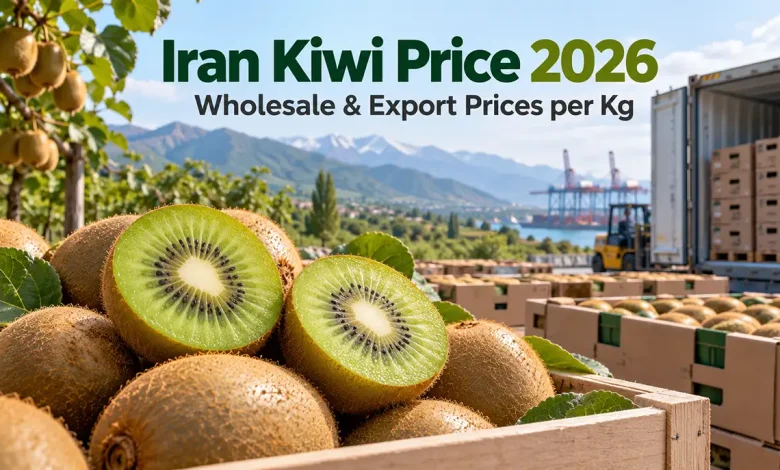
The Iran kiwi price in 2026 generally ranges from about $0.50 to $1.10 per kg for fresh export-grade kiwi, depending on fruit size, grade, season, packaging, order volume, and delivery terms. For international buyers and importers, Iranian kiwi wholesale prices, FOB quotations, and bulk export rates can vary significantly, especially for premium Hayward kiwi. This guide provides updated Iran kiwi prices per kg, export pricing factors, grades, packaging options, and key information for sourcing kiwi from Iran.
Current Iran Kiwi Prices per Kg
Updated: October 2, 2026
The latest available trade data indicates that the Iran kiwi price for export-grade fresh fruit is currently around $0.50–$0.80 per kg in observed bulk transactions, although actual supplier quotations can move outside this range depending on size, grade, packaging, season, order volume, and delivery terms.


In July 2026, Iranian fresh kiwifruit recorded an average observed export unit value of approximately $0.52/kg. Similar transaction data showed about $0.52/kg in June 2026, while Iranian Hayward kiwi was recorded at approximately $0.48/kg in April 2026. Fresh green kiwi from Iran showed a higher observed value of approximately $0.81/kg in April.
 .
.
Iran Kiwi Price Benchmark
| Period | Product | Observed Price | Reported Volume |
|---|---|---|---|
| April 2026 | Iranian Hayward Kiwi | $0.48/kg | 97,050 kg |
| April 2026 | Iranian Fresh Green Kiwi | $0.81/kg | 44,800 kg |
| June 2026 | Iranian Fresh Kiwi | $0.52/kg | 137,470 kg |
| July 2026 | Iranian Fresh Kiwi | $0.52/kg | 62,100 kg |
Source: Tridge Market Insights, Fresh Kiwifruit Monthly Update – June & July 2026. Prices represent observed
international trade unit values and should be used as market benchmarks rather than fixed supplier quotations.
Tridge – Fresh Kiwifruit Monthly Update, July 2026
These figures should be treated as trade-price benchmarks rather than fixed supplier offers. Transaction-based unit values may differ from a current FOB or CIF quotation because commercial contracts can include different product specifications, packaging formats, destinations, and Incoterms.
Historical shipment data provides an additional benchmark. For Iran-sourced fresh kiwi shipments recorded between May and July 2025, Volza reports approximately $0.50/kg at the lower end, $0.62/kg around the middle of the observed range, and $1.10/kg at the upper end.
For importers requesting a commercial quote, the most important variables are:
- kiwi variety, particularly Hayward kiwi
- fruit weight and caliber
- Grade A, Class I, or mixed commercial grade
- uniformity and cosmetic quality
- packaging type and net carton weight
- total order quantity
- harvest and storage period
- destination country
- FOB, CFR, or CIF terms
- refrigerated transportation requirements
Quick Price Review
Current benchmark: approximately $0.50–$0.80/kg for many observed Iranian export transactions.
Broader shipment range: approximately $0.50–$1.10/kg.
Important: these are market benchmarks, not a guaranteed supplier quotation. Buyers should request a current offer based on grade, size, quantity, packaging, destination, and Incoterms.
Data note: The latest publicly accessible 2026 transaction observations used here currently extend through July 2026. This page is updated as newer verifiable shipment and market data becomes available.
Iran Kiwi Wholesale Prices by Grade and Size
The Iranian kiwi wholesale price is strongly influenced by fruit size and commercial grade. Exporters typically sort Hayward kiwi by individual fruit weight or by the number of fruits packed in a standard carton.
Iranian exporters commonly offer Hayward kiwi in weight categories ranging from approximately 60–70 g to 110–120 g per fruit. Commercial specifications published by Iranian suppliers also use sizes such as 42, 39, 36, 33, 30, and 27, where a smaller count generally represents a larger individual fruit.
Iranian Kiwi Size and Wholesale Position
| Kiwi Size | Approx. Fruit Weight | Approx. Count per 3 kg | Commercial Position | Expected Price Level* |
|---|---|---|---|---|
| Size 42 | 60–75 g | ~42 | Small / value grade | Lower |
| Size 39 | 70–80 g | ~39 | Standard export | Low–Mid |
| Size 36 | 80–90 g | ~36 | Popular export size | Mid |
| Size 33 | 90–100 g | ~33 | Premium commercial size | Mid–High |
| Size 30 | 100–110 g | ~30 | Large premium fruit | Higher |
| Size 27 | 110–120 g | ~27 | Extra-large fruit | Higher / market dependent |
*Price positioning is indicative rather than a fixed price list. Actual quotations depend on grade, appearance, firmness, Brix, packaging, season, order quantity, and destination.
Iranian suppliers commonly list 70–80 g, 80–90 g, 90–100 g, 100–110 g, and 110–120 g as commercial export specifications. Some exporters also supply fruit up to approximately 120–140 g for buyers requiring larger calibers.
For international buyers, fruit size alone should not determine the purchase price. Two shipments of 90–100 g kiwi can have different wholesale prices if they differ in:
- external appearance and skin defects
- size uniformity within the carton
- firmness at loading
- maturity and Brix level
- cold-storage history
- export certification requirements
- packaging quality
- sorting and grading accuracy
Export-oriented Iranian suppliers distinguish higher-quality fruit from lower commercial grades. For example, some packing operations select healthy fruit with appropriate size, color, and appearance for export, while Grade B fruit may be directed to specific markets, processors, or domestic channels.
Common Export Size Reference
A practical reference for buyers is:
42 → 60–70/75 g
39 → 70–80 g
36 → 80–90 g
33 → 90–100 g
30 → 100–110 g
27 → 110–120 g
Because grading systems can differ slightly between packing houses and destination markets, buyers should include both the required fruit weight and acceptable size count in an RFQ rather than requesting only “large” or “premium” kiwi.
Buyer Review
For most commercial sourcing decisions, 80–110 g Hayward kiwi (approximately sizes 30–36) represents an important export-size range offered by Iranian suppliers.
When comparing offers, ask every supplier to quote the same size, grade, packaging, net weight, Incoterm, and loading date. Otherwise, comparing the price per kg alone can be misleading.
FOB Iran Kiwi Prices for Export Buyers
For international importers, the FOB Iran kiwi price is not a single nationwide rate. Exporters usually calculate each quotation according to the fruit specification, packing method, loading point, order volume, and shipment date.
Recent trade data provides a useful starting benchmark. In April 2026, Iranian fresh kiwifruit shipments in Tridge’s dataset recorded an average observed unit value of approximately $0.475/kg, while individual Iran-to-India transactions ranged around $0.41–$0.54/kg in the published samples. These figures represent observed trade values and should not automatically be interpreted as current FOB offers.
Public Iranian exporters generally do not publish a fixed FOB list. Instead, they ask buyers to specify the destination, grade, packaging, and quantity before issuing a quotation. One current Iranian exporter, for example, lists a minimum commercial order of one 40-foot reefer container of approximately 20 MT and states that pricing depends on grade, packing, and destination.
What Is Included in an Iran Kiwi FOB Quote?
| Cost Component | Usually Reflected in FOB Price? | Why It Matters |
|---|---|---|
| Fresh kiwi fruit | Yes | Base orchard or wholesale cost |
| Sorting and grading | Yes | Larger and more uniform fruit can cost more |
| Export packaging | Yes | Carton type and tray configuration affect cost |
| Pre-cooling / cold storage | Usually | Essential for export-quality fruit |
| Inland refrigerated transport | Usually | Depends on packhouse and loading port |
| Export documentation | Usually | Includes commercial export procedures |
| Port handling before loading | According to contract | Must be confirmed in the quotation |
| International sea freight | No | Normally paid separately under FOB |
| Destination insurance | No | Normally associated with CIF/CIP or separate insurance |
Under an FOB contract, the buyer should therefore compare quotations only after confirming that suppliers are offering the same grade, caliber, carton weight, loading point, and shipment period.
Iranian kiwi can be exported by sea through southern ports such as Bandar Abbas or transported overland to regional markets. Reefer-container and cold-chain requirements are particularly important because temperature management directly affects fruit firmness and arrival quality.
Before Requesting an FOB Kiwi Quote
An importer should ideally provide:
- required kiwi variety, usually Hayward
- grade or quality specification
- fruit weight or caliber
- required Brix and firmness if applicable
- net carton weight and packaging style
- total volume in metric tonnes
- loading port or requested Incoterm
- destination country
- preferred shipment date
FOB Price Review
There is no single official daily FOB price for Iranian kiwi. Recent shipment data provides a useful market benchmark, but a commercial FOB offer must be obtained for a specific grade, size, packaging format, quantity, and loading date.
For price comparison, buyers should request quotations from multiple exporters using identical specifications rather than comparing headline prices alone.
Source: Tridge Fresh Kiwifruit Monthly Update, April 2026; current Iranian exporter specifications and quotation practices.
Iranian Hayward Kiwi Prices
Hayward is the key commercial kiwi variety exported from Iran and therefore one of the most relevant products for international buyers comparing Iranian kiwi prices.
In Tridge’s April 2026 Hayward-specific trade dataset, Iran recorded 97,050 kg of reported Fresh Hayward Kiwifruit volume at an average observed unit value of approximately $0.479 per kg. This provides a useful transaction-based benchmark for Iranian Hayward kiwi, although actual supplier quotations vary with grade, size, storage condition, packaging, and Incoterms.
Iranian Hayward Kiwi Price Benchmark
| Indicator | 2026 Reference |
|---|---|
| Variety | Hayward Green Kiwi |
| Observed Iranian trade value | $0.479/kg |
| Reported volume | 97,050 kg |
| Reference period | April 2026 |
| Main commercial origin | Northern Iran |
| Typical export caliber | Approx. 27–36 |
| Typical individual weight | Approx. 70–120 g |
| HS Code | 081050 |
Price source: Tridge Fresh Hayward Kiwifruit Monthly Update, April 2026.
Hayward dominates many export-oriented Iranian supply programs because of its firm flesh, storage potential, recognizable green interior, and suitability for refrigerated international transport. Current Iranian suppliers offer export-grade Hayward from production areas in Gilan, Mazandaran, and Golestan.
Commercial specifications commonly include calibers around 27, 30, 33, and 36, corresponding broadly to fruit weighing roughly 70–120 g, although grading conventions can vary between exporters. One current Grade A Iranian Hayward specification lists calibers 27–36 and export cartons of 3, 4, or 10 kg.
The price paid for Hayward kiwi is therefore affected not only by kilograms purchased but also by the consistency of the lot. Importers seeking supermarket-grade product will normally place greater emphasis on uniformity, firmness, visual defects, Brix, and shelf life than buyers purchasing fruit for wholesale or processing channels.
Hayward Price Review
2026 transaction benchmark: approximately $0.48/kg based on reported April 2026 Iranian Hayward trade activity.
This figure should be used as a market reference, not a guaranteed supplier price. Current Grade A, large-caliber, specially packed, or long-storage fruit may be quoted differently.
Source: Tridge, Fresh Hayward Kiwifruit Monthly Update – April 2026.
Factors Affecting Kiwi Prices in Iran
The price of Iranian kiwi can change significantly during the export season, even when the fruit comes from the same growing region. For international buyers, understanding these price drivers is more useful than relying on a single price-per-kilogram figure.
Main Factors That Change Iran Kiwi Prices
| Price Factor | Typical Effect on Price | Importance for Importers |
|---|---|---|
| Harvest period | Can reduce or increase supply pressure | High |
| Fruit caliber | Large uniform fruit may command a premium | High |
| Grade and appearance | Grade A generally costs more | High |
| Brix and maturity | Correct maturity improves export suitability | High |
| Firmness | Important for long-distance shipments | High |
| Packaging | Premium cartons/trays increase packing cost | Medium–High |
| Cold-storage duration | Adds handling and storage cost | Medium–High |
| Order volume | Container-size orders may receive different terms | Medium |
| Transport to loading point | Varies by origin and route | Medium |
| Exchange-rate movements | Can affect USD quotations | High |
| Destination requirements | Certification and protocols may add cost | Medium–High |
| International freight | Changes CFR/CIF landed cost substantially | High |
1. Harvest Season and Supply
The main commercial harvest of Iranian Hayward kiwi occurs during autumn. Current industry sources identify October through November/December as the key harvest window, while controlled cold storage can extend export availability into the following months.
The timing is particularly relevant in 2026. Iran permitted kiwi exports again from the beginning of Mehr 1405 (late September 2026) after changing the previously announced seasonal export restriction. This means early-season supply conditions and export demand can affect quotations as the new crop enters international trade.
2. Kiwi Size and Grade
Uniform, export-quality fruit normally receives different commercial treatment from mixed-caliber or processing-grade kiwi. Iranian export specifications currently cover a wide range, from fruit around 40–60 g to premium sizes above 100 g, depending on supplier and destination requirements.
3. Brix, Firmness and Storage Quality
Kiwi harvested too early or stored incorrectly may arrive with poor eating quality or insufficient shelf life. Export suppliers therefore monitor maturity indicators such as Brix, firmness, temperature, humidity, and cold-chain continuity. Current Iranian Hayward specifications commonly cite harvest Brix near 6.5% or above and cold-storage temperatures close to 0°C.
4. Packaging
The same kiwi can have a different per-kilogram export cost when supplied in bulk cartons, single-layer trays, smaller retail packs, or customized cartons. Current Iranian exporters advertise formats ranging from approximately 3–4 kg presentation cartons to 10 kg bulk export cartons.
5. Destination and Incoterms
A buyer comparing an orchard or ex-packhouse price with FOB, CFR, or CIF pricing is not comparing equivalent values. Refrigerated inland transport, port costs, sea freight, insurance, destination protocols, and phytosanitary requirements can materially change the final landed cost.
Market Review
The lowest quoted price is not necessarily the lowest landed cost.
For a meaningful comparison, international kiwi buyers should normalize every quotation by:
USD/kg + grade + caliber + net packaging weight + shipment date + Incoterm + destination.
This creates a much more reliable benchmark than comparing supplier price per kilogram alone.
Editorial note: Market prices for agricultural products change continuously. MyIndustry recommends treating published figures as dated benchmarks and confirming a current commercial quotation before making a purchasing decision.
Iran Kiwi Harvest Season and Price Changes
The Iran kiwi harvest season is one of the most important factors affecting availability, fruit condition, and wholesale pricing. Iran’s main commercial green kiwi variety, Hayward, is generally harvested in autumn, with the principal harvest period running from late October through November and into early December, depending on the production area and fruit maturity.
Iranian industry sources indicate that fresh shipments are concentrated around November and December, while properly stored Hayward kiwi can remain commercially available through winter and into spring. Controlled-atmosphere (CA) storage allows some exporters to supply Iranian kiwi through approximately April, well beyond the orchard harvest period.
Iran Kiwi Season Calendar
| Period | Typical Market Situation | Expected Price Influence* |
|---|---|---|
| September–October | Maturity testing and preparation for harvest | Limited new-crop supply |
| Late October–November | Main Hayward harvest begins | Supply increases |
| November–December | Peak fresh-crop export period | Strong availability |
| January–February | Increasing reliance on cold storage | Storage costs become more relevant |
| March–April | Late-season CA-stored fruit | Quality and storage history become critical |
| May–September | Limited conventional fresh-crop availability | Supply depends heavily on stored fruit or specific programs |
*This describes typical seasonal dynamics rather than a guaranteed price pattern. Export demand, crop size, exchange rates, destination-market demand, and trade conditions can override normal seasonal effects.
When Is Iranian Kiwi Usually Most Competitive?
The harvest and early post-harvest period can offer buyers access to larger volumes and a broader selection of grades and calibers. However, the lowest Iran kiwi price does not necessarily occur on a fixed month every year.
Price movements may be affected by:
- total production during the crop year
- export demand immediately after harvest
- Russian, Indian, CIS, and Middle Eastern demand
- availability of larger export calibers
- cold-storage inventories
- fruit firmness and remaining shelf life
- transportation and refrigerated-container costs
- Iranian rial exchange-rate movements
- government export regulations or seasonal trade measures
For this reason, professional importers often compare harvest-period quotations with forward supply offers rather than assuming that late-season stored kiwi will automatically be more expensive.
Cold storage also changes the nature of the buying decision. Iranian suppliers offering properly managed Hayward kiwi report storage conditions around 0–0.5°C with approximately 90–95% relative humidity, with selected fruit capable of several months of controlled-atmosphere storage.
Season Review
Main Iranian Hayward harvest: late October to early December
Peak fresh export period: approximately November–December
Cold-storage supply: can extend into approximately AprilBuyers sourcing outside the main harvest period should ask for the harvest date, packing date, cold-storage method, firmness, Brix, and temperature history before comparing prices.
Buyer tip: A lower late-season price may not represent better value if the fruit has reduced firmness or remaining shelf life. For long-distance shipments, arrival condition should be considered alongside the FOB price.
Kiwi Grades, Sizes, and Export Quality Standards
International buyers should specify both quality grade and fruit size when requesting an Iranian kiwi quotation. Terms such as “premium,” “Grade A,” or “export quality” are commonly used commercially, but they do not always represent an identical technical specification from one supplier to another.
A useful international reference is the UNECE FFV-46 Standard for Kiwifruit, which defines minimum quality, maturity, sizing, presentation, and classification requirements for fresh kiwifruit.
Under the current published UNECE standard, kiwifruit is divided into Extra Class, Class I, and Class II. The standard also specifies a minimum maturity at packing of 6.2° Brix or an average dry matter content of 15%.
International Kiwi Quality Reference
| Classification | Minimum Fruit Weight | General Quality Position |
|---|---|---|
| Extra Class | 90 g | Superior quality with only very slight superficial defects |
| Class I | 70 g | Good quality; slight permitted defects |
| Class II | 65 g | Meets minimum quality requirements with wider permitted defects |
Reference: UNECE FFV-46 Kiwifruit Standard, 2023.
The UNECE standard also requires fruit to be:
- intact and sound
- clean and practically free from foreign matter
- practically free from pests
- sufficiently firm
- free from serious flesh damage
- properly developed
- free from abnormal external moisture
- capable of withstanding transport and handling
- capable of arriving at destination in satisfactory condition
For uniformity, the permitted weight difference between the largest and smallest fruit in the same package also varies according to fruit size. For fruit between 85 and 120 g, for example, the UNECE standard permits a maximum size range of 15 g within the package.
Common Iranian Hayward Kiwi Sizes
In commercial Iranian export trade, suppliers commonly sort Hayward kiwi into calibers such as:
| Commercial Caliber | Approximate Fruit Weight | Typical Position |
|---|---|---|
| 42 | ~60–75 g | Smaller commercial fruit |
| 39 | ~70–80 g | Standard commercial |
| 36 | ~80–90 g | Popular export size |
| 33 | ~90–100 g | Large export fruit |
| 30 | ~100–110 g | Premium large size |
| 27 | ~110–120 g | Extra-large fruit |
Iranian export suppliers currently offer specifications including approximately 70–120 g fruit and calibers 27, 30, 33, and 36, while other packhouses also prepare sizes 39 and 42 according to buyer and destination requirements.
“Grade A” vs. “Class I”: An Important Difference
Buyers should not automatically assume that an Iranian supplier’s “Grade A” designation is legally identical to UNECE Class I.
“Grade A” may be a supplier’s own commercial classification, while UNECE Class I has defined requirements covering fruit condition, defects, firmness, sizing, and presentation.
A professional RFQ should therefore specify measurable requirements such as:
- variety: Hayward
- caliber or individual fruit weight
- minimum/maximum weight tolerance
- Brix at packing
- dry matter if required
- firmness
- permitted skin defects
- uniformity
- pesticide-residue requirements
- phytosanitary certification
- packaging configuration
Quality Review
For international trade, do not purchase kiwi based only on terms such as “premium” or “Grade A.”
A stronger specification is:
Hayward + Class/Grade + 90–100 g + Brix requirement + firmness + defect tolerance + packaging + phytosanitary requirements.
This makes quotations from different Iranian suppliers considerably easier to compare.
Authoritative reference: UNECE FFV-46, Standard concerning the marketing and commercial quality control of Kiwifruit. The current published version used here is the 2023 standard.
Export Packaging Options for Iranian Kiwi
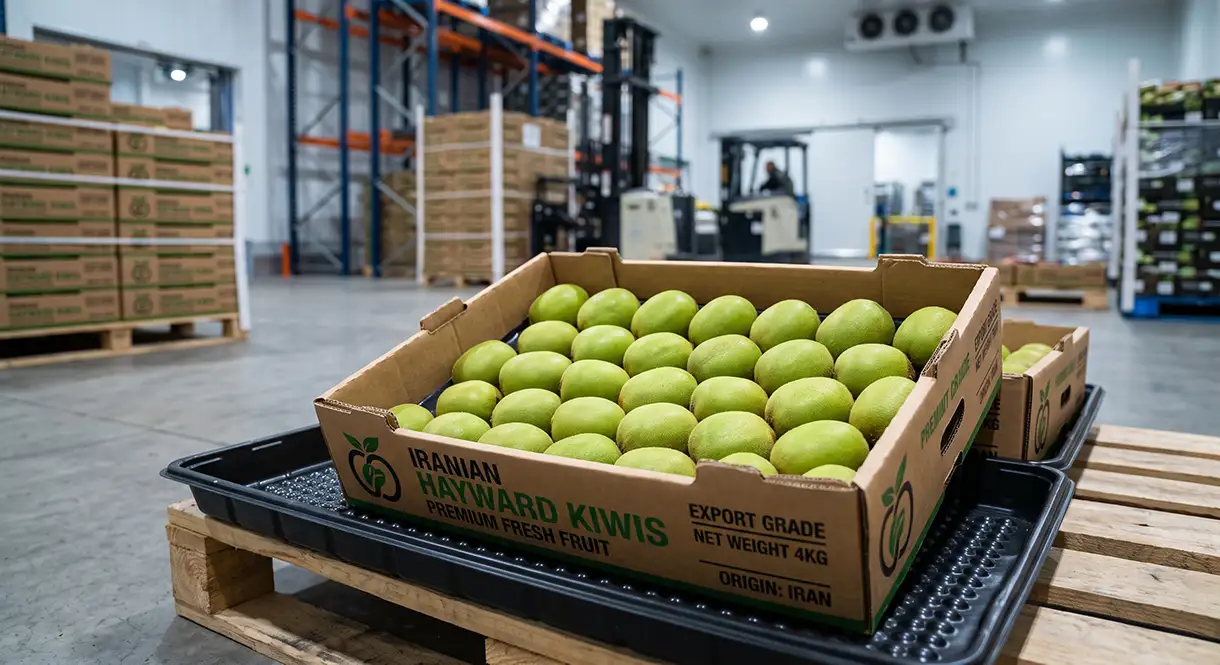
Iranian kiwi export packaging varies by destination market, fruit caliber, distribution channel, and transportation method. Common commercial formats range from small retail punnets to single-layer cartons and larger 10 kg wholesale packs.
Current Iranian suppliers offer formats including 3 kg single-layer cartons, 4 kg export cartons, 10 kg bulk cartons, and smaller consumer punnets. Packaging preferences also vary significantly by destination.
Common Iran Kiwi Export Packaging
| Packaging Format | Typical Use | Main Advantage |
|---|---|---|
| 1 kg punnet | Retail / supermarkets | Consumer-ready presentation |
| 3 kg single-layer carton | Premium export fruit | Better fruit protection and presentation |
| 4 kg carton | Wholesale and retail distribution | Balance of protection and handling |
| 10 kg carton | Bulk wholesale | Lower packaging cost per kg |
| 10 kg plastic basket | Selected wholesale markets | Durable handling for bulk distribution |
Destination-market preferences can differ considerably. One Iranian exporter reports:
- India: commonly 10 kg net plastic export baskets
- Russia: commonly 4 kg single-layer packaging
- GCC markets: 1 kg punnets, 4 kg, and 10 kg formats
- Uzbekistan, Kazakhstan, and Turkmenistan: commonly 4 kg export packs
These configurations represent current supplier practices rather than mandatory national packaging rules. Buyers should always confirm the requirements of their own market.
Premium vs. Bulk Kiwi Packaging
Single-layer cartons are generally better suited to premium-caliber kiwi because they reduce pressure and fruit-to-fruit contact during transportation.
Bulk cartons or baskets can lower packaging costs and improve loading efficiency, but correct fruit firmness and internal protection become more important.
Some Iranian export programs use:
- molded trays
- protective liners
- moisture-control materials
- ethylene absorbers
- ventilated cartons
- palletized export cartons
- modified-atmosphere liners
These technologies are particularly relevant for longer refrigerated shipments where maintaining firmness and controlling ripening are critical.
What Should Be Printed on Kiwi Export Cartons?
An export buyer should confirm labeling requirements before production. Depending on the destination, relevant carton information may include:
- product name
- variety
- country of origin: Iran
- packer/exporter identification
- net weight
- grade or class
- caliber or size
- lot number
- packing date
- traceability code
- storage instructions
Iranian export suppliers already use carton labeling that includes information such as the packer, net weight, product, lot number, packing code, and packing date.
Packaging Can Change the Price per Kg
Packaging should be included when comparing Iran kiwi wholesale prices. A quotation for 3 kg single-layer premium cartons cannot be compared directly with a quotation for 10 kg bulk packaging.
The final export cost may include:
fruit + sorting + grading + carton + tray/liner + labeling + palletizing + cold storage + inland refrigerated transport
For this reason, buyers requesting several quotations should require the same packaging specification from every supplier.
Packaging Review
Premium retail/export: 3–4 kg single-layer cartons
General wholesale: 4 kg cartons
Bulk distribution: approximately 10 kg cartons or baskets
Retail programs: smaller punnets can be supplied for selected marketsFor long-distance shipments, packaging should be selected according to fruit firmness, transit time, pallet configuration, ventilation, and destination-market handling, not simply the lowest packaging cost.
Commercial reference: Current Iranian exporter specifications show 3 kg, 4 kg and 10 kg formats as common options, with packaging customized according to the destination market.
Main Kiwi-Producing Regions in Iran
Commercial kiwi production in Iran is concentrated along the humid Caspian coast, particularly in the northern provinces of Mazandaran, Gilan, and Golestan. Agricultural authorities and research institutions consistently identify these three provinces as the country’s main kiwifruit-growing belt.
The combination of relatively high humidity, suitable soils, moderate temperatures, and access to cold-storage infrastructure has made northern Iran the center of the country’s Hayward kiwi industry.
Main Kiwi-Growing Regions of Iran
| Region | Importance for Kiwi Trade | Notable Production Areas |
|---|---|---|
| Mazandaran | Major production and export hub | Tonekabon, Abbasabad and western Mazandaran |
| Gilan | Major production, storage and export region | Talesh, Astara, Rezvanshahr, Rudsar |
| Golestan | Smaller but established production area | Bandar Gaz and western Golestan |
In Gilan, agricultural authorities identify Talesh, Rezvanshahr, Astara, and Rudsar among the province’s most important kiwi-producing districts. The province also has extensive cold-storage infrastructure supporting long-term storage and export.
Mazandaran is another major export center. By October 2, 2026, provincial agricultural authorities reported that 119 kiwi consignments totaling approximately 2,742 metric tonnes had already been exported during the new season.
Iranian industry suppliers also operate export programs around Tonekabon in Mazandaran and Bandar Gaz in Golestan, with Hayward fruit prepared for refrigerated international shipment.
Why Origin Matters to International Buyers
The production area can influence:
- harvest timing
- fruit firmness
- fruit size distribution
- cold-storage availability
- proximity to sorting and packing facilities
- inland transportation cost
- access to northern land borders or southern seaports
However, province of origin alone should not be used as a quality grade. Orchard management, harvest maturity, sorting accuracy, storage conditions, and cold-chain performance can create significant quality differences within the same region.
Origin Review
Main Iranian kiwi belt: Mazandaran, Gilan and Golestan
Key commercial variety: Hayward
Important export infrastructure: packhouses, refrigerated storage and access to regional trade corridorsBuyers should evaluate the specific orchard, packhouse and shipment specification, rather than purchasing solely on the reputation of a province.
Source: Iranian Ministry of Agriculture-related agricultural reports and provincial agricultural authorities.
How to Buy Kiwi from Iran
International buyers sourcing Iranian kiwi in bulk should begin with a detailed RFQ rather than requesting only a general “price per kg.”
A professional quotation should clearly define the product specification, packaging, quantity, Incoterm, loading point, and shipment period.
Recommended Iran Kiwi Buying Process
| Step | Buyer Action | Why It Matters |
|---|---|---|
| 1 | Define variety and grade | Prevents incomparable quotations |
| 2 | Specify fruit size/caliber | Size strongly affects commercial value |
| 3 | Define packaging | Packaging changes cost per kg |
| 4 | Request current quotation | Kiwi prices change during the season |
| 5 | Confirm Brix and firmness | Important for shelf life and transit |
| 6 | Check supplier documentation | Reduces commercial and compliance risk |
| 7 | Agree on Incoterm | Determines cost and risk allocation |
| 8 | Arrange inspection if required | Confirms cargo before shipment |
| 9 | Confirm cold-chain conditions | Critical for long-distance exports |
| 10 | Finalize payment and shipping documents | Required before commercial dispatch |
What to Include in Your RFQ
A buyer requesting an Iran kiwi wholesale price should provide:
- Variety: Hayward
- Grade or required quality standard
- Caliber or fruit weight
- Example: 80–90 g, 90–100 g or 100–110 g
- Required Brix
- Required firmness, if applicable
- Maximum permitted defects
- Packaging format
- Net weight per carton
- Order volume in tonnes
- Destination country
- Required Incoterm
- Requested shipment date
- Certification or residue requirements
Instead of writing:
“Please send your kiwi price.”
a commercial buyer should request:
“Please quote 20 MT Iranian Hayward kiwi, 90–100 g, export grade, 4 kg cartons, refrigerated shipment, with price under the agreed Incoterm and loading point.”
This makes supplier quotations significantly easier to compare.
Product Inspection Before Shipment
For larger commercial orders, buyers may request pre-shipment verification of:
- caliber distribution
- net weight
- packaging
- fruit appearance
- firmness
- Brix
- temperature
- labeling
- pallet condition
- container loading
The applicable destination-country phytosanitary and pesticide-residue requirements should also be confirmed before purchasing, because import requirements differ between markets.
Buying Review
Never compare Iranian kiwi suppliers using price per kilogram alone.
The correct comparison is:
same variety + same caliber + same grade + same packaging + same quantity + same Incoterm + same shipment period
Only then does the price comparison become commercially meaningful.
Iran Kiwi Export Markets and Major Destinations
Iranian kiwi is exported to a wide range of regional and international markets, with particularly active trade toward Eurasia, Central Asia, India, Iraq and neighboring countries.
Current 2026 shipment data shows that export destinations can change substantially during the season.
For example, by September 29, 2026, Mazandaran had exported approximately:
| Destination | Reported Kiwi Volume | Period |
|---|---|---|
| India | 942 MT | Start of 2026 export season |
| Uzbekistan | 823 MT | Start of 2026 export season |
| Other markets | 595 MT | Same period |
These figures represent Mazandaran’s early-season exports, not Iran’s complete annual export market.
During the previous export cycle, Mazandaran agricultural authorities also identified Eurasian markets, Uzbekistan, Turkmenistan, Tajikistan and Gulf countries as important destinations. By early April 2026, approximately 51,978 tonnes of kiwi had been exported from Mazandaran during that reporting period.
Broader Shipment-Level Market Evidence
Third-party customs shipment databases also show frequent Iranian kiwi movements to markets including:
- Russian Federation
- Iraq
- Kazakhstan
- India
- Turkmenistan
- Kyrgyzstan
- Tajikistan
- Uzbekistan
- Armenia
- Azerbaijan
A current Eximpedia dataset containing Iranian kiwi shipment records lists Russia and Iraq as the most frequently represented destinations in its available sample, followed by markets including Kazakhstan, India and Turkmenistan.
Important Note on Export Rankings
Different trade databases may produce different rankings because they can vary by:
- reporting period
- customs coverage
- shipment availability
- HS-code granularity
- land-border coverage
- whether shipments or trade value are being measured
For this reason, a claim such as “the number-one buyer of Iranian kiwi” should always include a date and data source.
What Different Markets Typically Require
| Market Type | Common Buyer Priorities |
|---|---|
| India | Size consistency, firmness, phytosanitary compliance |
| Russia / Eurasia | Competitive pricing, reliable volume, cold-chain performance |
| Central Asia | Flexible packaging and overland logistics |
| Gulf markets | Presentation, premium grading and retail packaging |
| Neighboring markets | Competitive delivered price and rapid transit |
These are general commercial tendencies rather than mandatory national specifications. Importers should verify the regulations and buyer standards of each destination.
Export Market Review
Iran does not depend on a single kiwi export destination.
Recent evidence shows active demand across India, Eurasia, Central Asia, Iraq and neighboring markets, while destination shares can change substantially between seasons.
For traders, current shipment activity is more useful than relying on an old annual ranking.
Sources: Mazandaran Agricultural Organization export reports, 2026; Eximpedia customs shipment database.
Shipping and Delivery Terms
Iranian kiwi is shipped internationally by refrigerated road transport and reefer containers, depending on destination and route.
Cold-chain management is particularly important for Hayward kiwi because poor temperature control can accelerate softening and reduce commercial shelf life.
Current Iranian export specifications commonly recommend approximately:
| Parameter | Typical Export Reference |
|---|---|
| Storage temperature | 0–1°C |
| Relative humidity | 90–95% |
| Container type | Refrigerated / reefer |
| Common commercial load | Approx. 20–22 MT for selected 40-ft reefer programs |
| Product | Fresh Hayward kiwi |
Current Iranian supplier specifications describe continuous cold-chain transport at around 0–0.5°C and 90–95% relative humidity for export Hayward kiwi.
Actual reefer settings should be agreed according to:
- maturity at loading
- fruit firmness
- packaging ventilation
- transit duration
- controlled-atmosphere requirements
- carrier recommendations
- destination protocol
Common Delivery Terms
| Incoterm | Basic Commercial Meaning | Buyer Relevance |
|---|---|---|
| EXW | Buyer collects from seller’s premises | Buyer controls most logistics |
| FCA | Seller delivers to agreed carrier/location | Often suitable for containerized cargo |
| FOB | Seller delivers goods on board vessel | Traditional maritime quotation |
| CFR | Seller pays freight to destination port | Insurance normally buyer’s responsibility |
| CIF | Seller includes freight and specified insurance | Useful for landed-port comparison |
| CPT/CIP | Seller pays carriage to named destination | Suitable for multimodal transport |
FOB vs. FCA for Reefer Containers
Although FOB kiwi price Iran is a commonly searched commercial phrase, importers should understand an important Incoterms distinction.
Under Incoterms® 2020, FOB is intended for sea or inland-waterway transactions where the seller delivers the goods on board the vessel. The ICC specifically notes that where containerized cargo is handed to a carrier at a terminal before vessel loading, parties should consider FCA rather than FOB.
This means that a professional contract should specify both the Incoterm and the exact named location, for example:
FCA [named terminal], Iran – Incoterms® 2020
rather than simply stating:
FOB Iran
Cold-Chain Checklist
Before loading, buyers should confirm:
- pulp temperature
- reefer pre-cooling
- carton ventilation
- pallet configuration
- temperature setpoint
- humidity strategy
- ventilation settings
- ethylene management where applicable
- data logger placement
- seal number
- loading photographs
Shipping Review
For refrigerated kiwi shipments, the cheapest freight offer is not necessarily the safest commercial option.
Buyers should evaluate:
fruit condition + packaging + reefer specification + transit route + Incoterm + total landed cost
Maintaining the cold chain is essential to protecting the value of the fruit purchased.
Trade-term reference: International Chamber of Commerce, Incoterms® 2020.
How to Find Reliable Kiwi Suppliers in Iran
Choosing a reliable Iranian kiwi supplier requires more than finding the lowest online quotation.
For commercial imports, buyers should verify that the exporter can consistently control the product from sourcing through sorting, packing, cold storage and shipment.
Iranian Kiwi Supplier Due-Diligence Checklist
| Check | What the Buyer Should Verify |
|---|---|
| Company identity | Registered legal company and contact details |
| Export experience | Evidence of previous fresh-produce shipments |
| Product origin | Orchard or verified sourcing network |
| Packhouse | Sorting, grading and packing capability |
| Cold storage | Suitable refrigerated facilities |
| Quality specification | Written grade, caliber, Brix and defect limits |
| Traceability | Lot identification and packing records |
| Phytosanitary capability | Ability to obtain required documents |
| Residue testing | Laboratory testing where destination requires it |
| Packaging | Ability to meet destination specifications |
| Logistics | Experience with refrigerated exports |
| Inspection | Acceptance of independent inspection when requested |
Documents to Request
Depending on destination and contract, buyers may require documents such as:
- Commercial Invoice
- Packing List
- Certificate of Origin
- Phytosanitary Certificate
- Bill of Lading / CMR or transport document
- laboratory pesticide-residue report where required
- quality or inspection certificate
- packing-house information
- lot and traceability information
For buyers requiring internationally recognizable quality specifications, the UNECE FFV-46 Kiwifruit Standard can also provide a useful reference for fruit quality, sizing and classification. UNECE lists FFV-46 as its current commercial quality standard for kiwifruit.
Warning Signs When Selecting a Supplier
Buyers should investigate further if a supplier:
- refuses to provide a detailed specification
- quotes unusually below comparable market prices
- cannot identify fruit caliber
- does not specify net carton weight
- avoids discussing cold storage
- provides no recent packing or loading evidence
- changes banking information unexpectedly
- cannot explain shipment documentation
- refuses reasonable pre-shipment inspection for a large order
Trial Orders and Inspection
When starting with a new exporter, a buyer can reduce commercial risk by using:
- a trial shipment
- third-party inspection
- agreed photographic/video loading records
- independent weight verification
- clear written quality tolerances
- temperature data loggers
Supplier Review
A reliable kiwi exporter should be able to answer five questions immediately:
What variety? What caliber? What grade? What packing? What Incoterm?
If these five points are unclear, the quoted Iran kiwi price per kg is not yet a useful commercial offer.
Frequently Asked Questions About Iran Kiwi Prices
What is the Iran kiwi price per kg in 2026?
Recent 2026 trade observations suggest approximately $0.50–$0.80/kg for many Iranian fresh-kiwi export transactions, while wider shipment-level observations can extend to approximately $0.50–$1.10/kg depending on size, grade, packing, season and trade terms.
These are market benchmarks, not guaranteed supplier quotations.
What is the wholesale price of Iranian Hayward kiwi?
A reported April 2026 trade benchmark for Iranian Hayward kiwi was approximately $0.48/kg. Current commercial quotations may be higher or lower depending on fruit caliber, quality, packaging, storage history and Incoterm.
Which kiwi variety is mainly exported from Iran?
Hayward green kiwi is the principal commercial variety associated with Iranian kiwi exports. It is widely grown across the northern Caspian production belt.
When is the Iranian kiwi harvest season?
The main Hayward harvest generally begins in late October, with strong fresh-crop availability during November and December. Refrigerated and controlled-atmosphere storage can extend commercial supply into the following spring.
Where is kiwi grown in Iran?
Most commercial production is concentrated in Mazandaran, Gilan and Golestan in northern Iran.
What sizes of Iranian kiwi are available for export?
Common commercial sizes include approximately:
- 70–80 g
- 80–90 g
- 90–100 g
- 100–110 g
- 110–120 g
Exporters may also describe fruit by caliber numbers such as 27, 30, 33, 36, 39 and 42.
What is the HS code for fresh kiwi?
Fresh kiwifruit is commonly traded under HS 081050.
What packaging is available for Iranian kiwi?
Common formats include 3–4 kg export cartons, single-layer packs, smaller retail punnets, and approximately 10 kg bulk cartons or baskets, depending on destination and buyer specifications.
What is the minimum order quantity for Iranian kiwi?
MOQ varies by exporter. Some commercial suppliers quote by full refrigerated container, with selected programs using approximately 20–22 metric tonnes per 40-ft reefer, while other suppliers may accept smaller quantities.
Can Iranian kiwi be purchased FOB or CIF?
Yes. Iranian exporters may provide quotations using terms such as FOB, CFR, CIF, FCA or other agreed Incoterms. Buyers should always specify the named port or place and the Incoterms® version.
For containerized shipments delivered to a terminal before vessel loading, FCA may be more technically appropriate than FOB under ICC guidance.
What countries import Iranian kiwi?
Current and recent trade data shows Iranian kiwi moving to markets including India, Russia, Iraq, Uzbekistan, Kazakhstan, Turkmenistan, Tajikistan, Armenia, Azerbaijan and Gulf-region markets. The relative importance of individual destinations changes from season to season.
How can buyers get an accurate Iran kiwi price?
The most accurate quotation requires the buyer to specify:
variety + grade + caliber + packaging + quantity + destination + Incoterm + shipment date
Without these details, an advertised price per kilogram should only be treated as an indicative market reference.
Final Buyer Review
Product: Iranian Hayward Kiwi
2026 indicative trade benchmark: approximately $0.50–$0.80/kg for many observed transactions
Main origin: Northern Iran
Main production provinces: Mazandaran, Gilan and Golestan
Main harvest: Late October–December
Commercial sizes: roughly 70–120 g
HS Code: 081050
Transport: Refrigerated road or reefer container
Key buying variables: grade, caliber, packaging, volume, season and IncotermFor purchasing decisions, always request a current dated quotation. Historical or shipment-derived prices are useful benchmarks, but they are not substitutes for a live commercial offer.