Dried Nuts Wholesale Price in Iran (2026): Bulk Export Guide
2026 Wholesale Prices for Iranian Pistachios, Almonds, Walnuts & More

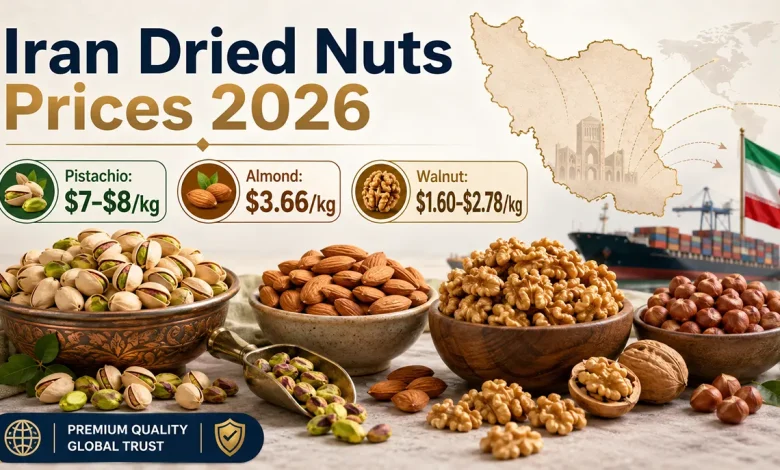
Iran is a major sourcing market for international buyers of dried nuts, particularly pistachios, almonds, walnuts, and hazelnuts. This guide provides an updated overview of the dried nuts wholesale price in Iran and explains how export quotations are determined. There is no single fixed price — actual offers vary significantly depending on variety, grade, size, crop year, processing level, packaging, order volume, and Incoterm.
More importantly, domestic wholesale prices, farmgate prices, supplier quotations, and actual export transaction values should not be treated as the same thing. For this reason, MyIndustry only uses a price in this guide when its source, price date, and market level can be identified.
MyIndustry Consulting Group has provided market research, market-entry, strategy, and consulting services in the Iranian market since 2008, including support for international companies interested in doing business with Iran.
Last reviewed: August 24, 2026
 .
.
Our price-data policy: A price without a verifiable date is not presented as a current 2026 benchmark. Supplier quotations are identified as supplier quotations, while transaction data are identified separately.
Quick Summary
Iran is a major sourcing market for dried nuts, especially pistachios, almonds, walnuts, and hazelnuts. However, wholesale prices vary based on variety, grade, size, quality, quantity, and Incoterms.
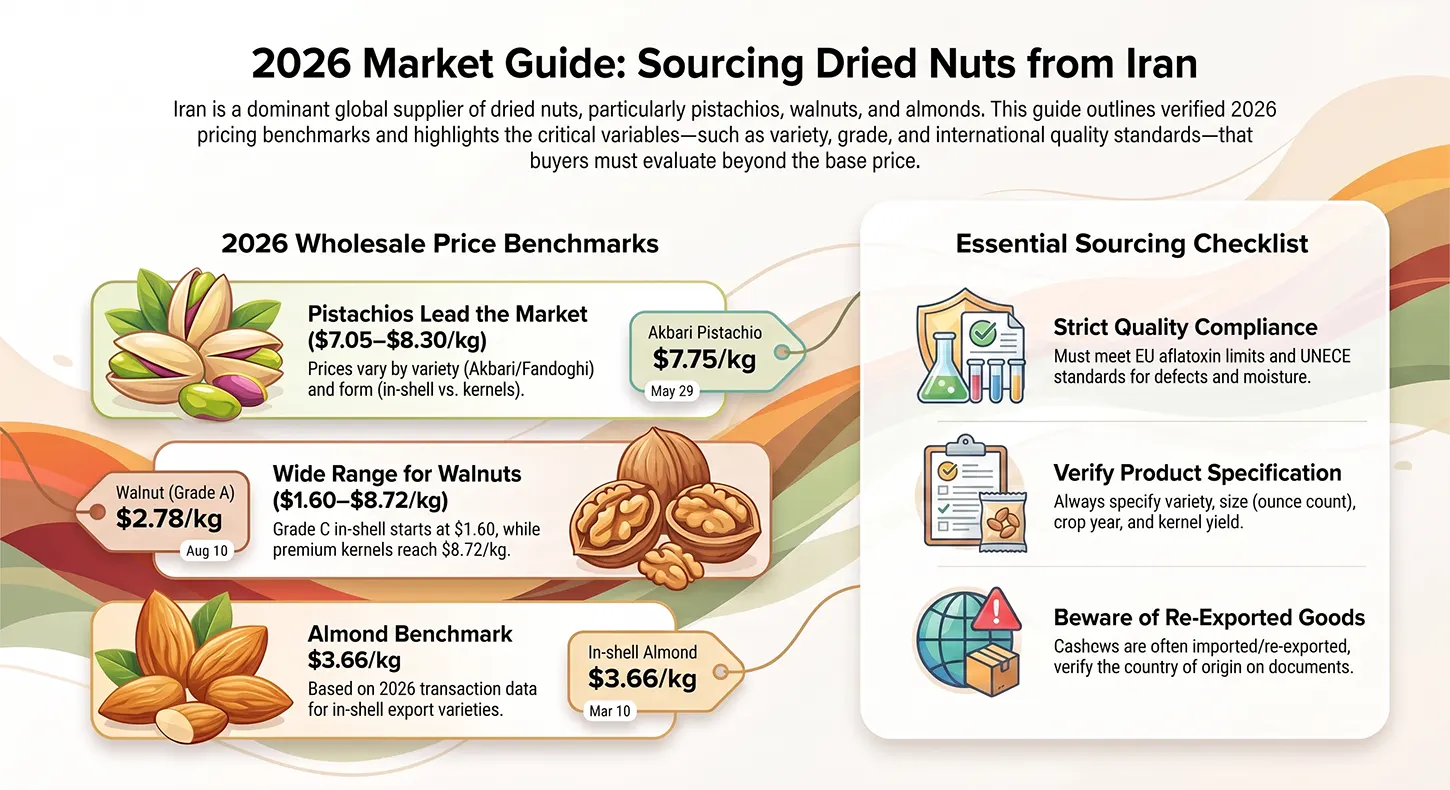
Verified 2026 benchmarks include $7–$8/kg FOB for many Iranian pistachio grades, $3.66/kg for an in-shell almond export transaction, and $1.60–$2.78/kg FOB for in-shell walnuts.
For buyers, the key is comparing dated quotations with clear product specifications, not simply choosing the lowest price.
2026 Wholesale Prices for Iranian Pistachios, Almonds, Walnuts & More
For international buyers, pistachios currently provide some of the strongest publicly verifiable 2026 pricing data among Iranian nuts.
Recent Iranian export quotations show Fandoghi pistachios at approximately $7.05–$7.35/kg FOB, depending on size. The same May 29, 2026 quotation listed Jumbo/Kalleh Ghouchi pistachios at $7.45/kg FOB, Akbari pistachios at $7.75/kg FOB, and selected pistachio kernels at approximately $8.15–$8.30/kg FOB.
For almonds, recent publicly visible transaction data are more limited. Tridge records an Iranian in-shell almond export transaction at $3.66/kg on March 10, 2026. Its Iran almond dataset was updated on August 23, 2026 and includes a more recent transaction dated July 16, 2026, but the unit price of that transaction is not publicly disclosed. Therefore, $3.66/kg is used here only as the latest publicly visible priced 2026 transaction benchmark, not as an August 2026 market quotation.
Recent walnut quotations are also available. An Iranian supplier listing updated on August 17, 2026 quoted in-shell walnuts from $1.60 to $2.78/kg FOB, depending on grade, while premium walnut kernels were quoted at $8.72/kg.
These figures should be treated as market benchmarks rather than a single national price. Actual export offers can vary considerably according to variety, grade, size, crop year, quantity, packaging, destination, and trade terms.
Dried Nuts Wholesale Prices in Iran
The table below summarizes the most recent publicly verifiable 2026 price benchmarks identified for major Iranian nuts. Each figure is labeled according to whether it represents an FOB supplier quotation or a sampled export transaction.
| Iranian Nut Product | Indicative Price | Price Basis | Price Date | Source |
|---|---|---|---|---|
| In-shell Almond | $3.66/kg | Sampled Iranian export transaction unit value | Mar. 10, 2026 | Tridge [1] |
| Fandoghi Pistachio 24/26 | $7.35/kg | FOB Iran supplier quotation | May 29, 2026 | 21food / TGG Export [2] |
| Fandoghi Pistachio 26/28 | $7.25/kg | FOB Iran supplier quotation | May 29, 2026 | 21food / TGG Export [2] |
| Fandoghi Pistachio 30/32 | $7.05/kg | FOB Iran supplier quotation | May 29, 2026 | 21food / TGG Export [2] |
| Jumbo / Kalleh Ghouchi Pistachio | $7.45/kg | FOB Iran supplier quotation | May 29, 2026 | 21food / TGG Export [2] |
| Akbari Pistachio | $7.75/kg | FOB Iran supplier quotation | May 29, 2026 | 21food / TGG Export [2] |
| Jumbo Pistachio Kernels | $8.15/kg | FOB Iran supplier quotation | May 29, 2026 | 21food / TGG Export [2] |
| Akbari Pistachio Kernels | $8.30/kg | FOB Iran supplier quotation | May 29, 2026 | 21food / TGG Export [2] |
| Walnuts in Shell – Grade A | $2.78/kg | FOB supplier quotation | Aug. 17, 2026 | 21food / TGG Export [3] |
| Walnuts in Shell – Grade B | $2.00/kg | FOB supplier quotation | Aug. 17, 2026 | 21food / TGG Export [3] |
| Walnuts in Shell – Grade C | $1.60/kg | FOB supplier quotation | Aug. 17, 2026 | 21food / TGG Export [3] |
| Iranian Walnut Kernels | $8.72/kg | Supplier quotation | Aug. 17, 2026 | 21food / TGG Export [3] |
Sources:
[1]Tridge — In-shell Almond Suppliers & Prices in Iran — Sampled Iranian export transaction: $3.66/kg on March 10, 2026; dataset updated August 23, 2026.
[2]21food / TGG Export — Iranian Pistachio — FOB Iran quotation updated May 29, 2026, including Fandoghi, Akbari, Kalleh Ghouchi, and pistachio kernels.
[3]21food / TGG Export — Iranian Walnuts in Shell and Walnut Kernels — Supplier quotation updated August 17, 2026, including Grades A–C and walnut kernels.
Update: All referenced prices and supplier quotations were re-verified and remain valid as of August 24, 2026.
Important: The almond figure above is the latest publicly visible priced 2026 transaction in the Tridge Iran dataset, not an August 2026 supplier quotation. Likewise, the pistachio and walnut figures are individual exporter quotations rather than official national average prices.
Note: Prices reflect publicly visible supplier listings as of the stated dates; actual offers may differ.

Pistachio Wholesale Prices
Pistachio is one of Iran’s most established nut exports, and wholesale prices vary significantly by variety, size, and whether the product is sold in-shell or as kernels.
A dated Iranian supplier quotation from May 29, 2026 listed Fandoghi pistachios at $7.05–$7.35/kg FOB Iran, depending on size. The same quotation listed Kalleh Ghouchi at $7.45/kg, Akbari at $7.75/kg, and pistachio kernels at approximately $8.15–$8.30/kg FOB.
For foreign buyers, size is particularly important. In the same quotation, Fandoghi 24/26 was priced at $7.35/kg, while the smaller 30/32 specification was $7.05/kg. This means that comparing two Iranian pistachio offers without checking the ounce count and variety can give a misleading impression of which supplier is cheaper.
Buyers should therefore request a quotation that clearly specifies the variety, size, crop year, in-shell or kernel form, packaging, quantity, and Incoterm.
Source: 21food / TGG Export — Iranian Pistachio, quotation updated May 29, 2026.
Almond Wholesale Prices
Publicly available 2026 pricing for Iranian almonds is less extensive than for pistachios. The most recent publicly visible priced transaction identified in the Tridge dataset is an Iranian in-shell almond export transaction at $3.66/kg on March 10, 2026. The dataset itself was last updated on August 23, 2026.
Tridge also records a more recent Iranian almond export transaction dated July 16, 2026, but its unit price is not publicly disclosed. For that reason, it would be misleading to describe $3.66/kg as the current August price; it is better treated as the latest publicly verifiable priced 2026 transaction benchmark.
International buyers should also distinguish between ordinary in-shell almonds and higher-value products such as Mamra almonds and graded almond kernels. These products can have substantially different commercial values and should be quoted separately according to variety, kernel percentage, size, grade, and order quantity.
Source: Tridge — In-shell Almond Suppliers & Prices in Iran, dataset updated August 23, 2026; latest publicly visible priced 2026 transaction dated March 10, 2026.
Walnut Wholesale Prices
Iranian walnut prices vary considerably between in-shell walnuts and export-grade kernels, as well as according to grade and kernel recovery.
A supplier quotation updated on August 17, 2026 listed Iranian in-shell walnuts at $2.78/kg FOB for Grade A, $2.00/kg for Grade B, and $1.60/kg for Grade C. Premium Iranian walnut kernels were quoted separately at $8.72/kg. The supplier stated a minimum order quantity of 20 metric tons.
The large difference between in-shell and kernel prices is important for overseas buyers. A lower price per kilogram does not necessarily represent better value if the shell-to-kernel ratio, kernel color, broken-kernel percentage, moisture level, or grading specification is different.
When requesting an Iranian walnut quotation, buyers should therefore specify whether they need in-shell walnuts or kernels, along with the required grade, kernel quality, quantity, packaging, and delivery term.
Source: 21food / TGG Export — Iranian Walnuts in Shell and Walnut Kernels, quotation updated August 17, 2026.
Hazelnut Wholesale Prices
Iran produces hazelnuts and can be a sourcing option for buyers looking beyond the country’s better-known pistachio and walnut markets. FAO-based production data show that Iran produced approximately 13,806 metric tons of in-shell hazelnuts in 2024.
However, we did not identify a sufficiently recent and publicly verifiable 2026 Iranian hazelnut wholesale or FOB quotation that meets the pricing standard used in this guide.
This distinction is important because some websites currently display an “August 2026” Iranian hazelnut price of $4.38/kg, while the underlying page states that this figure is actually a January 2023 farmgate price sourced from FAOSTAT. The same source’s export unit value of $7.69/kg relates to 2022 trade data, not a current 2026 quotation.
For this reason, MyIndustry does not present either figure as a current 2026 wholesale price.
International buyers interested in Iranian hazelnuts should request a fresh quotation specifying whether the product is in-shell or shelled, the required grade and size, crop year, quantity, packaging, and Incoterm.
Source: Selina Wamucii / FAOSTAT / UN Comtrade — Iranian hazelnut price and trade data. The displayed $4.38/kg farmgate benchmark is dated January 2023, so it is intentionally excluded from our 2026 price table.

Cashew and Other Nuts Requested by International Buyers
Cashew requires a different approach from pistachios, almonds, walnuts, and hazelnuts when sourcing through Iran.
Foreign buyers should not automatically assume that cashews offered by an Iranian trader are of Iranian origin. Available international trade data show substantial cashew imports into Iran. In 2022, for example, exporters to Iran included the United Arab Emirates, India, Turkey, Tanzania, and Sri Lanka, with the UAE accounting for the largest recorded volume.
This means that an Iranian company may act as an importer, processor, distributor, or re-exporter of cashews rather than as the producer of an Iranian-grown product.
The same caution applies to pricing. A page currently titled “Cashew Nuts Price in Iran, August 2026” displays $6.29/kg, but its underlying data explicitly state “Price as of: January 2022.” We therefore do not use that figure as a 2026 wholesale benchmark.
For buyers seeking cashews through Iran, the quotation should clearly state:
- Country of origin
- Kernel grade, such as W240 or W320
- Raw or roasted form
- Packaging
- Order quantity
- Incoterm and destination
Other nuts and kernels may also be available through Iranian suppliers, but the same rule should apply: Iranian supplier does not necessarily mean Iranian origin. Buyers seeking specifically Iranian agricultural products should confirm the origin on the quotation, certificate of origin, and export documents before purchase.
Sources: World Bank WITS / UN Comtrade — cashew exports to Iran by origin country; Selina Wamucii / UN Comtrade — historical Iran cashew unit values.
What Affects Dried Nuts Wholesale Prices in Iran?
The wholesale price of dried nuts in Iran can vary substantially even for the same type of nut. For international buyers, comparing only the price per kilogram is therefore not enough.
The most important pricing factors are:
- Variety: Akbari, Fandoghi, Ahmad Aghaei, Mamra, and other varieties can trade at different price levels.
- Size and grading: Larger or more commercially desirable grades generally command different prices from smaller grades.
- In-shell vs. kernel: Kernel prices cannot be directly compared with in-shell prices because processing, yield, and usable product weight are different.
- Crop year: New-crop and older inventory may be priced differently.
- Quality: Color, moisture, defects, broken-kernel percentage, freshness, and contamination requirements can materially affect the quotation.
- Order volume: A container-scale order may receive different commercial terms from a smaller wholesale shipment.
- Packaging: Bulk sacks, cartons, vacuum packs, and retail-ready packaging involve different costs.
- Incoterm: An EXW price in Iran is not directly comparable with an FOB, CFR, or CIF quotation.
- Destination market requirements: Testing, inspection, certificates, labeling, and food-safety requirements may add costs to an export order.
- Exchange rates and logistics: Changes in currency conditions, inland transport, and international freight can affect the final export price.
For this reason, a foreign buyer comparing Iranian nut suppliers should request quotations using the same product specification and the same Incoterm. Otherwise, a seemingly cheaper offer may simply represent a different grade, product form, packaging standard, or delivery basis.
Buying Iranian Nuts for Export
Buying nuts from Iran for export should begin with a clear product specification, not simply a request for the lowest price per kilogram. Two quotations can look similar while referring to very different grades, sizes, product forms, or delivery terms.
Before requesting a final quotation, international buyers should specify:
- Product and variety
- In-shell or kernel form
- Size and grade
- Crop year
- Required quantity
- Bulk or retail-ready packaging
- Destination country
- Required Incoterm, such as EXW, FOB, CFR, or CIF
A serious supplier quotation should also include a quotation date and validity period. This is particularly important in Iran, where exchange rates, logistics costs, seasonal availability, and inventory can change the export price.
Before a commercial shipment, buyers should normally request a representative sample and agree in writing on the product specification. Depending on the product and destination market, supporting documents may include a commercial invoice, packing list, certificate of origin, laboratory certificate or Certificate of Analysis (COA), phytosanitary or health documentation where applicable, and transport documents.
Buyers should also calculate the landed cost, rather than comparing only the Iranian supplier’s price. An attractive EXW quotation may no longer be the cheapest option after inland transport, export handling, freight, insurance, customs clearance, testing, and destination-country charges are included.
Payment, banking, shipping, and compliance requirements related to Iran can also differ by buyer jurisdiction. These issues should therefore be checked before a purchase contract or payment is finalized, particularly where Iran-related trade restrictions apply.
For buyers specifically interested in pistachios, we have a separate detailed guide: How to Import Pistachios from Iran. Keeping the pistachio-specific purchasing process on that page also allows this guide to remain focused on Iranian nuts wholesale prices and broader sourcing decisions.
Quality Standards for Iranian Export Nuts
For international nut buyers, price should never be evaluated separately from quality. A cheaper shipment can become significantly more expensive if it fails the food-safety or commercial-quality requirements of the destination market.
One of the most important issues for tree nuts is aflatoxin contamination. The European Union, for example, sets maximum levels for aflatoxins under Regulation (EU) 2023/915. For almonds and pistachios placed on the market for final consumers or used as food ingredients, the EU maximum levels are 8 μg/kg for aflatoxin B1 and 10 μg/kg for total aflatoxins. For hazelnuts and Brazil nuts in the same category, the limits are 5 μg/kg for aflatoxin B1 and 10 μg/kg for total aflatoxins. Different limits apply to certain nuts intended for further sorting or physical treatment.
Sampling and laboratory testing are therefore critical. EU Regulation 2023/2782 establishes official sampling and analysis methods for mycotoxins, including nuts such as pistachios.
Commercial quality is another consideration. UNECE publishes internationally recognized standards covering products including almond kernels, in-shell pistachios, pistachio kernels, in-shell walnuts, and walnut kernels. These standards provide useful references for characteristics such as quality classes, tolerances, sizing, presentation, and marking.
Before shipment, buyers should therefore agree on measurable specifications such as:
- Aflatoxin limits
- Moisture
- Size and grading
- Kernel color where relevant
- Broken or defective kernel tolerance
- Foreign matter
- Packaging specification
- Country-of-origin requirements
- Any additional microbiological, pesticide-residue, or food-safety requirements imposed by the destination market
A COA should be matched to the actual shipment or lot whenever possible, rather than relying only on a generic laboratory report supplied during initial negotiations.
Sources: European Commission / EUR-Lex — Regulation (EU) 2023/915; UNECE — Dry and Dried Produce Standards.
Why Source Dried Nuts from Iran?
Iran is particularly important in the international pistachio trade. USDA’s January 2026 Tree Nuts: World Markets and Trade reported record global pistachio exports supported by strong shipments from Iran, while FAO continues to describe Iranian pistachios as having a significant position in global markets.

For international buyers, Iran offers several practical sourcing advantages:
- Established pistachio export experience, with commercial varieties such as Fandoghi, Akbari, Ahmad Aghaei, and Kalleh Ghouchi.
- Access to different grades and specifications, allowing buyers to source for retail, food processing, confectionery, or other B2B applications.
- Availability of other Iranian-grown nuts including almonds, walnuts, and hazelnuts, depending on season and specification.
- The possibility of purchasing products as in-shell nuts, kernels, graded products, or bulk-packed shipments.
- A large domestic agricultural and trading network that gives buyers multiple sourcing options rather than relying on a single supplier.
Price can also be competitive for particular products and grades, but buyers should compare Iran with alternative origins on the basis of equivalent specifications and landed cost. A $/kg comparison has little meaning if one quotation represents a different grade, size, kernel yield, packaging type, or Incoterm.
For this reason, Iran should be evaluated not simply as a source of “cheap nuts,” but as a market where the right combination of product variety, specification, supplier, quality control, and export terms can create value for an international buyer.
Sources: USDA Foreign Agricultural Service — Tree Nuts: World Markets and Trade, January 2026; FAO in Iran — Pistachio Production and Export Resources.
How to Find a Reliable Iranian Nuts Supplier
A reliable supplier should be able to provide more than a competitive quotation. International buyers should verify the company and the product before making a substantial payment or placing a large order.
A practical supplier-screening process should include:
- Verifying the company’s legal and commercial identity
- Confirming experience with the required nut and destination market
- Requesting a dated quotation with clear Incoterms
- Receiving a detailed product specification
- Requesting a representative sample
- Reviewing recent laboratory results or obtaining independent testing
- Confirming country of origin
- Agreeing on packaging and labeling before production
- Checking export documentation requirements
- Defining inspection and rejection criteria in the purchase agreement
Buyers should be particularly cautious when a quotation is substantially below comparable market prices without a clear explanation. Differences may result from grade, crop year, defects, kernel recovery, packaging, origin, or delivery basis rather than genuine price advantage.
For large orders, an independent pre-shipment inspection can reduce the risk of disputes over quantity, packaging, specifications, and product condition.
MyIndustry Consulting Group works within the Iranian market and can assist international companies with market research, supplier identification, supplier comparison, and commercial due diligence in Iran. For buyers unfamiliar with the local market, independent verification can be especially useful before moving from initial quotations to a commercial order.
Contact Myindustry Consulting Group (MCG)
Before Buying Iranian Nuts: 5 Things to Verify
Before placing a bulk order from Iran, make sure you verify:
- Product specification: variety, grade, size, and whether the product is in-shell or kernel.
- Price validity: quotation date, price basis, and Incoterm (EXW, FOB, CIF, etc.).
- Quality documents: COA, laboratory tests, and food safety requirements.
- Supplier reliability: company background, export experience, and references.
- Shipment details: packaging, quantity, documentation, and delivery terms.
A reliable supplier is not always the one offering the lowest price — it is the one providing a clear specification, verified quality, and a transparent export process.
Frequently Asked Questions
What Is the Wholesale Price of Dried Nuts in Iran in 2026?
There is no single national wholesale price. Based on the dated 2026 benchmarks reviewed earlier in this guide, Iranian pistachio quotations vary by variety and size, while almonds and walnuts have their own substantially different price levels. The price table above should always be read together with its date, source, and price basis.
For a current purchase, buyers should obtain a fresh supplier quotation because a historical benchmark—even one from 2026—is not necessarily today’s executable price.
Which Iranian Nuts Are Most Suitable for Bulk Export?
Pistachios are Iran’s most established internationally traded nut, with several recognizable commercial varieties and an extensive export market. Almonds, walnuts, and hazelnuts can also be sourced from Iran, depending on the buyer’s required specification, quantity, season, and destination-market standards.
What Is the Minimum Order Quantity for Iranian Nuts?
There is no single MOQ for the Iranian nut market. Minimum quantities depend on the supplier, product, grade, packaging, and whether the buyer needs a mixed, pallet-scale, or container-scale shipment.
Buyers should therefore request both the MOQ and the price at their intended order volume, since a quotation for 20 metric tons cannot automatically be applied to a substantially smaller purchase.
Can Foreign Buyers Purchase Nuts Directly from Iran?
Yes, commercial buyers in many markets source food and agricultural products directly from Iranian exporters. However, import rules, banking arrangements, shipping availability, food-safety requirements, customs procedures, and Iran-related compliance restrictions vary by destination and buyer jurisdiction.
The commercial and legal feasibility of the transaction should therefore be confirmed before payment and shipment, rather than assumed from the supplier’s ability to issue a quotation.
Are Cashews Sold by Iranian Suppliers Grown in Iran?
Not necessarily. As explained earlier in this guide, Iran has historically imported cashews from other producing and trading countries. An Iranian supplier may therefore be an importer, processor, distributor, or re-exporter rather than the producer of Iranian-origin cashews.
If origin matters to the buyer, the quotation and subsequent certificate of origin should identify it clearly.